A story crafted from bone to flesh takes many months, or years of vested time where emotional attachment is difficult to relinquish.
There comes a time in every delightful story where the writer cedes the pen (for a while before the editing clean-up).
Knowing where to start is as important as knowing when to stop.
Writing sequels, trilogies and series is a long-term relationship between the writer and manuscript. Characters become real when they consume sleeping and waking thoughts. A character wanting a bigger space on the pages of a story holds the writer to ransom.
Endings must be free of padding or info-dumping that feed the writer’s attachment to the tale, people or place, serving no express purpose to the story. Readers will thank the writer for avoiding the stuffing.
The original plan for the story veers off when a character wanting to be acknowledged calls out the loudest. Such a character is allowed a voice that directs the action on a different path. This is a natural part of the process, but rogue characters must be reeled in and put under a microscope to assess their primary role—is the character essential to the plot, does the character add an exciting plot twist or are they unnecessary?
A benevolent muse is the one to thank for all that arrive to prod the writer. If the voice/story/scene are ignored, they find a way into somebody else’s story. Lady Muse is a perpetual huntress.
Heed the call we must!
Writing is joyful, hard work. It takes committed diligence to keep going until the story is over. It will only ever be over when the writer is convinced it is time to stop. Soliciting advice from a trusted other, The Reader, is a good way to ensure that it is indeed the right point to type in ‘The End’.
Well-written stories will entertain audiences long after the writer’s time has passed.
When it feels right to end it — do it! If it is deemed not right later down the editing track — change it or add in a few subtle changes. To ignore that gnawing feeling that something is not right, but not worth the trouble to rectify it, is a mistake that comes back to haunt the writer.
Great is the art of beginning, but greater the art of ending ~ Henry Wadsworth Longfellow, American poet, educator, linguist.
Structure in a story is important, but the creative does not adhere to structure alone at the sacrifice of something unique that has the potential to hold the reader’s attention.
Should the ending resolve all issues?
Are all life’s issues resolved?
Fiction entertains but should mirror life to connect with readers on the universality of our fundamental humanity.
Walking in the shoes of the reader is a good way to access whether a story crafted over a length of time, the writer’s blood on the page, has value for the reader.
A story begins with action or change, and everything follows on from there, and it may end with change, the character’s growth or downfall, but ultimately it must guarantee reader satisfaction. If not, then a sequel or epilogue might do the trick, or leave it open to interpretation, but keep the element of surprise.
Tie up loose ends without deliberating over them
Would you write the ending first? This might be a sure-fire way to lead the scenes throughout the process of the first draft.
Please share the endings of some of your favourite books in the comment box below.
Writing with a pen or pencil in hand has the natural rhythm of heart, mind, and soul, working in sync.
When creative thought emerges, there is no schedule. It arrives on the wings of Mother Muse who transports the message for the composer to pick up.
Longhand novel drafting and writing has been my process from the middle of my third book. I tested the shift to handwriting, and the creative process flowed with ease and gained momentum sooner on story advancement. While this is positive for creative flow, additionally time has to be built into the deadline to type up the longhand manuscript. Essentially this is like a second draft if writing entirely in longhand, then type on Word or other preferred platforms. There are pros and cons to the process. The toll on the wrist for one — writer’s occupational health matters. The positive side is that before the first full self-edit, the dried leaves, dead wood bits and pieces are swept away as the typed word hits the digital page.
How do we maximise the pros to meet deadlines, and create a polished piece? Dictating from longhand onto Word is a great way to save the old wrist issues. This takes time and will be near accurate when voice recognition is on the mark, or there will be more to clear up than just the longhand manuscript flaws.
Scrivener dictation is great across all devices and allows easy transition to a Word document. There are countless other ways to dictate the handwritten word to the digital format.
The brain engages differently when handwriting, compared to keyboard writing. Memory is enhanced with handwriting, a great way to keep track of sequence, characters, scenes etc in their contribution to the whole novel/story. Memory alone will not suffice to keep track of such, note making and journaling are an important part of the process. Scrivener helps the digital tracking of all the parts that make up the sum.
Handwriting, according to psychological studies, is therapeutic for coping with trauma, and to process emotions — the physical formation of letters to words to sentences to paragraphs is undistracted with handwriting, it settles the mind and spirit. This has the benefit of capturing emotional scenes in novels with authenticity to enhance reader engagement.
… handwriting like playing a guitar or preferred musical instrument, it is thoughtful and mindful.
In an era where speed is the demand (a mixed blessing) anxiety levels have increased across all generations. Handwriting is akin to playing a musical instrument, think of the strokes on a guitar to produce the sweet melody. Notice the musician’s facial expression, lost in moments of pleasure. Handwriting is markedly slower than tapping a keyboard, and thus intensely calming. The very act of handwriting like playing a guitar or preferred musical instrument, makes the process thoughtful and mindful.
As a teacher and writer, spelling benefits from handwriting without spellcheck, free of predicted text that can at times mumbo jumbo intention/meaning.
If you’re a digital only writer and need a conversion test, start small.
Write out your daily or weekly home or work plan on a bedside or desk notebook.
Poets don’t draw. They unravel their handwriting, and then tie it up again, but differently~ Jean Cocteau (French poet, playwright, novelist, designer, filmmaker)
Now sit back and watch your creativity grow!
Happy handwriting. Let it flow!
What’s your best writing practice?
Please share, like and comment in the message box.
It is with great joy today that I travel on the blog from Sydney to Washington to feature the inspirational Keshni Washington who I met through an introduction from a respected and trusted mutual acquaintance. I have had the privilege of attending a virtual screening of ‘Immigrant Story Telling Night’ with Keshni Washington and speakers on the night who shared their honest, authentic, lived experiences as immigrants.
Regardless of where we reside in the world, the connection is palpable.
Author – Keshni Washington
My ten questions introduce Keshni’s life and work in Washington DC as a writer and compassionate person, living, working, and contributing to DC society with a strong connection to her South African roots.
1.What is your most vivid memory of South Africa?
I miss those perfect hot dry Joburg summer evenings, the smoke of a braai (bbq) with friends and the clear skies and stars. Along with this memory, I also miss the taste of Koo baked beans and South African mayo potato salad.
2. Did you move to Washington for work?
Yes, I was recruited from South Africa to work for an international non-profit that is based in Washington DC. I had never been to the USA before coming through for the interviews. I worked there for 8 years but have been trying my hand at being an entrepreneur for the past year.
3. When did you realize you wanted to be a writer?
I can remember composing the opening to my first book when I was 11 on the walk to and from school in Chatsworth, Durban. But I was soon discouraged and advised to do something more financially rewarding that would secure my future – I grew up in an apartheid segregated neighborhood and so being able to support yourself and others financially was a natural priority. I put away the dream until decades later in life. Coming back to it about 5 years ago, reaffirmed the feeling inside me, that this is what I was meant to do, and I know I will be telling stories for the rest of my life. I have been learning and honing my skills and now have two draft novels.
4. Tell us about your ‘Signal Fire Series’ podcast and what motivated you to do it.
I wanted to fuel my own fires of inspiration by talking to some of the people that inspire me about their journeys and glean some of their wisdom. I realized quickly that these conversations could do the same for others out there, whatever their passion. Since I have deep roots in South Africa, I decided to host conversations with both Americans and people from my first home. It has been an expansive experience, in which I have found a new admiration for every single person’s journey, whether they pursue their passion in their spare time or full time. It’s my offering, and I hope the person who needs it will find their connection and inspiration.
5. Please share your recent publishing success and writing motivation.
Published in Yellow Arrow Literary Journal
I have recently had short pieces/essays published in American literary journals: Yellow Arrow Literary Journal, Mer Vox Quarterly and Pen-in-Hand Literary Journal. I have also been fortunate to attend two writing workshop intensives – VONA (Voices of Our Nations Arts Foundation) with author Daniel Jose Older and Tin House Writing Workshop with author Alaya Dawn Johnson.
Keshni Washington’s favorite writing spaces where a cup of South African Rooibos tea is served at the Jamaican Tea Shop in DC.
Sunday street-side cafe
Espresso and mini cake
Writing at Deep Creek Lake, Maryland
Jamaican Tea Shop in DC
6. What genre do you enjoying reading the most?
This is hard to narrow down as I read just about everything. When I was young, I was obsessed with science fiction. When I got older, I gravitated to literary fiction and poetry. Over the past year, I have been reading a lot of YA as my latest novel is a YA novel, which has been a ton of fun.
7. Tell us about Tin House, and the experience you have gained/are gaining.
Tin House is an American publisher of award-winning books of literary fiction, nonfiction, and poetry; home to a renowned workshop and seminar series; and partner of a critically acclaimed podcast, Tin House champions writing that is artful, dynamic, and original.
The writing workshop consists of a series of small classes of no more than eight writers per class, so spots are limited. I got to work with the amazing Alaya Dawn Johnson. As part of the selection process, I submitted the first three chapters of my book, and these chapters were critiqued during the workshop by both my classmates and my workshop leader. All my classmates were critiqued this way. It was an invaluable opportunity for feedback and discussion. I had one-on-one meetings with Alaya and a literary agent who gave me feedback on my query letter. There were many amazing craft lectures by the faculty, generative exercises, and discussions about the publishing industry. We had the opportunity to do a reading from our work and mingled with other amazing writers attending and teaching at the workshop. It was an intense but invaluable experience.
8. When did KAMA DC start and what is your role at KAMA DC?
I first found Kama DC when I signed up to participate in their Immigrant Story-Telling Night. (where immigrants share a five-minute story from their experience on the theme of the night.) I have since stayed with Kama DC as a volunteer – part of the Storytelling team. Kama DC is a nonprofit in the DC area, run by volunteers, whose mission is to build community through immigrant-led experiences, providing a platform for immigrants to teach classes, share stories and their skills and passions to foster awareness, understanding and community. I also inaugurated and now run the @immigrantsOftheDMV Instagram feed, which is similar to Humans of New York in that we invite immigrants on the DC, Maryland, and Virginia area to do a takeover – hold the handle and share a bit about their story, home country, and experiences in the USA. It is a wonderful group of people and I am immensely proud to be a part of this mission.
9. What has been most inspirational about your semester of Creative Writing at GW?
During this semester we get to learn from published author Cutter Wood. It is focused on creative non-fiction aka essays, and how to write our true stories. As my self-study has been focused on fiction and novel writing for many years it’s wonderful to develop this different writer muscle. It is a small class of 13 people. We write a new piece every week, so I have to dig around in my memories and experiences and create something on a schedule. And the best part is sharing in class and getting to grow through the experiences and creations of the wonderful writers in my class.
10. If there is one piece of advice that you would share with young aspiring writers, what would it be?
To just start. Just write. Whether you think it’s imperfect or feel you are not ready. Just write. Put your fingers to the keyboard, or your pen to paper today, start journaling today. You are not too young nor too old. Just write. You will get better by doing, I guarantee this. But you must start, the world needs your stories.
With gratitude and best wishes to the inspirational Keshni Washington for sharing her creative journey, life and work in Washington DC.
Brevity is not only the soul of wit, but the lifeblood of today. Now— the immediate, matters in a world where nothing is constant.
Attention span flits in the blink of a second.
Words matter, live and linger…
The upswing in the unquenchable thirst for poetry is a gratifying return to the appreciation of the poetic word and form. Poetry propels one on a light year’s journey into measureless realms. It delights and moves the human spirit with the evocative and provocative choice of words, themes, shape and style.
Haiku is short, so brief that every word tells a story to leave its inscription on memory.
For the writer, (for me) haiku is inspiration, a deep but quick inhale and a rapid expulsion of observations and emotions. The effect is cathartic but unforgettable.
The on-tap, sharp and visual that bombard our senses every day, growing an ever-increasing need for quick satisfaction—that adrenalin rush akin to a gym workout.
The economy of life’s necessities gives haiku breath in a world juggling too many balls, where survival is a luxury.
Haiku, originally a seventeen syllable (5-7-5) three-line structure poem was predominately about nature—weather, animals, plants, and changing seasons. Traditionally the Japanese form was the opening of a longer poem, serving as a haiku introduction to the composition.
Variations to the original 5-7-5 syllables are widely used by poets in the modern world to capture values, love, life’s challenges, and varying themes beyond the natural world.
Writing might simmer in the novice writer’s subconscious, afraid to put words on a page, or perhaps a manuscript sits half-written or complete, but safely locked in a desk drawer or tucked away in the garage under a heap of stuff.
Are you that person?
Risk 1: Creative Exhilaration
Taking the first creative risk is writing the story or poem that dwells in the mind’s hinterland.
Then pursuing the idea through to completion is the time risk invested to get to ‘the end.’ This is the honeymoon period. Bliss reigns as a generous muse massages words
Risk 2: New Eyes on the Page
The most daunting risk is getting an extra pair of eyes to read those beloved, private words. This could go horribly wrong if fresh eyes are inclined to be super critical about EVERYTHING.
The novice writer is a sensitive soul in need of validation. A poor selection of new eyes could end a potentially stellar career. Then again, choosing new eyes as your significant other, carries the risk ramifications that over validates, or liberally criticises, and possibly risks ‘the end’ to the union!
New eyes on new words should be benevolent in first congratulating the timid scribe on getting that far, then comment on the story, and throw in a few suggestions, expectations, and gently draw attention to plot holes that might exist.
Risk 3: Who will edit?
Choosing an editor who is the right fit for a novice writer has its risks that could go either way. Choose wisely, ask and check out vetted individuals through organisations such as ALLi, or trusted fellow authors in finding the right match that assures writing longevity.
Nobody’s perfect
Image Credit: Mohammed Hassan (Pixabay)
If a novice is averse to professional feedback then the red flag goes up, and it’s best to consider whether the risks taken to get this far will be worth risking much more, or if it’s time to hand in the pen.
To be a successful writer, lock ego in the desk drawer or stash it under the rubbish in the garage, or better still, scrub it out of existence.
It is imperative to observe and listen to the safe, knowledgeable advice of those who do it well and successfully so. This applies to anything in life. In publishing, it is necessary to do so.
Be authentic, be unique, but know the ropes.
Take risks with an open mind. Push boundaries but know when to ponder the road ahead.
The journey is not over yet, there is the risk of whether the general reading public will love or loathe a close to the heart piece of literature.
When fear is overcome, it steels the novice (for a while – NB creatives are sensitive beings) to continue dipping a toe into the world of writing and publishing.
Risk 4: Publishing
There are many ways to get your words out into the world, so carefully consider the risk of giving up all the rights of a creative endeavour that spanned many days and nights, the ultimate sacrifices made to get to the grand finale before the decision to hand over blood, sweat, tears, and other emotional hooks.
Protect your rights, know your rights.
Risk you must, for unheard stories to be told, leave your legacy — stories have value, but choose your tribe wisely.
George Orwell in his essay, Why I Write:
‘In our time, political speech and writing are largely the defense of the indefensible.’
Best wishes, always!
Happy Reading, Happy Writing!
Where are you now in your writing dreams?
Please share, and leave a comment to help a fearful novice step out in the right writing shoes.
As creatives, we are flexible in what we do if we are steering the vessel.
A sense of place and time is important to the creative, but in the unpredictability of current times, adapting to everything that comes our way is daunting.
Patience is the ultimate virtue in a creative life. Nothing happens overnight, now more than ever, with all that blew in with 2020.
It is the slow burn that needs a tender mind, hand and heart
Amidst waiting for the right time, there is the desire for the energy of the muse to enlighten the artist on how much, when, and what will be written/created. This wait is underpinned by the bend and twist of the tide of change that tests adaptability.
Shifting an established creative routine generates a splurge of musings when the noise and demands of new daily expectations receive attention.
A daily meeting with oneself in morning reflections on what is and is not working facilitates the coming to terms with how to create a new routine.
Reflection is the art of patience that sharpens the creative pen.
The writing muse happily visits if the mind is willing.
Patience takes hard work; it sits on the back of perseverance — one without the other is a no go.
To cultivate the art of patience, look at reactions/behaviours to situations outside of creativity, learn from it and readjust the behaviour. While patience is a virtue, it is also a personal inner medic, keeping creative work in check by allowing the body and mind to process situations without elevating stress levels.
Finding what calms and settles the creative is the best way to grow in being patient rather than becoming a patient.
The writing world is competitive enough without adding layers of undue stress — the art of writing is profoundly therapeutic.
After writing a scene or chapter, the sense of exhilaration that follows such achievement is remarkable. Journal these moments to refresh a reflective morning that needs a reminder about why we do what we do.
To be a writer, requires barrel-loads of patience in how to nurture a story from seed to flower, chip back words and scenes, polish to refine the story and then publish.
Patience, perseverance, and adaptability are the keys to creating more stories and poems as is refining before a book/product hits retail shelves.
Step back, let time and place do the work, relax overthinking and communication to create valuable space to refine the manuscript. This aspect of the creative zone has the potential for success, abundant success if that is the desire.
Be gentle and patient with yourself, persevere with your creative goals and adapt to the ever-changing demands of a writing and publishing life.
Go well in all your endeavours.
Share, like and commenton what works for you as a creative sailing through the winds of change.
Being a people-pleaser often impedes the writing deadline. Some perceive writing as not a regular day, serious job, and expectations are that the writer is always available, because the writer is self-employed, locked in the head of imagination that does not,(by choice of some), demand a fixed workspace.
Write as a free-flowing creative. Be the rigid business manager
If we do not rectify this thinking, impositions on the writer’s free time could seriously hinder writing progress to the point of murdering the writing mojo.
Know when to say No
The writing mojo is temperamental and disappears if there’s no plan, the time and process wind up bending to the noise and demands that soon override it.
Being flexible is paramount to the creative
If the writing mojo is showing signs of being at risk — set down a plan and stick to it as far as possible. Achieve at least 80% of your daily or weekly goals with consistency to make a writing life productive.
A writing life incorporates many facets and significant among them is audience/reader engagement. To flourish in this career, and a career it is, if given every opportunity of serious intention, then it becomes that sweet spot of primary income or multiple streams of writing income – a way of life.
Turn off the phone – block the internet
Creating blocks of time to have regular hours that are not sidelined by the daily demands of life happens if there is a set plan.
Here are a few pointers to keep the writing mojo on an upswing.
• create a routine and stick to it as you would any day job • set the clock – have several /number of words per session/chapter a day goals • take your working day coffee and lunch breaks – remember ONE coffee break in the morning and ONE in the afternoon. • choose your most creative part of the day to get your words on the page. • leave your phone in another room, muted to avoid its cradle cry. • get some exercise – a walk outdoors for half an hour should get the mojo back on track • track monthly, weekly and daily productivity. • note potential distractions and cut them out. • the space you write in must be free of distractions – • no internet – no television – no phone. • have water and a healthy snack close by • learn to say: writing is my work life. • begin your day with a writing reflection, FREE Writing (Free, Raw, Exact and Easy) as Orna Ross, Founder of The Alliance of Independent Authors, teaches or writing morning pages as Julia Cameron advises in, The Artist’s Way – clear the cobwebs to open the creative path to your writing day.
Now, what is holding you back? Get to it with a further nudge from these inspirational lines:
If I waited for perfection, I would never write a word – Margaret Atwood
Without great solitude, no serious work is possible – Picasso
Like an ability or muscle, hearing your inner wisdom is strengthened by doing it – Robbie Gass
Inspiration may be a form of super consciousness, or perhaps of subconsciousness — I wouldn’t know. But I am sure it is the antithesis of self-consciousness – Aaron Copeland
Happy Writing, Happy Reading!
Best wishes.
Share your thoughts and ideas on how to avoid distractions in your creative day. Please like and share.
We have read it and heard it repeated everywhere we look and listen.
Change is — has been — will impact all facets of life. The current global change that has claimed 2020 has challenged the ‘do I dare?’ mindset of the creative. The muse is a sensitive soul. She feels the angst as deeply as the joy — inspiration is derived and mined from this seat — gold mined!
Health crisis, economic crisis, the uncertainty of life, the fear of not so much the outdoors but whether we can trust that everybody is doing the right thing.
For how long must we entertain fear as it enslaves us by forfeiting joy?
The creative forges on to leave the carbon footprint of these challenging times.
Dare and dare again and the muse shall heed the call.
The creative day, if allowed to slide, is a difficult one to recover but is possible with the determination of, ‘I will dare.’
TS Eliot’s poem, The Lovesong of J Alfred Prufrock. conveys the uncertainty of modern times where ‘normal’ becomes unusual. Images of desolation pervade his poem:
Like a patient etherized upon a table/Let us go, through certain half-deserted streets,/The muttering retreats
This echoes the current emotional and scientific uncertainty we face.
The yellow fog that rubs its back upon the window-panes,
The yellow smoke that rubs its muzzle on the window-panes
Eliot’s raw emotions capture the universal angst of his time where rapid economic and technological advancement changed his perceptions of life. And the yellow fog of uncertainty seeps into 2020 rising, falling …
The natural outcome is to be perplexed but navigation to the new normal through introspection is vital.
The pen is the mighty memory of our time, of all times, and writing must go on as must art and music and all creative pursuits.
In the making as creatives, writers, artists, we share a universal experience in that it is normal to be afraid, and it is brave to dare by creating new worlds that either mirror the present or transport us to worlds we dream of. In dreaming we bring those hopeful worlds into the conscious mind of the reader/audience who in turn subconsciously works towards making that dreamed, hopeful world, a new reality.
The writer’s pen will never dry or fade — words speak into the future from the past bringing meaning and understanding that this too shall pass.
The human condition is live with the possibility for new stories to be told, poems to be written, songs to be sung and paintings to be created to articulate and quell all fear.
Do I dare, and do I dare, — oh yes, we must, to make this life the best life we have had the courage to dream into our reality!
Today step forward — leave the fences and backyards of your mind and speak of your fears, insecurity, and uncertainty through artistic expression.
Take a chance. Live your passion.
This is a time for you to be YOU in all that you do without the fear of judgement.
Happy writing. Happy creating. Happy daring to channel your way forward for a life free of angst with the promise of joy.
Diverse voices exist in literature but are under-represented by trade publishers.
All hail the dawn of self-publishing!
The tragedy of George Floyd’s death in the United States has sparked a resurgence for the recognition of black writers. Read the rumble in the UK here on what the newly found Black Writer’s Guild has initiated.
It is shocking to note that black writers are offered a lower advance to that of their white contemporaries, and editors ask for white or racist characters to be added to books.
As an author of colour, in Australia, I faced the dilemma of whether I should create a neutral non-black pen name to get publishing recognition. But my writing mission is, In our angst and joy, we are ONE under the sky of humanity, which does not support using a pen name and so authenticity prevailed.
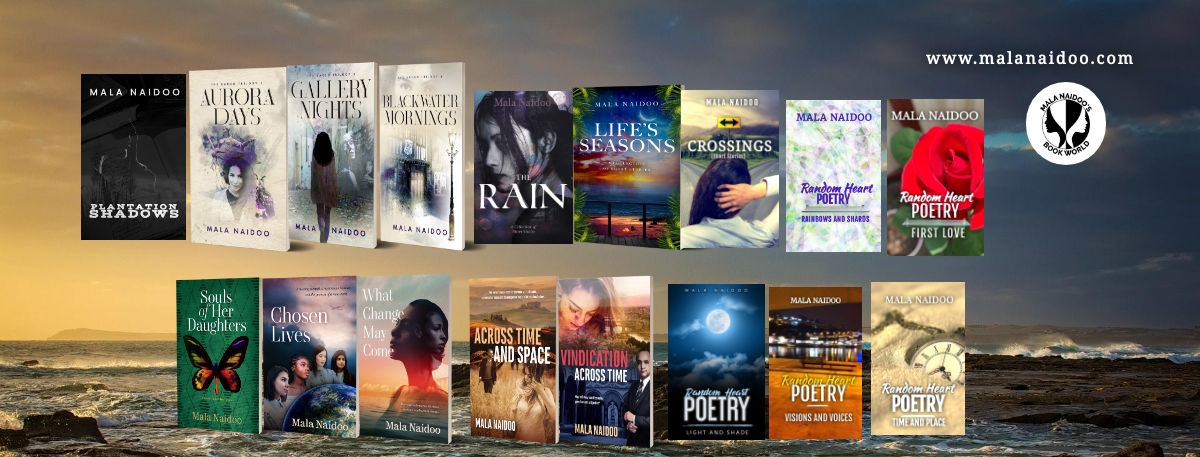
My apartheid past in South Africa had stolen the right to feel comfortable in my skin or to dare to speak out against racism. Hence my debut novel Across Time and Space and the sequel Vindication Across Time, present the bald face of racism as a universal disease through my eyes. My third novel, Souls of Her Daughters exposes injustice on multiple levels.
Fear makes one believe that a name that hints at race would be bypassed by publishers and readers. Listen to the words of author Michael La Ronn who articulates the issues black writer’s face in writing and publishing. Note what he says about gaslighting
Racism – Inequality – Injustice – Prejudice – by any name must be caught and called in the books we read, movies we watch and conversations we have
The Zulu word Ubuntu refers to the human spirit as it should be:
I am because we are
humanity towards others
the belief in a universal bond of sharing that connects all humanity
In writing multicultural stories as I do – the spirit of Ubuntu prevails.
What will you be reading and watching in the renaissance of Black Lives Matter in literature?
I recommend watching the movie In My Country on the Truth and Reconciliation Commission (TRC) in South Africa and Rabbit-Proof Fence on Australia’s Stolen Generation.
From the Uncle Tom’s Cabin and beyond, voices have raised the alarm but sadly the call to end racism fell on deaf ears. Now it must be made history, an unforgotten one to remind us that prejudice is heinous and should be obliterated from the stage of life. Diverse voices that are in the main ignored, share why the human condition needs a radical shake-up.
Feel the angst, walk a mile in the shoes of the racially downtrodden – only then will you know the corrosive impact of racism.
The wound of prejudice cuts deep to the soul leaving indelible scars.
But you pick your head up, as you do, to face another day no longer silent especially to subtle bias…
In the wake of the change in 2020 and beyond, walk a mile through these suggestions to know and feel that in our diversity the common factor is that we are emotional beings with the capacity to rectify prejudice by the stories we tell and read.
Here are ten suggestions where diverse voices rip out your heart to sensitise your soul.
Long Walk to Freedom – Nelson Mandela
. My Place -Sally Morgan
Talking to My Country – Stan Grant
To Kill a Mockingbird – Harper Lee
The Underground Railroad – Colson Whitehead
Between the World and Me – Ta-Nehisi Coates
Cry the Beloved Country – Alan Paton
The Power of One – Bryce Courtney
The Bluest Eye – Toni Morrison
Race Talk and the Conspiracy of Silence – Derald Wing Sue
May you write and read stories that share histories to sensitise our souls to dismantle racial bias.
Some quick pointers as we either drown in or swim out of the quagmire of negative news.
As fiction writers we are wired to all that happens around us as our receptors absorb ideas for the next great story. The blessing and curse of the news – more a curse in the current times while essential for updates on matters of health and mortality, the economic slump and the general state of the nation – it is disruptive in its overdose of negativity.
Brain receptors
The writer’s receptors grab ideas at the speed of a 5G network – the mind is never at rest, dreams emerge during troubled times as stress levels are elevated and the quest for ideas, for the next great book, arrives in a mangled mind needing time out. Once this agglomerates to confuse and clog thinking which we are at risk of in the current global climate, the danger is depressing outcomes for the writer on high alert – never wanting to miss a moment of the rapid global change we are undergoing. The virulent effect, if we are not selective, leaves its scar for a lifetime.
Be Selective
Choice matters when words count and writing deadlines are set-up. Where possible avoid mismanaged choices that deaden your writing plans – dry the inkwell or moves the virus into your hard drive. Choose to read inspirational material to reframe how you see yourself in the world. I recommend reading TheUntethered Soul, the journey beyond yourself, by Michael Singer to redirect thoughts to positivity and peace.
To attain true inner freedom, you must be able to objectively watch your problems instead of being lost in them – Michael Singer, The Untethered Soul
Erase Negative News for Creativity to Shine
Poetry, meditation, or inspirational music will reset your inner dial for greater productivity. Catch up on writing podcasts to refresh your muse. There are loads of positive platforms to draw from to rev your creative mojo free from negativity.
Whatever your choice of music choose healing sounds to quieten the mind and open the creative receptors free of the pollution of an overload of negative news.
Dance like nobody is watching is an excellent way to get the blood pumping and the mood in an upswing, so whatever you choose to do, jive, toe-tap or nod to the rhythm of the sounds, you will feel energised to activate what might be momentarily blocked.
Watch old comedy movies/television sitcoms or stand-up comedy shows. Slapstick humour relaxes the body and mind and transports us to joy – a positive mental state necessary for general wellbeing and a surge in creative energy.
Fawlty Towers
Are you being served?
‘Allo ‘Allo
Select what you will read, listen, dance or move to in your week and notice how your writing flows when you mindfully infuse beauty and peace into your daily activities.
Stay safe, find peace, abundant writing best wishes sent your way!
Happy Reading. Happy Writing!
Share your ideas on how to uplift positivity in our writing lives and life in general.
Mother’s Day this year has a different ring to the freedom of yesteryear.
The nation waited to hear if we would be allowed to visit our mothers on this special day of the year. Something we took for granted… our mothers would always be there to listen, comfort, cook an amazing meal, take care of grandchildren, advise on matters of the heart, and chastise bad behaviour.
Love the whole world as a mother loves her only child ~ Gautama Buddha
The hype leading to Mother’s Day has been a buzz from infancy. 2020 has been still but some retail stores have opened for a dash purchase of a gift and a card to celebrate our mothers to tell them we love them. We fervently add that we want our mothers to be safe and well during this global health crisis. Some among us ache to see our mothers, some have passed on, and others are in social isolation — it has been two months of just telephone conversations and if possible, FaceTime, Zoom and Skype chats. The aching emptiness of the missed mama/nana hug is still not a possibility. A joyous expression of love is now a cause for global anxiety as we fear the unknown, the lethal. The comforting hug now a possible cause of harm.
Mothers occupy a universal, sacred place in our hearts. A mother’s unconditional love goes with her children from the cradle to the grave. Cultures revere mothers with a divinity deserving of profound respect and care. This value should undoubtedly be universal. The hearth of family and home is a mother.
Paradise lies at the feet of your mother~ Prophet Muhammad (PBUH)
In paying tribute to all mothers today I also refer to the fictional mothers in, Souls of Her Daughters, and two follow-up novels in the trilogy (each reads as a stand-alone novel too) Chosen Lives, and, What Change May Come.
Mothers Varuna and Elsie present as the yin-yang of motherhood. Mama Varuna is Grace’s bold and strong mother who has weathered hardship with loss and societal criticism. Patience’s mother, Mama Elsie is a mild-mannered mother who faces racism and hardship in apartheid South Africa. Both mothers raise their daughters as one family united in their cultural difference and struggles. The highs and lows of the lives of mothers and daughters captured in the daily lives of Grace and Patience are what makes Mother’s Day a constant expression of love.
To all mothers, and future mothers, you are the pillars of family and society and should be celebrated daily.
She opens her mouth with wisdom, and the teaching of kindness is on her tongue.’ ~ Proverbs 31:26
Share your thoughts in the comments.
Stay safe and well as restrictions ease in New South Wales and around the world.
Life is topsy-turvy. The news makes us morose. But creativity must go on.
So how do we keep the momentum going when all else has fallen apart?
This time shall pass
To avoid dwelling on the negative statistics of the world’s mortality rate, look for reading matter that will stimulate your soul to breathe as the mind’s eye turns inward. This will generate refreshing conversations. Too much has been coming at us in recent weeks, but we have the imaginative capacity to redirect this towards positivity.
Movies will come and go, but a novel or poem lingers. Change your routine. Begin your day doing some inspirational reading. Download free eBooks. Load your Kindles, iBooks, Kobo readers with words that enhance creative thinking.
Roll up the newspaper, shut off the television
We need to be informed — limit this to once a day because overkill might devour your muse. Turn to poetry, short stories, novels and inspirational music. Teach the creative muse to move beyond the immediate.
Limit the online interactions.
Lend a helping hand to a fellow creative. Encourage the reading and writing of new content — unrelated to the current context. Bring the wonder of nature back into our lives, even if it’s from an armchair perspective — watch a documentary — mentally travel to another realm
Free yourself from fear
Here are some hand-picked inspirational suggestions to awaken and maintain a healthy muse. This is a brief list to get the creative juices flowing, to inject an abundant dose of ideas, if you are feeling the slump with each passing day. There are many more you might have already read and perhaps a re-read is another way to lift the lid to ignite the imagination.
Poetry:
The Daffodils – William Wordsworth First Hush – Orna Ross Frost at Midnight – Samuel Taylor Coleridge Still I Rise – Maya Angelou A Spark of Hope Vol 1 &11 – Brenda Mohammed and HTWFS
Fiction and Non-Fiction:
The Alchemist – Paulo Coelho The Catcher in the Rye– J.D. Salinger Beloved – Toni Morrison A Thousand Splendid Suns– Khalid Hosseini Swami and Friends– R.K. Narayan Half of a Yellow Sun– Chimamanda Ngozi Adichie
We are not alone, reach out, touch a life or mind and enjoy the benefit of the enhanced energy this brings.
Stay safe and well.
Read or write something today.
How do you keep your creative juices flowing when things fall apart?
Every corner of the world has been hit by Covid19 — life for millions has come to a grinding halt. Businesses have shut down left, right and centre. Bookstores have closed their doors. Libraries are no longer a sanctuary as silent voices are in lockdown.
The question tossed around is: do we go ahead with the launch of a new book?
My heart says yes but my mind says, should I? Then a voice whispers an answer: yes, launch it online, reach people who need to move out of the mental space of the current crisis we all face. We need the sanctity of books. Bookshops continue to take orders online if a digital book is not a preference.
In the face of a global crisis, publishing is vital now more than ever before — it says we are here, later it will speak confirming that we were here, and this is what we did. It is akin to writing historical fiction. The Great Books of the world brought us knowledge of people, cultures, events, aspirations, challenges and celebrations from eras long before our current existence. Without those scribes, the artists of the past, we would be as ignorant of the world as the occupants in Plato’s cave.
Literature is the light into now, the glow of the past and spotlight into our dreams of the future.
Books imprint memory
Writers have the acute ability to sense mood and observe human behaviour down to minuscule details. So, why wait? It is time to pick up the pen of prose or poetry. Each will speak of this time and of our dreams and visions. Leave the messages that say we are indeed one.
In our angst and joy, we are ONE under the sky of humanity
Forthcoming Title This April
To ignite compassion, we must walk in the shoes of angst, or suffering, to extend love and care to others because we know it—we feel it. Stories elicit compassion and bring meaning more particularly as we sit in self-isolation to protect our loved ones and communities.
Writing and publishing must go on, as must, soft digital launches of news titles and relaunching of backlists. Lower prices, offer free titles, reach the masses by bringing meaning to the lives of those living in fear of what the next news bulletin or press conference will announce. Our uncertainty unites us in our desire for a renewed tomorrow. We inhabit the same house under a global sky.
Now we speak with the same human voice in our sans streets, sans parks, sans beaches… but we should never be reduced to fearing each other.
Keep literature flowing for generations to come—it is within our control, thanks to the digital platforms that serve us.
Keep Writing, Keep Reading.
Stay Safe.
This time will pass. Keeping hope alive through poetry and stories.
Psychological boundaries are either self-constructed or built by others. Whoever is doing the construction of the wall is of no relevance — both will hinder creative energy.
We need people around us as creatives just not their negative energies that overwhelm and stifle.
Vulnerability is the birthplace of innovation, creation and change ~ Brene Brown.
Creatives are sensitive souls, dreamers in tune with what the naked eye might not see. This opens the mind and soul to all aspects of the universe and in so doing leaves the creative vulnerable.
Choose your associations. This is crucial to creative energy. People who understand the creative, appreciate the need for space to commune with the muse, nature and the imagination.
Positive vibrations come from such associations that sustain and enhance a creative life. People who understand solitude and the creative need to slip off the radar for a brief period are associates to nurture and stay connected to.
In seeking creative space distancing the self from negativity is crucial to avoiding that which mars the creative process
What to watch…
those who tell you what you should be creating
those that question what you write or why you write
those who are not writers but freely offer writing advice
those who imagine a character or situation reflects their lives. It’s good if they do — that’s being a good writer to be able to craft lives/stories that people feel connected to — the ultimate writing goal is to reach the reader.
those who scour your books and comment that your book is a reflection of your own life by ignoring that you’re writing fiction and have not got down to writing a memoir yet.
Creative energy is more critical than learning ~ Albert Einstein
Who should we hang onto?
those who can’t wait to read your next book
those who let you know what they loved about your writing and let you know what thoughts your book has left them with
those who allow you to be you — gentle, idiosyncratic or wild.
those who spread the word about your books
Choose your friends and associates with care — those who appreciate the creative in you, and if it’s a small number — that’s all you need for abundant positivity to flow
Choosing your tribe is vital to preserving creative flow and production.
Engage in activities that enhance the creative within. Turn to meditation, singing, writing or reading poetry, reading the books you have on the nightstand calling out to you, read something different, a different genre. Take a walk on the beach or in a park or forest — do whatever makes your heart sing!
We undertake certain spiritual exercises to achieve alignment with the creative universe ~ Julia Cameron
Be your wildest or quietest authentic self and gravitate to those people who appreciate you for whoever you are, wherever you are in your creative life.
~Dare to be different~
Share your thoughts on your quest for creative space.
While the world is swamped by social media and every form of communication possible — words fly at us, to us and among us at a speed we cannot keep pace with.
Yet amid this world of words there is always an aspiring writer with a story to tell — struggling with the fear that it might not be good enough — or imposter syndrome takes hold. It’s every writer’s fear each time a new book is sent out into the world.
The first step is the most difficult like anything in life — being authentically YOU is all that matters
Finding the courage to put your work out into the world is dependent on a range of factors. How serious are you? Do you have patience, and will you be persistent in achieving your writing aim? It really is about sitting down to write and then finding the courage to hand it over to a stranger. Try a friendly eye first to gauge if the story excites and entertains. Be prepared to accept whatever feedback comes your way. Everything is fixable if you have a manuscript on hand — plot, structure, style, sense etc.
As many words as there are in the dictionary, there are professionals who will guide you in the right direction. This may come at a cost and, some find friendly writers by joining writers’ forums online to share feedback/impressions of each other’s work and to offer advice
If a story is brewing and bubbling within, you need to begin toiling if you know it will make a difference to someone.
Stop pondering and get writing — BE YOU
If you’re afraid of writer’s block — news is — it does not exist. You might pause and research and redraft parts of a piece but once a story bites — something truly magical happens. You begin to write as though you are guided by that which is transmitted through you. You will only experience this when you take that first step and allow yourself to deepen the process.
Writing is not for a chosen few. We all have the language to communicate our thoughts and feelings. The imagination develops from reading and takes hold with an unquenchable thirst. This opens the gateway of the creative font as stories emerge from stories. Then pick up the pen and write all that you can at a speed that you find bearable.
Stephen King said, ‘To be a writer you have do to two things, read a lot and write a lot.’
Once you have taken that step towards writing, choose a comfortable space to call your own. This invites the magical muse to transmit through you. Begin with meditating to ease your mind, body and spirit. Choose your time of day or night — your most lucid, productive time and begin — one word at a time…
Listen to the whispers and act on them — or beware — they will go looking for the next transmitter.
Missed opportunities are of our own making because the signs do come. It took me ten years before that voice pecked at my waking and sleeping state and I had no option but to answer the call.
Writing is the blood pumping in my veins — it’s the air that sets my breath aflame
Nothing happens in life without desire, determination and persistence. Courage will flow if the mind is open to desire.
Don’t be an aspiring writer, don’t wait ten years, you have the ability to take that step but do persist.
If stories were never told — history would not exist — change would not occur.
So much that is fictional is drawn from reality.
The horrors that have occurred historically and afresh each day (as the daily news never fails to report) become the fictional realities writers create in imagined worlds. The fiction writer’s world is in tune with current and past societal occurrences. The subconscious mind sifts and imprints that which has emotive associations. From this collaboration of mind and emotions, the writer begins with a particular premise — then something magical happens — the pen takes on a life of its own.
Plotter or panster merge when that magic happens. Hey, presto! Fiction and reality commingle!
For this reason, mindful writing is imperative. It helps guide your book to a niche or a wider audience with a message melded to the entertainment a good book affords.
Every good story has a lesson to teach, an angst or joy to share
Where does the act of creative mindfulness emanate from?
The soul of the writer, his or her angst and joy sensitize the writer to the struggles people undergo — be it a socio-economic matter such as Charles Dickens’ novels that exposed England’s elitism, and Jane Austen’s portraits of gender and social class. These are two writers selected from a host of others of the day.
Today fictional writers create worlds around ‘me too,’ racism and power struggles. Power struggles and injustice are timeless from Fritz Lang’s 1927 German expressionist film Metropolis based on the 1925 novel by Thea von Harbouto, Orwell’s dystopian novel, Nineteen Eighty-Four and my current reading of American Dirt by Jeanine Cummins referred to as a ‘high-octane’ story, are a few in the countless number of books that connect readers through discomfit to what it means to struggle and survive.
Political thrillers expose mismanagement, and immorality while entertaining readers with suspense, the drama of high stakes, etc.
If fiction mirrors reality it becomes a record for posterity like all good books. A ‘good book’ depends on which end of the moral spectrum both reader and writer share. If a book angers and soothes, keeps the reader on the edge of their seat by creating desired expectations for the protagonist — it’s a great story penned.
Fiction should make us uncomfortable enough to question where we went wrong, and how can we rectify it
Nothing is political in writing if it showcases reality. The word ‘political’ from my apartheid history conjures thoughts of being labelled as being on the wrong side of the law. Yet a political thriller exposes heinous human behaviour in organizations that we trust to uphold justice.
Fiction is reality dressed up as the world on the pages of a good book, one that dares expose the foibles of troubled societies
Discomfit, guilt and thought
Let’s continue to create fictional realities by rocking the boat of complacency in assuring that the history of the past and history in the making generate discomfort — discomfit elicits thought and one can only hope that positive action will follow to change catastrophes that are within the human scope and rectify atrocious human behaviour.
My stories cut to the bone on forgotten voices who deserve to be heard.
Here’s to more fictional stories for all our better tomorrows.
Happy Australian long weekend. Happy pleasurable reading hours.
As I work through cleaning up my latest manuscript, a first in series, I am weeding out those darling crutch words, scene shifts, and other hidden gems (I thought they were gems until I read them with an unemotional, critical eye) to clear the wood for the trees to have a better view of where my characters are and what they’re getting up to. If I don’t have a clear, error free, sense of my story, how will the editor? Worse still what would the reader do?
It’s not easy after several self-edits to handover your baby for professional scrutiny. There’s no getting away from it, self-editing is turning the eye inward without a tear, first the incision then as you pass judgement, the brutal chop of your precious, crafted words, emotions, descriptions, settings, characters, and whatever else might need adjusting in your created world.
very, really, rather, quite, in fact… do you need them?
So, how many steps are there during the self-editing phase? (These are the steps I follow which varies from writer to writer)
First, line by line, chapter by chapter, on the computer screen change the double word use, missing words, etc.
The second step is to correct timelines if there are errors.
During the third phase, put the manuscript through editing software such as Grammarly, and Pro-Writing Aid — excellent to pick up flaws the naked eye missed — spelling (American or British?), grammar, repetitions, and general style especially when that sneaky passive voice creeps in.
The fourth step is reading your manuscript out aloud and recording the story for playback editing. Rhythm, the cadence, and sense become distinct during this process which directs you back to the screen to fix those snags.
The fifth phase is print a hard copy of the manuscript and rip though it with the colours of the rainbow to show you what is working, and what needs another chop or perhaps another trim.
The sixth phase is formatting an eBook in Scrivener to read through in a different form — anything that slipped through the self-editing cracks screams out, in a new form, for rectification.
Now the manuscript is ready for the professional edit although I might enlist a trusted, closely held, proof-reader to check through once before the professional submission. Then proofreaders step in for the final check.
During the process of self-editing do not rely solely on your gut experience in making changes. Consult those in the industry that you admire, read or use as a role-model . An editing guidebook, and a thesaurus is a must have on any good writer’s desk.
When working with an editor, it should be a negotiation on necessary changes, but be prepared that there could be changes suggested that might not sit too well with you, but for the success of the book, within reason, you should take the suggestions on board.
What is the editing timeframe?
There are many ways to do this , some say spend three months drafting, three months editing. However, some write a book a month — at best I could get through two to three in a year as a part-time writer. Remember, the professional editor could ask for a month to check your manuscript.
I generally veer to three months writing, three months editing, but sometimes life makes its call on time and energy so that varies year to year, book by book.
What are your self-editing tips? Let us know how you do it your way.
Collaborate + Consider + Cooperate + Change = an excellent MS ready to go.
Best wishes with writing, editing, and publishing.
Today we travel across the Indian Ocean to meet Magie Faure-Vidot. Magie is a French-language poet from beautiful Seychelles. She has published work in English and Seychelles Creole. She is the Chief Editor/Director of the Publication SIPAY and is an inspirational supporter of rising poets and writers. She is tireless in her dedication to upholding international close connections between writers of all genres and forms.
Recently she has travelled to India for the World Thinkers’ and Writer’s Peace Meet attending two international events in December 2019 in Vijayawada and Kolkata.
Meet the Poet
Magie Faure-Vidot
The Peacock Opinion Award
Magie Faure-Vidot was born in Victoria. She is a member of the Institut Académique de Paris and the Académie Internationale de Lutèce. She has won numerous prizes over the course of her career, including the Coupe de la Ville de Paris, a Lyre d’honneur, and six silver and numerous bronze medals in various international literary competitions, and she has represented her home country at many international poetry festivals and other initiatives. Her work has been discussed in critical studies of Seychellois literature. She has also achieved some fame as an oral performer.
After living for some time in Lebanon, England, Italy, and France, Faure-Vidot returned to Seychelles. There she co-founded and continues to codirect, both the online literary review Vents Alizés and the online publishing house Edisyon Losean Endyen, both of which she runs in conjunction with Hungarian poet Károly Sándor Pallai. Her work is regularly published in Seychelles Nation and The People, and she is the Chief Editor/Director of SIPAY, the only Seychellois international literary magazine. Her poems were published in the international poetry anthology Amaravati Poetic Prism in India. In 2017, she received the prestigious Seychelles Arts Award in literature for her outstanding literary work and achievements. She writes for Spirit of Nature where she features amongst the 60 poets published in 2019.Opa Anthology of Poetry.
She is a member of the World Nations Writers Union Kazakhstan. She is the Regional Director – East Africa and Central Asia and on the Administration Council of MS.
Additional information on Magie Faure-Vidot is available on Wikipedia.
Getting to know Magie
When did your love for poetry begin?
The love for literature began when I was a kid. My parents worked on a vast agricultural property and had many animals. I loved them so much that I used to tell them small stories. We lived close to the beach and I had my private beach where I used to enjoy the sea, the birds, coconut trees, swimming with small fish, and playing with crabs. Being a loner, I had to keep myself busy. The sea carried me to faraway imaginary places. And I would always be asking my parents to buy me pencils and exercise-books.
What do you enjoy the most about living in Seychelles?
The island life, friendliness of the inhabitants, no snow but the sand.
The View From Magie Faure-Vidot’s Home in the Beautiful Island of Seychelles ~ A Creative Haven
Tell us about the International Literary Journal, SIPAY. When did it begin? What is itsaim?
SIPAY saw birth in 2008 but registered in June 2009. At first, the aim was to promote the French language at 60% and 40% shared between our two other national languages, English and Creole. But now it has taken another turn. It is affiliated to Motivational Strips, and Spanish has been added to the three languages. SIPAY is now an International Literary Magazine and opportunities are given to various writers all over the globe. SIPAY is a non-political, non-religious magazine. SIPAY is distributed to the Ministry of Education for all the schools, Ministry of Culture, Creole Institute, the National Library, the National Journal (NISA), and some private individuals. One copy is posted to all contributors at no charge. SIPAY is a non-profit making publication. Money generated from the sale is reinvested in the next edition.
Describe your typical writing day.
I write when the urge tickles me. First, however, I take care of my home, family and animals – three dogs, and I feed some fifty birds every day. I then take to writing, attending to posts in MS, Lasosyasyon Lar san Frontyer, Congo Ecrit etc.
What are your future goals for literature both within Seychelles and internationally?
I’m planning my 7th book, assisting the Lasosyasyon Lar San Frontyer as a Chief Consultant and Congo Ecrit. I attended two international events in December 2019 in Vijayawada and Kolkata.
***
I extend my gratitude to Magie Faure-Vidot for sharing her illustrious writing journey. You can connect with Magie Faure-Vidot for more information on her recent literary travels and works:
As 2020 dawns it will be remiss not to look at the world that is changing before our very eyes.
Through Australian eyes, sadly, the ongoing bushfires have encircled our lives affecting health, and mindset with loss of human lives, homes, fauna and flora — this impacts the creative soul and spirit which is closely aligned to the natural cycle of life. There is an unease that wants answers and quick solutions to a problem that has been steadily growing.
As we cry, ‘climate change’ — it is more about necessary unified ‘human change’ to rectify that which ails our burning country. Change can be initiated by ongoing fostering of awareness that we all have a part to play to improve the state of our country, the world and subsequently the human condition. As writers, this awareness becomes a moral obligation, as I see it. Books/stories are valued for the message/s they extend to make us aware that our angst is a global issue.
Natural disasters multiply around the world causing human decimation, yet the power to minimise this rests in human hands. I draw the analogy to writing, the creative arts — the passion exists, but a huge effort is required to produce quality art — passion without persistence is naught.
Literature today will speak into all our tomorrows about human negligence and irresponsibility in the quest for more. Like the wars of the past and those that exist in the here and now, it is a time for soul searching and a coming together to rectify that which has gone awry. Like editing a manuscript, we cannot take out without replenishing with good, better, and best to improve the story, poem, or essay — likewise, constant extraction from the earth must be restored.
Healing is not a band-aid fix to the problem — it takes a mammoth collaboration of all sectors of society to reach out and do what is necessary — cut back on all forms of pollution/emissions for a purer balanced tomorrow.
It’s never too late to begin afresh if it matters, like revisiting a manuscript to cleanse, to be rid of that which is not necessary, to clear the waters for something brighter, purer, clearer and better.
Let’s make the 2020’s a healing decade of body, mind, spoken and written word, the spirit, relationships and heal the earth we live on and from.
All positive contributions matter — raising one life, saving one wild animal or property is the beginning of survival from extinction by fire or other natural or human ills that befall the planet.
As we look forward to a bushfire-free future, let us remember we all have a part to play to save this beautiful land we call home.
Have a safe and happy entrance into the next decade. May it be filled with many blessings.
May peace abound and the earth receive the blessing of rain, may poverty and pain diminish.
As the year draws to a close in the blink of the year bowing out, it is a time to reflect on where we are, where we’ve come from and of course where we’re heading to.
Gratitude
My gratitude for a writing life is the blessing of the creative gift to tell the stories of forgotten or unheard voices and the passion to sustain this. I am indebted to the people I’ve met along the way who support my creativity by reading my books and inspiring and supporting my desire to write more.
ALLi guides my ethical author status by providing up-to-the-minute publishing and marketing advice through podcasts, publications, members’ forums and Orna Ross’ weekly, Maker, Manager, and Marketer accountability for creatives.
The vibrant How to Write for Success FB group supports seasoned and novice writers in a nurturing, inspirational forum and is a space to create and showcase some of my pieces while supporting writers on their creations in a constructive, non-judgmental forum.
Joanna Francis Penn’s Travel and Books Podcast and Mark Dawson’s SPS Podcasts are informative, entertaining and inspirational.
Writers no longer work in isolation. Seclusion is necessary for the creative process and networking creates visibility
Publishing
The third novel in theSouls Of Her Daughters Collection was completed, titled What Change May Come and a collection of short stories, Life’s Seasonswas published this year. It has been a year of many things on all of life’s fronts with life experience extending understanding and the capacity to live my passion.
Souls Collection (Trilogy)
2020 – Onwards and Upwards
Currently, a new novel series/trilogy is in the making with the first draft complete and chilling for a month before several rounds of editing and reworking to be born into the world in the first quarter of next year.
Poetry is a calling that intensifies as evident in the post, Poetry Educates Prose. It was a joy to have my poem, ‘Listen,’ published in the December edition of the literary journal SIPAY. Coleridge, Wordsworth, Byron, Keats, Yeats and Orna Ross are poets I enjoy reading.
Additionally, supporting rising poets brings joy to my creative space.
What more…
Lots more writing and possibly looking at non-fiction and poetry publications while teaching, learning and growing.
A writing life, like reading, is the breath and pulse of life.
Have you signed up for my monthly or bi-monthly newsletters for special offers/ free books/stories and updates on new publications? Click here to enter and receive two free short stories.
As the year closes this chapter, I look forward with a glad and grateful heart.
Happy Reading, Happy Writing and Publishing this holiday season.
Season’s Greetings, may 2020 bring you the very best in peace, joy, good health, enhanced creative productivity, and abundant success in all your endeavours.
What are you grateful for as 2019 draws to a close?



You must be logged in to post a comment.