Conflict casts a shadow on truth telling, giving rise to versions of the truth over time.
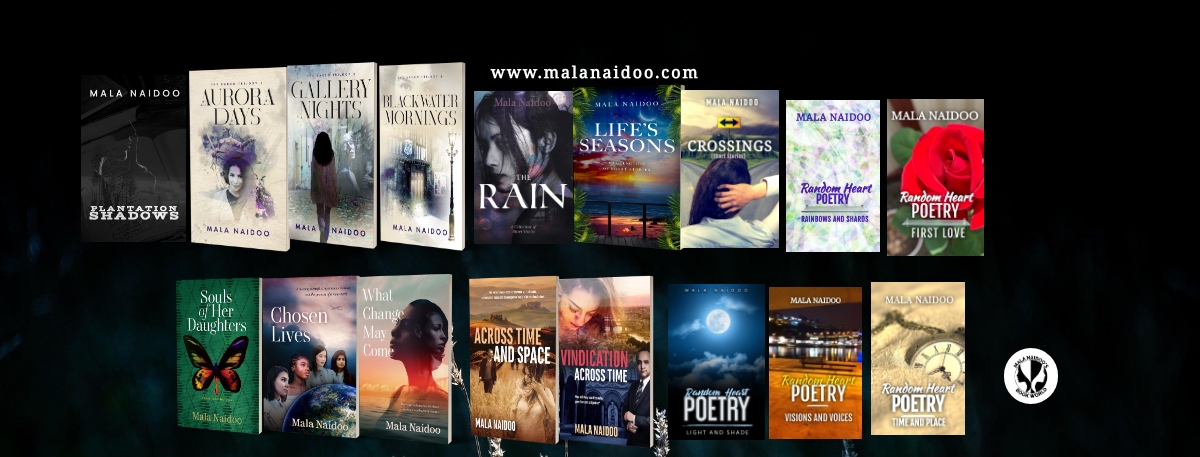
Plantation Shadows unravels secrets through competing perspectives or on point revelations captured for posterity to convince the reader on a particular point of view.
The crafting of characters influences how the reader receives fictional truths. The proven trustworthy character holds the stronger sway in storytelling. Often, the social standing of a character influences following the ‘esteemed’ character, which might, unfortunately, lead the reader down the rabbit hole to a multiplicity of mistruths.
Who should the reader trust, the doctor, gardener, or domestic staff? Truth is not devoid of emotional strains, and memory creates versions of it, depending on who demands it, narrates it, and receives it.
Plantation Shadows unearths the inner and outer conflict spanning three generations in a family drowning in secrets. The women living in a patriarchal community on the canefields of Natal, South Africa, take the forefront in narrating the truths that unfold one perspective at a time. The only male perspective has no blood ties to the conflicted family he serves. Edgar is the all-knowing eyes and ears between the two plantation houses, embroiled in secrets withheld in the living years. What ancestral truths will the grave yield?
There was internal strife that I was privy to, but I kept my head down and my ears open… Part Three, Edgar, ‘Plantation Shadows’
In unraveling the truth in a land buckling under colonial domination and rising resistance, is the twisted patriarchal mindset genuflecting to colonial expectations by preventing women from being heard. It is not until the fourth generation breaks the cycle of control, by assuming the courage and conviction to address and accept the long-held secret of an imploding family—hope rises.
Creating fictional women as untainted characters in a controlled society is to deny their right to break with convention in choosing the path they desire. Plantation Shadows is a closely held sisterhood of hidden truths among grandmothers, mothers and daughters.
Truth is a double-edged sword—it names and shames but creates understanding and gradual acceptance. Are generations of secrecy ever allowed to rest in peace?
Read Plantation Shadows, to feel and understand the secret hearts of the aging Milly and her dead mother.
Secrets diminish with death – Part 3, Edgar, ‘Plantation Shadows’
The days of writing rigidly to a particular genre, crime fiction, detective fiction, sci-fi, horror, historical fiction, thriller fiction, and romance have slipped, crept, and rolled across the genre borders.
Romance has the potential to capture the coldest of hearts.
The basic elements of the genre remain. Mystery and suspense with a soft touch of romance add to the allure of the tale. Romance as a genre in its pure form has limitless power to create relationships that stretch and bend the imagination as far as it will go.
While romance engages the emotional side of the reader, it does not overwhelm the crime/detective/historical/sci-fi, which occupies the greater space of the genre.
The love story element in any story adds the desirous human connection.
Age is no deterrent to romance. It’s not restricted to young love such as that of Romeo and Juliet. Including older characters in the angst and joy of their romantic interludes creates an inclusive perception of love. It increases the appeal of the overarching genre at work.
The happily ever after isn’t always true. Fiction is a mirror of life. Testing the strength or commitment of a relationship between crime/detective fiction heightens its entertainment value. Romance, while not central to the story outside the romance genre, might add a satisfying element against the crime/detective fiction at work.
Love is just a word until someone comes along and gives it meaning ~Paulo Coelho
Wonderfully true — it is indeed our charismatic or struggling fictional characters who love, or are in love, that linger to remind us why love given and received should never be extracted from the soul.
There is no charm equal to tenderness of heart ~Jane Austen.
Magical! The reader is drawn to the story regardless of the genre.
I would like to be the air that inhabits you for a moment only. I would like to be that unnoticed and that necessary ~ Margaret Atwood.
Brilliant! This stirs ideas on how this would unfold in a crime fiction tale!
The gist of these well-known lines deepens the human connection in any genre.
Happy Reading. Happy Writing.
Please like, share, comment and hold on to a tender heart. We need it in both fiction and life.
A story crafted from bone to flesh takes many months, or years of vested time where emotional attachment is difficult to relinquish.
There comes a time in every delightful story where the writer cedes the pen (for a while before the editing clean-up).
Knowing where to start is as important as knowing when to stop.
Writing sequels, trilogies and series is a long-term relationship between the writer and manuscript. Characters become real when they consume sleeping and waking thoughts. A character wanting a bigger space on the pages of a story holds the writer to ransom.
Endings must be free of padding or info-dumping that feed the writer’s attachment to the tale, people or place, serving no express purpose to the story. Readers will thank the writer for avoiding the stuffing.
The original plan for the story veers off when a character wanting to be acknowledged calls out the loudest. Such a character is allowed a voice that directs the action on a different path. This is a natural part of the process, but rogue characters must be reeled in and put under a microscope to assess their primary role—is the character essential to the plot, does the character add an exciting plot twist or are they unnecessary?
A benevolent muse is the one to thank for all that arrive to prod the writer. If the voice/story/scene are ignored, they find a way into somebody else’s story. Lady Muse is a perpetual huntress.
Heed the call we must!
Writing is joyful, hard work. It takes committed diligence to keep going until the story is over. It will only ever be over when the writer is convinced it is time to stop. Soliciting advice from a trusted other, The Reader, is a good way to ensure that it is indeed the right point to type in ‘The End’.
Well-written stories will entertain audiences long after the writer’s time has passed.
When it feels right to end it — do it! If it is deemed not right later down the editing track — change it or add in a few subtle changes. To ignore that gnawing feeling that something is not right, but not worth the trouble to rectify it, is a mistake that comes back to haunt the writer.
Great is the art of beginning, but greater the art of ending ~ Henry Wadsworth Longfellow, American poet, educator, linguist.
Structure in a story is important, but the creative does not adhere to structure alone at the sacrifice of something unique that has the potential to hold the reader’s attention.
Should the ending resolve all issues?
Are all life’s issues resolved?
Fiction entertains but should mirror life to connect with readers on the universality of our fundamental humanity.
Walking in the shoes of the reader is a good way to access whether a story crafted over a length of time, the writer’s blood on the page, has value for the reader.
A story begins with action or change, and everything follows on from there, and it may end with change, the character’s growth or downfall, but ultimately it must guarantee reader satisfaction. If not, then a sequel or epilogue might do the trick, or leave it open to interpretation, but keep the element of surprise.
Tie up loose ends without deliberating over them
Would you write the ending first? This might be a sure-fire way to lead the scenes throughout the process of the first draft.
Please share the endings of some of your favourite books in the comment box below.
Librarians are Writers’ Greatest Allies in their Ability to Influence the Joy of Reading
It gives me great pleasure, today, to introduce you to Fiona Sharman who has kindly shared her passion for her favourite books. One of Fiona’s favourite quotes is from ‘Pride and Prejudice’, when Mr. Bennet says, ‘for what do we live but to make sport for our neighbours, and laugh at them in turn?’
Fiona Sharman
Fiona works as a Teacher-Librarian at an all-girls’ school in Sydney but her friends think this is a cover for her slight obsession with reading and the beauty of well-crafted language. She came to librarianship by way of a background spent teaching English and History. Fiona is a passionate educator who loves working with and supporting young women but horse riding, sailing, traveling and generally seeking new adventures are what she enjoys when she’s not at work. Actually, books frequently accompany her on these adventures (except the horse riding) and her memories of great reads are interwoven with memories of great travel experiences – Lucky Jim (Vietnam), The Blind Assassin (India), The Fishing Fleet (sailing in Burma)… you get the idea. The historian in her is committed to non-fiction especially biography, the nature-lover is devoted to landscape memoirs, the feminist loves strong female protagonists, and the English teacher appreciates beautiful prose in whatever form it may come.
Here are ten of her all-time favourite reads and why she loves them.
1. Jane Eyre by Charlotte Bronte
The original, timeless, strong female protagonist. Bronte’s use of narrative voice captivates the reader from the first page, be they 14 or 40 years of age. Anyone who has ever felt like an outsider can relate to Jane and will champion her independent spirit.
2.The Blind Assassin by Margaret Atwood
I LOVE this book. Atwood is a genius but it’s also the time period, characters, split narrative, suspense and tightly controlled plot-line that won me over hook, line, and sinker.
3. The Shepherd’s Life by James Rebanks
This is so much more than a memoir account of a Lake District farmer’s life. Rebanks captures the history and beauty of the Lake District, the relationship between those who live on the fells and their environment, and contemporary conservation issues. Beyond this, Rebanks celebrates the richness of cultural traditions and humanity’s deep connection to the cycles of the natural world. He positions readers to ponder the value of informal education and knowledge in relation to more formal education systems. Pheww…
4. A Fine Balance by Rohinton Mistry
I once read a review of this book where the reviewer exclaimed that they ‘felt sorry for anyone who hasn’t read this book’. I am not sure I can top that. Without spoiling the story, the title is a nod to the invisible line between hope and despair and it is a deeply humane story. It’s beautifully controlled narrative is set against the backdrop of the ‘Emergency Act’ of Indira Gandhi in 1970s India. Personally, I genuinely enjoy and have studied Indian history (which clearly helps) but this is a stunning book without needing to know its political context.
5. The Human Stain by Phillip Roth
A compelling story set against the background of the Clinton-Lewinsky scandal of the 1990s. While Roth’s characters are clearly flawed, it is his deeper commentary on the prejudices of the broader society that are exposed and questioned in this book. The title is also fabulous as it works on so many levels, literal and metaphorical, throughout the story. A very thought-provoking read about individuals and the societies that determine their fate.
6. The Painted Veil by Somerset Maugham
When people ask me what I mean by ‘beautiful prose’ I usually say “Somerset Maugham”. I ADORE this man’s ability to capture in a few words or lines an entire era, its values, prejudices or (merely) the essence of human experience. I love that Maugham created female characters (like Kitty) who expose the injustices of patriarchy in real but subtle ways. I read this book (not all of it) curled up in the gorgeously excessive Victorian style Hopetoun Tea Rooms in Melbourne’s Block Arcade. The staff was so lovely that I was able to keep my table for lunch through until afternoon tea (this place usually has a queue outside all day every day). It was a total sensory indulgence – between the food, the décor and this exquisite novel. Bliss.
7. Six Degrees of Separation by Paul Guare
This play is profound in its simplicity. Inspired by true events it uses a dual-sided Kandinsky painting to expose the superficiality of an extremely affluent family in New York. Metaphorically, I’ve come across a number of ( the main character) Ouisa’s in my life but she is the most aptly drawn example that I’ve seen on the page. Constantly over-dramatising her own existence whilst simultaneously diminishing the real suffering of others, Guare uses Ouisa to show readers the starkness of the socio-economic divide and the misplacement of Western materialistic values.
8. Vile Bodies by Evelyn Waugh
No ‘best’ list of mine could be complete without acknowledging Evelyn Waugh. His satirical style is a delight as he captures the excesses of the 1920s and the Bright Young Things. Irreverent and fun.
9. The Last Painting of Sara de Vos by Dominic Smith
This contemporary novel asks the moral question of whether mistakes made early in life should be paid for later, regardless of how much the individual has striven to make amends for their misjudgement. Set against the world of art, Smith’s narrative cleverly links Renaissance Europe to 1960s New York to contemporary Sydney. An engaging and suspenseful read.
10. Burial Rites by Hannah Kent
I wanted to give a ‘shout out’ to this very talented Australian author. It is not so much the subject matter that draws you in, rather it is Kent’s keen ability to evoke a foreign time, place and cultural context in such a way that the reader truly loses themselves in the story. I liked that this work was inspired by true events and that it so cleverly builds suspense and drama, right until the final chapter.
I wish you many happy hours of reading and encourage you to take a pick from Fiona’s generous sharing of her favourite books.
Please leave a comment in the message box below to start the conversation on your favourite books or add your thoughts on Fiona Sharman’s book selection.
Have you tried reading beyond the bewitching hour when a hush rests upon your home, all are sound asleep – the only light being your reading lamp setting the page aglow?
Books take on a life of their own when you have undisturbed reading pleasure. Places invite you in, characters entice your entrance into their worlds – you yield – you enter this magical realm free from the mundane responsibilities of daily existence.
The time spent wrapped inside the pages of a world you enter and leave at will, exudes forbidden pleasure away from the gaze of the world. Each new page, each new chapter, begs you to go on with the promise that hidden discoveries will surface. Days pass, weeks pass, the tension mounts, emotions are unleashed and you read on – you wipe away a tear, you break out in a smile, you breathe deeply as you smell, see, taste and relish this world you cannot extract yourself from.
The book falls, your head slides off the pillow, you waft off into a deep sleep.
Photo credit: Sandro Schuh (Unsplash)
The sun comes up, the alarm clock goes off – the day beckons – your book sits silently up against your bedside drawer waiting for your return from the bewitching hour- your night reading sojourn is over- the memory lingers…
Until then… See you beyond the bewitching hour when the pages of your book are aglow…



You must be logged in to post a comment.