Holiday Reading

It’s time to get off the wheel. Imagine days lying in or relaxing on the beach, or in your own backyard.

Laid-back days are built for leisurely or serious reading. Soul searching or fun, reading is a fascinating activity that delivers anywhere -anytime- every time.

I asked readers to recommend some of their recent great reads. With Black Friday deals still available at some retail bookstores, it’s quick and easy to bag a good book bargain.

Here is a mixed-genre recommened booklist of the most enjoyed and/or informative reads. Blurbs are not included; they are available online and at bricks and mortar bookstores wherever you are.

Three recommendations from Queensland’s Logas Padayachee, who thoroughly enjoyed her choices:

LL’s Selections:

When the Singing Stops by Di Morrissey

Without Merit by Colleen Hoover

Apples Never Fall by Liane Moriarty


Mavis’ Sydney Picks:

Black & Buddhist by Pamela Ayo Yetunde and Cheryl A. Giles

Man’s Search for Meaning by Viktor E. Frankl

Black Teacher by Beryl Gilroy

Blue Mercy by Orna Ross


Jenny Trotter’s Choice:

The Tilt by Chris Hammer


More Suggested Reads

Notes from a Small Island by Bill Bryson

Miracles Happen by Dr Brian Weiss


Stories with a Christmas theme are appealing during this time of year.

Stocking Fillers, Twelve Short Stories for Christmas by Debbie Young

Christmas in the Scottish Highlands by Donna Ashcroft

The Christmas Bookshop by Jenny Colgan


My Books with a hint of Christmas:

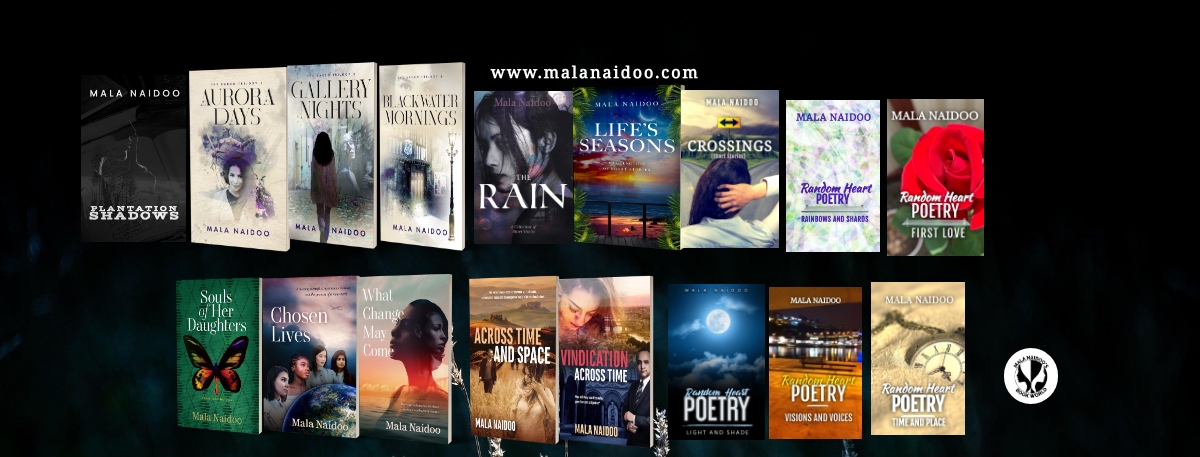
Gallery Nights by Mala Naidoo

Souls of Her Daughters by Mala Naidoo


Literary classics by Charles Dickens, Jane Austen, and many other literary great-reads offer timeless entertainment.

Add your favourite reads in the comment box below to spread the love of reading this holiday season to keep books alive.

Happy Reading! Happy Holidays!


← Back

Thank you for your response. ✨

Author Spotlight: Mel Goven

As creatives, news about a debut author from the land of one’s birth is received with great joy. The creative landscape is a connected, supportive space that celebrates newcomers to the publishing fold.


Meet Mel Goven, South African debut author of the crime novel, Unfinished, launched in July, 2022 on Amazon. Please join me in welcoming Mel Goven to the blog this month.


Get to know South African Author : Mel Goven


1. Biography : Mel Goven

Mel Goven

I hail from Johannesburg and have quite a demanding day job as a teacher in a primary school.

Unfinished is my first novel although I have written many short stories which have gained a place in short story competitions in local magazines and writing groups.

My short story, Scorned, a crime mystery,  was placed 3rd in Woman and Home, in 2014. Love Knots, another short story, was shortlisted in the annual short story competition run by The Writer’s Group. One of my favourite short stories, Lucky, featured on a few writing blogs and had quite a successful run in 2016. All these stories can be read on my blog site.

I have also published newspaper feature articles and opinion pieces during my stint as editor for the local newspapers: The Randburg Sun, Fourways Review and the Northcliff Melville Times.

My features were around education challenges in South Africa. Some of which were: Preparing for Future Career Opportunities, Effective use of Technology in the Classroom, Private versus Public Schools.

Having always been drawn to the romance genre, I imagined I would write romance novels, which I haven’t completely taken off the table yet. However, I found my voice in thrilling crime mysteries.

I have two more novels in the pipeline and have realised that with each new world I create, I am finding myself as a writer. I don’t like conforming to a specific trope and while I admire the writing styles of my favourite authors, I don’t think I am in the same league and so choose to write my way.

I have been blessed with four incredible children of whom I am super proud. In formally starting my writing career at this stage in my life, I hope to inspire them that dreams come true at any age, no matter what challenges and obstacles arise.


2.When did your passion for writing emerge?

I love reading. I believe you must be an avid reader to be a good writer. When I was a child, I would beg my parents to take me to the library.

I visited many libraries in the area I grew up in: from the little mobile libraries that would go around the community on Tuesdays and Thursdays; to the community libraries that were finally built when the demand increased, and then to the Durban City Hall library when I was old enough to travel to the city on my own.

I started writing after I read Anne of Green Gables. I felt such a deep connection to the main character, Anne. Although she was a lifetime removed from my world in terms of the era, race, and circumstances, she felt what I felt; messed up like I did; was the odd duckling — just like me.Anyway, the community library did not have the sequel to Anne of Green Gables and so I decided to continue the story in my imagination. Eventually, I wrote it at the back of a Maths book (I did not like Maths very much). That was how I began writing.


Every time I finished reading a book, and if I felt that I wanted more from it, I would continue the story to bring it to a satisfactory conclusion.


3. What inspired you to write your debut novel, Unfinished?


In 2012, I became fascinated by a story I heard from a patient in a doctor’s surgery.  The patient had undergone a heart transplant a few months before and she had been excited to meet the family of her donor.

I found myself researching it and was surprised to find that some heart recipients experienced major personality changes which are sometimes connected to their donor. The idea of the heart, which we consider the seat and symbol of emotion, sparked a story and this epic drama unfolded.

Unfinished is set in Hout Bay, Cape Town, because the first human heart transplant occurred successfully at the nearby Groote Schuur Hospital. But, it is more than just a story about a heart transplant. It revivifies an unsolved murder committed almost 40-years before the story begins; those affected by that crime and how their lives have interwoven until a heart transplant finally exposes the truth. I wanted my characters to come to life on the page, and each one needed to have a voice, so I opted to write in each main character’s POV.


4. Who are your favourite authors?

I have so many. I have great respect for the classics, so Jane Austen, Thomas Hardy, Emily Bronte, L.M. Alcott, Charles Dickens, Sir Arthur Conan Doyle and of course, L.M. Montgomery.

Contemporary authors: I would say, Khaled Hosseini, Kazuo Ishiguro and Eleanor Catton. But there are so many others. I have never restricted my reading to specific genres. I read all, except perhaps horror. Although I did spend a few sleepless nights reading Stephen King’s, The Dream Catcher.

I suppose I could say I have favourite books rather than authors. At present I am enjoying Barbara Kingsolver’s, The Lacuna. And, A Madness of Sunshine, by New Zealand author, Nalini Singh, and The Winter Garden by Kristen Hannah.

Oh, dear! There are so many more books I still have on my to-be-read list. My guilty pleasure is that I also enjoy a Harlequin romance novel now and again.


5. What advice would you offer to aspiring writers?

Write about what you experience. Write that story you wished could have had a different ending. Write about your dreams. Whatever takes seed in your imagination, write about it.


Grab your copy of Unfinished at these Amazon Book Links

  Paperback

 Kindle edition


Join Mel Goven on social media:

Facebook

Instagram


I extend my gratitude to Mel Goven for sharing her author journey and wonderful advice to aspiring authors. Unfinished has certainly grabbed my attention!


Happy Reading, Happy Writing.


Please sign up,  like, share, and comment blow.


← Back

Thank you for your response. ✨

Creativity: Flex and Extend

Routine is necessary to accomplish a finished product. The creative benefits from a routine that maximises goals and intentions.

Rote, however,  harms creative growth when curiosity is denied in favour of robotic daily ‘doing’ that limits the capacity and capabilities of the mind. Rote erodes enjoyment, takes the fun out of creativity if allowed to fester in mindlessness.


Once we relinquish the act of questioning, debating, and learning alternative ways, the creative quest goes down the rabbit-hole


Open to what others are doing successfully in their creative pursuits. Debate with the self, first, to test how to improve our creative patterns and when we observe or flex to alternative methods, before embracing them, then we are on the route to extending the creative mind.

What we read is as significant as what we write. As a fiction writer, it is essential for me to move beyond restricting myself to only reading fiction.


Get out of the box – mind the bog


It is imperative that we read judiciously selected, respected successful forerunners of the craft of fiction—past and present—for inspiration on the ways in which we can flex the mind. Engaging with the information gathered is the actual flexing—then question what does not sit well.  Argue why this is so, look for alternatives to the arguments that have surfaced. Never ignore your internal unrest without asking why and how. Why am I unsettled by this? How should I address why I feel this way? We learn to flex and extend our skills from observing first and then listening to what is around us. The inner well is deep, but testing the waters from the ocean of talent available deepens and brightens the path ahead.

The choice to extend ourselves is within our grasp to refresh or radicalise how we create. Flex to invite minor changes, analyse what is working for you, and incrementally extend to achieve more.

Like muscles that face a new physical challenge which is overcome by gradual flexing and extending, achieved through the art/act of trying—not rote, but being open to challenging the self, so too, the creative mind grows.


Photo Credit: My Life Through a Lens (Unsplash)


Creative and Critical

As creatives, we ought to be critical thinking beings—not cynical but critical. Herein is the source for debate to generate fresh waves of thinking and doing.

Watching a documentary, for example, on an unfamiliar topic that holds some interest is beneficial for starting the mindset extension with exposure to new knowledge. This opens inner and external debates that arise from the observation phase to grow the knowledge base and experience on the subject/topic. 

Extend listening skills to enhance creative growth without visual distractions by listening to podcasts that present new knowledge to stimulate thinking without the bias of the visual effect. The brain rain received generates novel ways of thinking or questioning how we can reinvent old patterns.


Never stop asking why, how or what can I gain from this?


As fiction writers, we should seek to understand the values that differ from our own to invite creative ideas to emerge from this openness to what lies outside of our inner workings.

I ground my novels in, in our angst and joy we are one under the sky of humanity.’ Inclusivity is my pre-wired emotional mindset because I have lived my formative years under South Africa’s apartheid regime’s divisive rule.


Suggested Reading

Try reading all or extracts from the following non-fiction books to open new vistas of understanding, or to deepen your understanding of human relations, justice, and politics, if this is of interest.

Essays – George Orwell

The Source of Self-Regard– Toni Morrison

The End of Imagination – Arundhati Roy

Caste – The lies that Divide Us – Isabel Wilkinson


Pick up, or do something different—something you have never read or done before and observe, reflect and note by writing what it stirs within. Get past the initial discomfort then decide if you want to extend what you do and how you do it.


When we flex the mind in a new direction, there’s discomfort at first, when extended, it fuels passion and ignites creativity


How do you flex and extend the mind in your creative pursuits?


Please like, share and comment.


← Back

Thank you for your response. ✨

On Writing a Trilogy

Writing a trilogy is not how I began writing, Souls of Her Daughters. The ending brought on an extension to the lives of Grace and Patience, and as the muse requested two more tales were born ending in the grand finale of, What Change May Come. The second book, Chosen Lives, picks up from Patience’s mission shrouded in mystery, and suspense when the aircraft she travels in disappears, followed by time tense revelations and heart-stopping fulfilling thriller magic!


Souls Collection (Trilogy)


enthrals with mystery and suspense  ~        engaging and addictive ~     exhilarating… oozes with deep passion

~ Goodreads


The present trilogy in the making was planned. Book 1 of The Bardo Trilogy, Aurora Days, was released in April 2020 and Book 2 is scheduled for an October/November release. Book 3 will follow in the first quarter of 2021. And poetry beckons, egging me on with each publication. Hence Viola is also a closet poet!  Stories crafted will always borrow some aspects from the writer’s world.


entrances and entertains… epic tale of courage, love and peril  ~ Goodreads


Lessons learned in writing a trilogy are keeping a tight track on characters, places, time, and events. While for the most part, I am a panster, I do plan on Scrivener and shift and rearrange as each idea emerges. The glory of Scrivener is a necessary asset in a writer’s toolkit! 

Sometimes the protagonist’s trajectory takes on a different path than originally envisioned. This is the power of independent creative choices — a freedom to chop or sustain at will.


Creative freedom is the stuff dreams are made of!


The Bardo Trilogy revolves around a family mystery in the life of PI Viola Bardo, schoolteacher extraordinaire with music in her heart and justice in her soul. Family relationships are a keen part of both my trilogies as are hidden secrets that connect to my thriller edge.

Changing locations is a wonderful way to revisit places I’ve been to in grounding the story.

While all this is in the making, a new venture beckons as an epic once-off or standalone novel on a family saga. The title came to mind first and pieces are emerging on that idea. Currently, I run two journals, something I have not done with my backlist publications. It has been largely one book at a time.

I am allowing the creative spirit to bite whichever way it wants so while the second book in The Bardo Trilogy is given priority, I am jotting down ideas as they appear on a new vision. I have taken on board Elizabeth Gilbert’s advice in ‘Big Magic’ — if you don’t pick up the stories coming to you, someone else will.


The muse will nudge the writer with her private messages when a story must be told.


The new venture beckoning will shift and change with time and no deadline is on the horizon for that yet. But it will be created as it comes.

I don’t intend on leaving Viola Bardo in the wings because she has many more revelations for the reader.

Keeping track of all that the divine muse dispenses is the best way forward.


May the Muse be With you!


Happy Writing! Happy Reading!


What’s your favourite trilogy read?


← Back

Thank you for your response. ✨

2020 and Beyond – Voices in Literature


Diverse voices exist in literature but are under-represented in traditional publishing

The tragedy of George Floyd’s death in the United States has sparked a resurgence for the recognition of black writers. Read the rumble in the UK here on what the newly found Black Writer’s Guild has initiated.

It is shocking to note that black writers are offered a lower advance to that of their white contemporaries, and editors ask for white characters to be added to books. At some universities, students are asked to write for a maninstream audience denying  rich cultural voices that confirm that we are indeed, …one under the sky of humanity.

As an author of colour, in Australia, I faced the dilemma of whether I should create a neutral ‘non-black’ pen name to get publishing recognition. But my writing mission is, In our angst and joy, we are ONE under the sky of humanity, which does not support using a pen name and so authenticity prevailed.

My apartheid past in South Africa had stolen the right to feel comfortable in my skin or to dare to speak out against racism. Hence my debut novel Across Time and Space and the sequel Vindication Across Time, present the bald face of racism as a universal disease through my eyes. My third novel, Souls of Her Daughters exposes injustice on multiple levels.


Fear makes one believe that a name that hints at race would be bypassed by publishers and readers. Listen to the words of author Michael La Ronn who articulates the issues black writer’s face in writing and publishing. Note what he says about gaslighting 


Racism – Inequality – Injustice – Prejudice – by any name must be caught and called in the books we read, movies we watch and conversations we have


The Zulu word Ubuntu refers to the human spirit as it should be:


  • I am because we are
  • humanity towards others
  • the belief in a universal bond of sharing that connects all humanity


In my writing of multicultural stories the spirit of Ubuntu prevails.


What will you be reading and watching in the renaissance of Black Lives Matter in literature?

The movies, In My Country poignantly depicts the Truth and Reconciliation Commission (TRC) in South Africa, and Rabbit-Proof Fence, a gut-wrenching  revelation on Australia’s Stolen Generation are reminders of human atrocities that should never be allowed to recur…

From  Uncle Tom’s Cabin and beyond, voices have raised the alarm but sadly the call to end racism fell on deaf ears. Now it must be made history, an unforgotten one to remind us that prejudice is heinous and should be obliterated from the stage of life. Diverse voices that are in the main ignored, share why the human condition needs a radical shake-up.


Feel the angst, walk a mile in the shoes of the racially downtrodden – only then will you know the corrosive impact of racism.


The wound of prejudice cuts deep to the soul leaving indelible scars.


But you pick your head up, as you do, to face another day no longer silent especially to subtle bias…


In the wake of the change in 2020 and beyond, walk a mile through these suggestions to know and feel that in our diversity the common factor is that we are emotional beings with the capacity to rectify prejudice by the stories we tell and read.


Here are ten suggestions where diverse voices rip out your heart to sensitise your soul.


  1. Long Walk to Freedom – Nelson Mandela
  2. . My Place -Sally Morgan
  3. Talking to My Country – Stan Grant
  4. To Kill a Mockingbird – Harper Lee
  5. The Underground Railroad – Colson Whitehead
  6. Between the World and Me – Ta-Nehisi Coates
  7. Cry the Beloved Country – Alan Paton
  8. The Power of One – Bryce Courtney
  9. The Bluest Eye – Toni Morrison
  10. Race Talk and the Conspiracy of Silence – Derald Wing Sue


May you write and read stories that share histories to sensitise our souls to dismantle racial bias.


← Back

Thank you for your response. ✨

Writing For Success

In my first post on the prolific and inspirational Trinidadian author and poet Brenda Mohammed, we got a glimpse into her writing journey.  Brenda has written twenty-five publications — her passion and dedication to literature is phenomenal.

Today we chat to Brenda Mohammed to catch up on her rapidly growing and expanding writing life and the scoop on her latest writing venture!


Tell us a little bit about yourself?

I am a former Bank Manager of a leading bank in Trinidad and Tobago. Later in life, I moved into the Insurance field and excelled there also. I always loved dealing with finance, and never dreamed that I would fall in love with Literature.


When did you start writing?

Actually, I was always a very good writer in my school days and won the top English Language prize when I graduated from High school at sixteen years of age.

When I joined the bank my superiors at the bank were always impressed with my ability to learn quickly, my efficiency in every department I was assigned, and also my writing skills.

When I was promoted to the job of Assistant Manager Credit I had to prepare detailed financial proposals for the Manager’s signature to be sent to the bank’s Head Office for approval. The Manager rarely changed a word, and the Bank’s Head Office always approved the proposals without any questions.

The Banking term for that was “clean sanctions,” something other Managers wished they could achieve. Later on, when I was appointed as Manager I continued with that skill and moved on to Senior Managerial positions. Yet, writing books never crossed my mind and I moved into Insurance where I also excelled, qualifying for membership in the Million Dollar Round Table, The Premier Association for Financial Professionals, {the name pertains to sales achieved and not earnings}, until I was struck by cancer and told by my doctor in Trinidad that she could do nothing for me.

To make a long story short, I survived and wrote the book, I am Cancer Free, which became a bestseller, and gave me the encouragement to write twenty-four more books.


You wrote twenty-five books. Can you tell us the genre of those books?

I write both fiction and non-fiction. The genres include Memoirs, Romance, Mystery, Poetry, Children, Science Fiction and Self Help.


Tell us something about your multi-award-winning book Zeeka Chronicles.


Zeeka Chronicles is about a vengeful man who misuses science in the year 2036 to create havoc in a small exotic island named Gosh. He is angry for two reasons. After his former lover jilted him, he married another on the rebound. His wife contracted the zika virus when she was pregnant. His child was born deformed as a result, and she died. He blamed the hospital for her death and his deformed child. This vengeful man kidnapped the son of his former lover and the story evolves thereafter.

The story is set in the year 2036 when there is great advancement in medical and information technology. It is a high-tech world.

Skillful robots are used as home helpers, and police use high tech weaponry, electric cars, and smartphones. The hospitals are well equipped with state of the art equipment and doctors and scientists are making significant breakthroughs and inventing cures for patients with critical illnesses.

Yet, in this high-tech world, the minds of some human beings remain evil.

Can Mankind ever achieve a sinless state? Will human beings forever continue to foster greed, malice, anger, jealousy, and the desire to control and take revenge?

I wrote this book to highlight the fact that material things can never improve the minds of some individuals.

Today, in spite of all the new and advanced developments, crime has increased to unstoppable levels. What will change humanity?

The benefits to readers are the underlying lessons to be learnt from the content, especially in light of the situation the world is experiencing today with COVID 19.


Who are the primary readers of your books?

My books are for both mature audiences and young adults and the children books are, of course for children.


What are you working on now?

I am working on the third story in a Mystery series – Barry Holmes Mysteries

What happened to Mary Loo has elements of romance, mystery and suspense. It will be a short story and should be ready for publishing by the end of May.

The book cover was designed by Mary L Schmidt.


Can you leave us with a valuable quote on Writing?

Writing is a mysterious journey of thoughts that can unravel the strangest imaginary plots.

Writing for me was exploring a new milestone.


What are your social accounts if people want to connect with you?

I am on Linked In, Twitter, Instagram, Pinterest, and Facebook, where I have nine author pages for each genre in which I write, and a personal page.

They are – Poetry to Enlighten, Zeeka Stories, Banker turns Writer, Romance Stories, Children’s Corner, Barry Holmes Mysteries, Brenda’s Video trailers, Fascinating Memoirs and Brenda’s Publications.

I am also available as the Founder of How to Write for Success Literary Forum.


Brenda Mohammed a former Bank Manager from Trinidad is a multi-award-winning author of 25 books, and Founder of the Literary Forums How to Write for Success, Poems for Suicide Prevention, Library of How to Write for Success, and Poems against Domestic Violence. Her award-winning book HOW TO WRITE FOR SUCCESS is popular amongst writers and University students.


She recently published three best-selling Anthologies – A Spark of Hope Volumes I and II, co-authored by 49 and 64 authors respectively, and Break the Silence: An Anthology against Domestic Violence by 87 authors. All three topped the charts on Amazon as Bestsellers No 1.

In November 2018 Brenda received two awards from Readers Favorite International at an award ceremony at the Regency Hotel in Miami for two of her books, ZEEKA CHRONICLES and I AM CANCER FREE.

She was inducted into the Indie Author’s Wall of Fame in January 2020.

Brenda was also honoured on 22nd February 2020 by the Peru Government for Excellence in Literature, and in August 2019 by the Seychelles Government for her Literary skills. 


You can connect with Brenda Mohammed through the links above.

I wish Brenda everything of the very best in her writing success.

Please like, share and comment.


← Back

Thank you for your response. ✨

Maintaining a Healthy Muse


Life is topsy-turvy. The news makes us morose.

But creativity must go on.

So how do we keep the momentum going when all else has fallen apart?


This time shall pass


To avoid dwelling on the negative statistics of the world’s mortality rate, look for reading matter that will stimulate your soul to breathe as the mind’s eye turns inward. This will generate refreshing conversations. Too much has been coming at us in recent weeks, but we have the imaginative capacity to redirect this towards positivity.


Movies will come and go, but a novel or poem lingers. Change your routine. Begin your day doing some inspirational reading. Download free eBooks. Load your Kindles, iBooks, Kobo readers with words that enhance creative thinking.


Roll up the newspaper, shut off the television


We need to be informed — limit this to once a day because overkill might devour your muse. Turn to poetry, short stories, novels and inspirational music. Teach the creative muse to move beyond the immediate.


Limit the online interactions.


Lend a helping hand to a fellow creative. Encourage the reading and writing of new content — unrelated to the current context. Bring the wonder of nature back into our lives, even if it’s from an armchair perspective — watch a documentary — mentally travel to another realm


Free yourself from fear


Here are some hand-picked inspirational suggestions to awaken and maintain a healthy muse. This is a brief list to get the creative juices flowing, to inject an abundant dose of ideas, if you are feeling the slump with each passing day. There are many more you might have already read and perhaps a re-read is another way to lift the lid to ignite the imagination.


Poetry:

The Daffodils – William Wordsworth
First Hush – Orna Ross
Frost at Midnight – Samuel Taylor Coleridge
Still I Rise – Maya Angelou
A Spark of Hope Vol 1 &11 – Brenda Mohammed and HTWFS


Fiction and Non-Fiction:

The Alchemist – Paulo Coelho
The Catcher in the Rye– J.D. Salinger
Beloved – Toni Morrison
A Thousand Splendid Suns– Khalid Hosseini
Swami and Friends– R.K. Narayan
Half of a Yellow Sun– Chimamanda Ngozi Adichie


We are not alone, reach out, touch a life or mind and enjoy the benefit of the enhanced energy this brings.


Stay safe and well.


Read or write something today.


How do you keep your creative juices flowing when things fall apart?


← Back

Thank you for your response. ✨

Short Stories – Imagined or True Life?


As writers, it goes with the territory that autobiographical bits of ourselves will slip into our writing. A creative project, the creative process is emotion-driven, its passion on a page — bleeding…
My collection of short stories, out this week,  Life’s Seasons into the digital and print worlds is a diverse collection that emanates from my visions of life and some from a generous muse — or perhaps a subconscious memory on history or culture of different times and places.


Life's Seasons

Here’s a little teaser on some of the stories:

The book cover is drawn from a story set at a picturesque beach resort when an incident occurs to disturb the world of the observer. Final View is both dark and lighthearted through the voice of an aging mortician — her take on why she serves the way she does. Now, I don’t know any morticians, personally, but this story found me. Those Were the Days, is part autobiographical and part imagined on life as a university student. Ancient cultures fascinate me, hence in, Moving On, the life choice of young Anqui emerged to represent the clash of the old and the new. Crime fiction is a passion and a particularly enjoyable teaching experience so The Call of the Outback was born with Inspector Donovan out and about during his early retirement days when a crime finds him, not your typical crime fiction story, but my spin on how things find you where your passion lies.
Then a story about a writer in search of her muse, set on the ocean aboard a luxury cruise ship stems from my love of the ocean although the story is far from peaceful, akin to the symbolism of a turbulent ocean. And there’s more in Stilled Heart, a University Professor struggling with not knowing what happened to his family during an air raid, and meeting a young, hopeful writer who shares the same sense of loss. A secret from the past is revealed by Jacob, a messenger of dreams in Wandering The Earth. And there’s Mai in Adrift, hiding her past on how she arrived in a new country. The shame apartheid enforced in my world is a trigger for Mai’s tale.

Haruki Murakami’s view on the writing of short stories captures the essence of pouring the self into what we write.

My short stories are like soft shadows I have set out in the world, faint footprints I have left. I remember exactly where I set down each and every one of them, and how I felt when I did. Short stories are like guideposts to my heart...
― Haruki Murakami

Without a doubt, the voices and visions of a writer’s world seep into the stories we tell, dressed in different clothes, stretched through the imagination with colour, light and shade, and not forgetting what the muse wills, and so stories are born.

Launch day this week is 22/8/19 for the ebook and 29/8/19 for the Print editions in hardback and paperback. For more on each story you are invited to go these links for the full description:


Amazon (print and ebook)
Kobo
B&N
Apple Books

Loot South Africa (print)

Other Select Retail Stores


Happy Reading, Happy Writing.


← Back

Thank you for your response. ✨

Sign up at www.malanaidoo.com for more updates.

Need A Good Book?

Librarians are Writers’ Greatest Allies in their Ability to Influence the Joy of Reading


It gives me great pleasure, today, to introduce you to Fiona Sharman who has kindly shared her passion for her favourite books. One of Fiona’s favourite quotes is from ‘Pride and Prejudice’, when Mr. Bennet says, ‘for what do we live but to make sport for our neighbours, and laugh at them in turn?’


Fiona Sharman


Fiona works as a Teacher-Librarian at an all-girls’ school in Sydney but her friends think this is a cover for her slight obsession with reading and the beauty of well-crafted language. She came to librarianship by way of a background spent teaching English and History. Fiona is a passionate educator who loves working with and supporting young women but horse riding, sailing, traveling and generally seeking new adventures are what she enjoys when she’s not at work. Actually, books frequently accompany her on these adventures (except the horse riding) and her memories of great reads are interwoven with memories of great travel experiences –  Lucky Jim (Vietnam), The Blind Assassin (India), The Fishing Fleet (sailing in Burma)… you get the idea.  The historian in her is committed to non-fiction especially biography, the nature-lover is devoted to landscape memoirs, the feminist loves strong female protagonists, and the English teacher appreciates beautiful prose in whatever form it may come.


Here are ten of her all-time favourite reads and why she loves them.

1. Jane Eyre by Charlotte Bronte

The original, timeless, strong female protagonist. Bronte’s use of narrative voice captivates the reader from the first page, be they 14 or 40 years of age. Anyone who has ever felt like an outsider can relate to Jane and will champion her independent spirit.

2.The Blind Assassin by Margaret Atwood

I LOVE this book. Atwood is a genius but it’s also the time period, characters, split narrative, suspense and tightly controlled plot-line that won me over hook, line, and sinker.

3. The Shepherd’s Life by James Rebanks

This is so much more than a memoir account of a Lake District farmer’s life. Rebanks captures the history and beauty of the Lake District, the relationship between those who live on the fells and their environment, and contemporary conservation issues. Beyond this, Rebanks celebrates the richness of cultural traditions and humanity’s deep connection to the cycles of the natural world. He positions readers to ponder the value of informal education and knowledge in relation to more formal education systems.  Pheww…

4. A Fine Balance by Rohinton Mistry

I once read a review of this book where the reviewer exclaimed that they ‘felt sorry for anyone who hasn’t read this book’. I am not sure I can top that. Without spoiling the story, the title is a nod to the invisible line between hope and despair and it is a deeply humane story. It’s beautifully controlled narrative is set against the backdrop of the ‘Emergency Act’ of Indira Gandhi in 1970s India. Personally, I genuinely enjoy and have studied Indian history (which clearly helps) but this is a stunning book without needing to know its political context.

5. The Human Stain by Phillip Roth

A compelling story set against the background of the Clinton-Lewinsky scandal of the 1990s. While Roth’s characters are clearly flawed, it is his deeper commentary on the prejudices of the broader society that are exposed and questioned in this book. The title is also fabulous as it works on so many levels, literal and metaphorical, throughout the story.  A very thought-provoking read about individuals and the societies that determine their fate.

6. The Painted Veil by Somerset Maugham

When people ask me what I mean by ‘beautiful prose’ I usually say “Somerset Maugham”. I ADORE this man’s ability to capture in a few words or lines an entire era, its values, prejudices or (merely) the essence of human experience. I love that Maugham created female characters (like Kitty) who expose the injustices of patriarchy in real but subtle ways. I read this book (not all of it) curled up in the gorgeously excessive Victorian style Hopetoun Tea Rooms in Melbourne’s Block Arcade. The staff was so lovely that I was able to keep my table for lunch through until afternoon tea (this place usually has a queue outside all day every day). It was a total sensory indulgence – between the food, the décor and this exquisite novel. Bliss.

7. Six Degrees of Separation by Paul Guare

This play is profound in its simplicity. Inspired by true events it uses a dual-sided Kandinsky painting to expose the superficiality of an extremely affluent family in New York. Metaphorically, I’ve come across a number of ( the main character) Ouisa’s in my life but she is the most aptly drawn example that I’ve seen on the page. Constantly over-dramatising her own existence whilst simultaneously diminishing the real suffering of others, Guare uses Ouisa to show readers the starkness of the socio-economic divide and the misplacement of Western materialistic values.

8. Vile Bodies by Evelyn Waugh

No ‘best’ list of mine could be complete without acknowledging Evelyn Waugh. His satirical style is a delight as he captures the excesses of the 1920s and the Bright Young Things. Irreverent and fun.

9. The Last Painting of Sara de Vos by Dominic Smith

This contemporary novel asks the moral question of whether mistakes made early in life should be paid for later, regardless of how much the individual has striven to make amends for their misjudgement. Set against the world of art, Smith’s narrative cleverly links Renaissance Europe to 1960s New York to contemporary Sydney.  An engaging and suspenseful read.

10.  Burial Rites by Hannah Kent

I wanted to give a ‘shout out’ to this very talented Australian author.  It is not so much the subject matter that draws you in, rather it is Kent’s keen ability to evoke a foreign time, place and cultural context in such a way that the reader truly loses themselves in the story. I liked that this work was inspired by true events and that it so cleverly builds suspense and drama, right until the final chapter.


I wish you many happy hours of reading and encourage you to take a pick from Fiona’s generous sharing of her favourite books.

Please leave a comment in the message box below to start the conversation on your favourite books or add your thoughts on Fiona Sharman’s book selection.

← Back

Thank you for your response. ✨

error: Content is protected !!