Are You Visible?


Starting out as a writer is daunting. The joy comes from creating ideas, one word at a time from sentence to paragraph, page, chapter, and finally a  book is born after months, or years of hard work… your heart on a page, your passion in words.


Where to from here?

Being published is not the final destination. The hard work is about to begin.You are a closed book if you stay in the shadows, expecting to have books fly off the shelves, or have a noble algorithm shoot your visibility through the internet roof.


On Marketing

Marketing your books brings writer visibility. How you do this depends on where, and to whom you offer invitations into your world of books.


Paying for advertising as a new writer can incur huge financial costs, without the certainty of sales. However, if you are prepared to stretch the budget then Facebook Ads, AMS Ads, Bookbub ads, etc might be the first point of reach to get the word out there to reader world. My listing of three ways to do this is not all you have available, there are a host of other services that you can turn to. Just check out their credentials first before you break the bank.


More Ways To Visibility

Another way to gain visibility is to join reputable writers’ organisations, writers’ groups, either genre focused or an advice network. Posts on Facebook, with a book cover and book description generates interest and brings attention to your space. Twitter, Instagram, and Pinterest spread your reach. These social media sites won’t put you out-of-pocket, as you build an audience. Author organisations require a yearly fee for membership, but it’s worth the spend with the writing advice, publishing updates, free publications, and support that comes with the membership package. Notably, ALLi offers an ethical service with an experienced body of advisors and authors who are successful entrepreneurs, managing multiple facets of the author creative and business world. 


Networking is a surefire way to gain visibility.


Creating an author network on-line or in your local area is effective in growing awareness around your writing life. Having an author Facebook page brings like-minded people into your fold. Promote each other’s books, and avail yourself to speak at book clubs, local libraries, schools etc. to present the face, passion, and expertise behind your words. Readers enjoy the connection with the author they are reading, or might begin reading, after hearing you speak at an event, no matter the size nor place. If you don’t enjoy public speaking or need assistance getting this off the ground, there are many online coaches to turn to, such as AmondaRose Igor (Speaking Success Strategist) on Facebook.

Other ways might  include teaming up with a local weekend event, a market, where you can share a table with a writer/s, or get your own table to sell and promote your author brand and books. Have a business card or a flyer at the ready to hand out.  Provide buy one get one half-price strategies. Offer special rates to educational institutions, and bulk-buying to independent booksellers to get yourself out there, to be noticed. Sometimes a small output of funds aids gaining recognition/visibility, and soon pays for itself. 

Whether traditionally or independently published, creating author visibility and promoting sales is solely the writers’ responsibility, unless you are lucky enough to have someone volunteer to do it all for you. 

Here are a few recommended podcasts to guide your marketing choices. 

Reach out and you will be noticed.

Go grab your space in the world of books, stand up and be counted, find your niche, invite your readers in.


Please leave a comment in the box below on your ideas on how to reach readers.


← Back

Thank you for your response. ✨

Whose Voice is it?

Voice is the defining feature of any book we read. It is unique to the author and is often what draws readers to pick up a particular book, by a particular author.


Turning to influencers is a significant aspect of the writer’s professional development, but mimicking the voice of another, as in tone, values, the nuance of language, etc, underscores the authenticity and value that a unique voice offers. Just as our personalities differ, so too does voice –  it has character, personality, and it becomes the signature of the writer/speaker/narrator.


Readers find comfort, delight, and excitement in the voice they read, in being entertained or informed, or perhaps both. The rush to ‘be like others,’ comes with the risk of losing purpose or creating a voice that is inconsistent with the message. Voice is a significant part of connecting with readers. It communicates values and visions drawn from life experience, culture, lifestyle, education, angst, joy, and more, as part of early, and ongoing socialisation. We are after all, beautifully unique.

The writer’s voice is delivered through narration, characterisation, description etc. In characterisation, the writer’s voice is distinct, based either on personal experience, research conducted, and observations of human patterns of behaviour and communicating. Tension or suspense through voice is also drawn from the writer’s observed, or experienced fears, to capture the moment with accuracy and evocative creative design. This should move the excitement/thrill to the next level, for the reader. Emotional aspects of a novel are effective in holding the reader’s attention when it comes through from an authentic/believable/unadorned voice.


We often say, ‘seeing’ is believing, but, ‘feeling’ is living the moment in a book – it might well be remembered long after the book has been put down. Now, Shakespeare’s Othello craved, ‘ocular’ proof, of his wife’s alleged infidelity, yet if he cautioned his doubting mind by embracing his deep love for her, he might have lived his happily ever after. Well, one can surmise and hope, it’s to the writer’s credit when readers are overjoyed or disappointed when the character/s either meet up to or deviate from their expectations.


The accolade is huge when readers say, I could hear your voice while reading.


 One Voice, Many Voices 


Voice in graceful narration is as important as the ‘voices’ that diverse characters are given in stories. Narration, description, and dialogue are the pillars of a novel with plot guiding the platform through the author’s voice as the vehicle that intersects with the reader’s experience.


Listen to an excerpt from  Morgan Freeman’s narration in The Shawshank Redemption, based on the novella written by Stephen King- reading a story, or excerpt out aloud after it has been written or during the process of writing is of tremendous value to shift and polish how meaning is created through voice. The flow, tone, and authenticity of voice become transparent when reading aloud. Record an excerpt and play it back to catch if ‘voice’ is represented as imagined during the writing phase.


Honesty or truth should ring through the writer’s voice to establish a valued connection to the reader, creating an expectation that makes the reader continue to turn the page. Voice can be frivolous, serious, angry, calm etc. depending on the type of tale being told. Hence consistency of voice, dependent on the genre/scene/story etc. is imperative to hold the reader’s attention. It makes the reader return for more. A relationship is formed between the reader and ‘voice’ for a fulfilling engagement with the book.


Whose voice is it anyway?


The writer’s unique voice does not have to be written in Jane Austen’s, Charles Dickens,’  or any favourite writer’s style, it is about reaching readers with an authentic voice regardless of the niche appeal the story might have. A writer’s voice is the ‘heard’ presence of the writer. 


Listen here to Pat Schneider, author, on how nuances of voice emerge.


More food for thought:


“For last year’s words belong to last year’s language
And next year’s words await another voice.”
~ T.S. Eliot


“Your writing voice is the deepest possible reflection of who you are. The job of your voice is not to seduce or flatter or make well-shaped sentences. In your voice, your readers should be able to hear the contents of your mind, your heart, your soul.” ~ Meg Rosoff


“My aim is to put down on paper what I see and what I feel in the best and simplest way.” ~ Ernest Hemingway


Happy reading and writing in your unique voice!


Please  share your ideas on the significance of ‘voice’ in stories in the comment box below.

← Back

Thank you for your response. ✨

On Characters – The Outlier

There are numerous defining aspects to what makes a character in a novel or short story, an outlier.

This is shaped by societal and cultural values, or more directly by prejudice. Size, race, ‘foreign’ origins are just some elements that create the outlier fence.
This deepens when layers of social and professional barriers are erected making the outlier, who ascribes to individual ways of expression, an ‘outsider’ rather than a unique contributor to society.

Regardless of the category/label attached to the outlier, it’s divisive, destructive,  and a living death for the character experiencing the hell of being (mis) treated as such.

The outlier syndrome is growing in society, slouching back to outdated values, and emerging new forms of prejudice in how individuals treat each other. Literature should mirror life in all its ugliness, hopes and dreams. While we read to lose ourselves in the pages of a good book, what is the experience worth if it does not linger with the ills evident in society, and the hope that we have the capacity to be change agents? Writing purely on the prejudice of life without  the yardstick or suggestion on how this ‘disease’ can be overcome, would be remiss on my part, in particular, in any story I tell. Writers are change makers by opening our minds and voices to what needs rectifying. This is the beauty and at times the daunting reality of being a writer.

Hardship is a fact of life for the majority of the worlds’ population. This is not defined by financial issues alone. My novels capture these issues from death, parting relationships, loneliness, cultural pressures, past psychological and physical traumas, and more.
In each situation, an individual or character is an outlier by choice or societal prejudice.

Literature offers that connection to the outlier’s suffering and hope for redemption and redefinition. Reading is imperative, words linger and dwell deep in the readers’ psyche as a visual and emotional connection to the situations and events the outlier might experience.

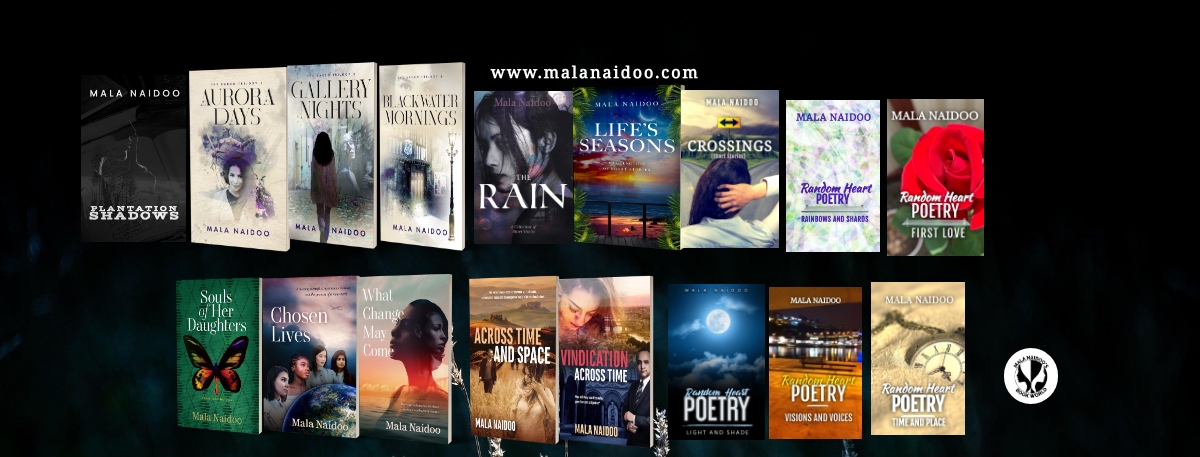
Souls of her Daughters reveals that the outlier syndrome affects all regardless of professional or social position. Dr Grace Sharvin struggles with her secret, making her an outlier in her family- in her need to conceal her pain from her mother and sister. Her sister, Patience, is an outlier through interracial adoption in apartheid South Africa, forcing her to acknowledge her birth culture. Across Time and Space and the sequel Vindication Across Time unveil both Meryl Moorecroft and Marcia Ntlui as outliers in personal, cultural and professional contexts. Michael Morrissey, a human rights lawyer, becomes the outsider in his relationship with Meryl when the course of their lives change. Housekeeper, Ana Kuznetsov and Boris Malakov are outliers in their complicated families.  Global landscapes invite the notion that the situations characters undergo are not isolated – shaping the universality of human angst and joy.

The Rain, a Collection of Short Stories presents this notion in the human capacity for good and evil.


Drama, crime and abduction bring high entertainment value to the reader, but beneath the layers lie the human face and soul of the outlier. The character should be carefully crafted to invite empathy or repulsion by stripping away layers that shroud the essence of human angst and joy.

The continuation of  ‘Souls of Her Daughters,’ in the next saga, Chosen Lives, grows in representing the outlier theme with glimmers of a futuristic world where perfection resides in imperfection.

One Voice, Many Worlds


Let’s continue to create stories that leave a lingering message.


Please add your thoughts in the message box below:

← Back

Thank you for your response. ✨

The First Draft

When a story takes hold, leaving you sleepless, daydreaming… the first words trickle in, you write them, and you can’t stop going back, creeping back to your laptop or journal to write a bit more. When the writing bug bites, it’s there to stay, calling you wherever you are.
There’s an excitement, a thrill, the adventure behind closed doors…  just you and your characters. With each line, you get to know more about them, then it’s almost as though the characters lead you into their stories.

The first draft is an exhilarating experience even if you have written a few books. You can’t stop thinking about it, you wake up at 3 a.m. with a jolt of inspiration, and if you don’t write it down, it’s gone… I have had a few lost… gone… but a 3 a.m. journal, a  gift from my daughter, is safely ensconced on my bedside table, close to my reading lamp,  capturing the late night unexpected bouts of inspiration that intrude upon restless sleep – not even a blaring alarm clock can do this on any good day!


Starting out

Starting out as a writer, I had two stories competing for attention. Thinking that this might be the one book I will write, I merged the stories, hooked them as plot and subplot. Across Time and Space pulled and tugged at intrigue, unexpected encounters, crime, romance and human rights issues.

Discovery

From that first draft of my first book to the first draft of my fourth book (locked in editing as we speak), my process has morphed along the way. While being between a plotter and pantser, I moved from laptop screen drafting to handwriting some chapters in a journal. 

This sped up the drafting time, I was writing by hand with speed, more naturally than the words that filled my little laptop screen as I tapped my way forward. I then started writing in my little journal, my second arm, traveling with me wherever I went. No backspacing, just scratch and keep going… forward… ideas gushed, building up at a faster pace.

The benefit

Having a chapter crafted by hand gave me so much more to work from and editing, stage 1 began as I typed up the manuscript. I noticed the difference from those chapters that went from head to screen from a basic ‘pantser plan’ to those chapters that were handwritten – less cleaning up and more ideas emerged and flourished to grow the plot.

As each handwritten chapter was completed, the digital chapter was typed no longer than a day later. The ideas are fresh, too much of life and its distractions have not happened in twenty-four hours or less, (fingers crossed) so there’s no fear that distractions will play havoc with the handwritten chapter, all that happens is a bit more spit and polish.

Am I converted?

I can’t quite be sure on that but I have stacked up on the journals that I feel comfortable writing in – the easily portable type, the ‘anywhere journal’ when inspiration strikes, even at 3 a.m.

How about you? Do you write from head to screen or are you a paper and pen person first?

Please share your thoughts in the message box below.

Happy Reading, Happy Writing.

Tell your remarkable story today to touch a life or many lives through storytelling.

← Back

Thank you for your response. ✨

Truth Reloaded

In telling stories, writers draw from values they either ascribe to or find abhorrent.

Are stories purely to entertain or do they serve a purpose beyond plot and characters? Grand narratives are timeless because they showcase society in all its grandeur and dismal failings.

Living today, in what is so much a constructed, fake, flawed world – fair enough perfection does not exist and my own take is perfection in imperfection, we should continue to be passionate about truth – in the books we read, the news we hear and spread. We want to read the sequel or the next book in a series because we want to know more, the truth, the outcomes…

Whether it is the writer’s intention or not, the truth is at the core of the narratives we read. In a previous post, I included thoughts on why we crave the truth.


The need to know is as necessary as the air we breathe, ignorance is bliss is a temporary state of bliss, soon, regardless the loss incurred, the truth will be pursued. The female protagonists in my novels hunt down the truth or live, at first, in a temporary state of ignorant bliss, but soon the gnawing urge to know the truth seeps in, in whatever shape or form it might appear.


For what it’s worth

One cannot be true to what one believes or to who one truly is, if being part of the zeitgeist is prioritised in life – is risking the joys of an authentic life, being comfortable in your own skin, worth the group affiliation? Narcissism guides the exclusivity individuals create while drowning a sense of what is just. A shared humanity is crushed, elitism (as in vanity, not the cha-ching) separates and invites unjust notions of difference. Prizing individuality over falling in with the clique can lead to social isolation, so is it the choice of the brave-hearted alone? – this shapes the thinking reflected in art and literature – the higher purpose in storytelling.


Perfection in Imperfection


Now back to ‘shades of truth’

The energy and time taken to justify an untruth can be used (truth be told) to benefit the lives of all around us.

Politicians and the media are often starved of a good dose of the antidote to the truth to face up to and fess up to the agendas they serve (often aligned to those who hold perceived power) and the mistruths they engender. Truth is valued over empty promises, no matter how deeply buried and ignored, it drips back wreaking havoc which could have been prevented early on, with the plain old truth, the whole truth and nothing but the truth saving the day.


Oprah Winfrey’s inspirational Commencement Speech at USC, 2018 sends a message to new graduates, (and the world at large) upcoming journalists, to accept truth as we see it, hear it and so should we report it. But is it as easy as that? What halts truth? Fear? Popularity?


Truth often pays a hefty price when the lid is lifted, it incurs cynicism and attack in the need to sweep its halo under a rug.

No matter how difficult or painful in the moment of revelation, owning up to the truth, perpetuating the truth ultimately leads to a stress-free glorious life, bringing a peaceful night’s sleep with it. Good mental health rests on truth, understanding, and compassion.


Go speak your truth, be who you truly are, nobody defines you, forget being cliquish, it destroys relationships and is often perpetuated by an egotistical leader. Meryl, Marcia, Grace, and Patience, strong fictional women in my novels, Across Time and Space, the sequel Vindication Across Time and Souls of Her Daughters with a forthcoming saga,  face the truth with dignity, speak their minds and try to make the world a better place. They are flawed characters, but truth helps them grow and at times trip up. In their fictional worlds, they make art mirror life.


What’s your take on speaking your truth, standing alone, avoiding the pseudo-elitism of cliques, how will you live with truth, understanding, and compassion? We all need a good night’s sleep, right?


Be a truth seeker, tell your story, set the record straight.


← Back

Thank you for your response. ✨

Story Ideas

As writers, students, readers,  we often hear, ‘where do all these ideas come from?’

There is no short answer to that question. Write what you know is not a mandatory ingredient to write well, to pique your readers’  interest.

Drawing from universal life experiences to create your work of fiction shapes characters and situations. At the heart of the story is the writer’s passion to either showcase a better world, expose the ills of the world or present hope in dark situations.

Thrillers can be inherently dark but genre in contemporary writing morphs into what the story becomes, often crossing more than one genre.

Crime Fiction will reflect the elements of the genre, as would Romance – what good would these be without a dead body, missing person, corporate embezzlement or terrorism etc. Crime Fiction without investigation is, for me, like eating apple pie without the apples. Imagine romance without lovers? While these might be diverse genres, the point of commonality is conflict.

Conflict keeps the reader, hanging on, will there be a resolution or does the tension mount, will the character I’m rooting for, be saved, loved, killed or elected etc?

To deny that conflict is a significant aspect of life (as much as we abhor it – oh the drama of life!) while creating a perfect world with perfect characters would no doubt be like having a dose of ‘soma’ as in Aldous Huxley’s Brave New World. 

In creating characters, the potentially ‘good’ characters that are fraught with conflict, are truly memorable ones. They represent the reality of life through fiction – a point of reader connection. Shakespeare’s mastery on the creation of the ‘good wayward’ character, is timeless, and there are many such writers who create unforgettable, quotable characters.

How do you imagine and create your character ideas? Where do they come from?

Observations of people in the bustle or stillness of life, the man sitting on a park bench or train alone, lost in thought – Who is he? Where does he come from? Why is here? Why is he alone? What is he thinking?- A story idea prompt is wherever you are in your day.

Who is he? What’s on his mind?


Turning to the works of influencers of the craft will create inspiration for story ideas:

To quote Stephen King, ‘You cannot hope to sweep someone else away by the force of your writing until it has been done to you.’ attests to ‘Reading a lot and writing a lot,’ as essential for generating ideas, developing and enhancing your writing style.

Reading gives the composer a storehouse of ideas to draw upon in creating a new, unique story world that readers connect to.

Keep reading, keep observing the hive of life, learning about new ways of thinking and behaving, story ideas abound around us.

Writers Block you say?

 It was the best of times, it was the worst of times, it was the age of wisdom, it was the age of foolishness…it was the spring of hope…we had everything before us (A Tale of Two Cities– Charles Dickens)

There’s much on the social and political landscapes, history in the making, story ideas can be a fusion of the past and present, to shock, delight, inform and move your reader.


What are your thoughts on where story ideas are drawn from?

Leave your thoughts in the message box below.

← Back

Thank you for your response. ✨

Do You Feel It?

No pain, no gain, no compassion, did the book you read make you feel, did it create a connection? Did you feel the fear, pain, joy, laughter, hope, and love or  perhaps just one, maybe two of these emotional triggers through the characters and events in your book?

‘In a dark time, the eye begins to see’ ~ Theodore Roethke


Some of the greatest artistic expressions emanated from the seat of pain, ‘a dark time’. Sylvia Plath’s Ariel comes to mind, her suite of poems on life and pain.

Emotion brings art to life, inviting the beholder to stop, listen, and absorb, to feel the pulse of the writer’s being.

In a dark time, challenges and struggles turn the eye and ear inward. Stop… still yourself from thought and action – listen and connect to your internal landscape. When writing grows from such a place, compassion is born through created events and characters.

Emotion, regardless of whether it’s negative or positive, draws us in, more so when love and understanding emerge through the connection. We are emotional beings. While Descartes said, ‘I think therefore I am’ (Cogito, ergo, sum) – it can be said, ‘I feel, therefore, I connect’ or ‘I feel, therefore, I understand, appreciate…’

Giving in to the emotion-feeling the pain to redefine your world (pixabay image)

Stories should build connections, to validate the reader by bringing characters and their challenges to life.  When readers leave a review on the connections the writer’s prose created for them, this provides valuable feedback and acknowledgment.


Here’s an extract from my latest novel, Souls of Her Daughters when the realization of where her life is at, comes crashing down on the protagonist… too much has happened, the past and present collide…

Grace walked around the hospital grounds, confused, lost in thought on the uncertainty of life. Visions of what her mother would have done came to mind. She walked to her car, sat back in the seat and sobbed for all she had lost in her life, and that poor Mrs. Beresford lay dead for the better part of a day, waiting for someone to claim her – Grace understood the pain of loneliness.


Loss and loneliness are sadly, but realistically universal. With the protagonist feeling the emotional weight of both, in a single moment, empathy is elicited and might perhaps connect with the reader, offering solace that we essentially are not alone in what we feel.


Emotional connections whether through song, literary fiction or a life-size painting, draw us in by the intensity of the emotion expressed.


Alternately, there are light-hearted moments in the novel, to lift the weight of the struggles the protagonist and the women around her undergo. The blurb concludes, ‘A timeless tale of every woman’s story…’ Timeless on the struggles and celebrations of life, of women from different cultural contexts and professional backgrounds but nonetheless women with collaborative fighting spirits.


Tapping into the essence of our humanity through any art form, is a way forward, to capture the moment in its rawness, to allow us to walk away from the wars of the world, to look at the pleasure and beauty of life, to let the time of struggle pass. Appreciation and compassion are bred from challenges – how do you know the dark side, if you have not felt it? So too, characters’  lives should represent life through art to make fiction sing with timelessness.

Souls of Her Daughters captures the dark side of life, but the positive emotions swell in the relationship between mothers and daughters. Amidst tears, there is laughter, the reality of the experience of life. I hope you read this tale which will leave you with the message – never deter telling the truth, no matter how painful it might be.

I leave you with this timeless TED message from Susan David, that encapsulates the essence of Souls of Her Daughters, on embracing your emotions in its truth.

Please leave your thoughts in the message box below or sign up to receive future posts, free book offers, and the occasional newsletter.

← Back

Thank you for your response. ✨


Cover Story

The adage ‘never judge a book by its cover,’ is a questionable one, in the world of publishing.
Writers and publishers agree that a professional cover is the first point of reader attraction. The successive triggers that consolidate interest are, genre, blurb, knowledge of the author’s body of work etc.


When is a cover visualised?

Most often the inspiration for a cover emerges during the writing process, or at the end of the first draft (this is pretty much my experience).
Some writers have a vision for a cover from the conception stage when the story idea strikes, and they stick with it. Others might see the initial perception for a cover morph over time, in consultation with the designer, or an epiphany might trigger a new wave of creative thought.


Creating a book cover should be a collaborative effort with the professional expertise of a cover designer


What decides the choice and layout of images on a cover?

Plot, character, and setting have a huge part to play.
A metaphor that hits the nail on the head is effective in creating curiosity to lead the reader in. It’s subtle and insightful.

My debut novel, Across Time and Space, captures the evocative landscapes of London and Florence, with the protagonist in the foreground,  her assailant centre-ground and the landscapes she traverses, in the background. While this is the main plot, the sub-plot, is not represented, to avoid cluttering the cover. There is a definitive reading path, depth in the placement of images from the foreground all way to the villa in Viareggio, seen in the background.  The colour choice represents the Tuscan setting.


With the sequel, Vindication Across Time,  the theme had to be maintained. The crime in the first book, Across Time and Space is played out in Book Two, in Florence, with the justice department, and media issues that arise. This cover has a Florentine backdrop,  with the Ponte Vecchio in the background, and representation of the courthouse, in centreground. The face of the protagonist, Meryl, in the top left corner,  is at the centre of the drama that unfolds. The male figure in the bottom, right quadrant, is mysterious, leaving the reader guessing who he is, (if you read Across Time and Space, you would have a pick of male characters to speculate upon) and what role he might play in Meryl’s world. Colours play their part in creating meaning, the word, ‘vindication,’ in red symbolises the significant unveiling of truth in this novel, the losses incurred in pursuit of truth. The dark suit of the male protagonist implies, he might be sinister or harbouring a hidden secret. The top half maintains the Tuscan setting,  while the bottom half is enclosed by a dark building – the seat of justice, where truth, lies, and deception are acted out.


There is a visual shift, to reflect a new story, a different saga. This cover is a metaphoric representation of characters and events. Green for renewal; fragility and beauty are emblematic through the butterfly image. Dark and light through the colours of the wings, imply situations encountered,  and the personalities of a mother’s daughters, two wings,  with different colours on one butterfly.


The Rain – A Collection of Short Stories reflects the metaphor of rain in its physical, emotional and psychological ramifications on the lives of characters.  Dark tones, with the glimmer of light with the female protagonist foregrounded, suggest the mood that pervades the stories. The image in the bottom right-hand quadrant is that of a hut in the title story.


Flick through any online retail bookstore, and a plethora of covers compete for attention.  A cover catches the eye –   title, author,  blurb are the next attraction and selection.


Covers tell a story, a summary through images.


Well-thought-out covers guide readers’ personal perceptions, speculations, and curiosity, asking,  ‘what story does this book tell, will it entertain and ‘move’ me?’

Seek the expertise of a cover designer and discuss the vision you have for your cover.

What’s your book cover choice? Share your ideas in the comment box below.
Sign up today for a free e-Book.

← Back

Thank you for your response. ✨

Writing Support

Often writers feel alone while tapping out the stories that come tumbling out of imaginative worlds with a benevolent muse guiding the next brainwave.

Writing starts out feeling like a lonely affair and the actual writing will always be a lone love affair with your writing tools – however, the number of support communities available to writers is phenomenal. Facebook groups with experienced authors and authorpreneurs abound.


You can choose to actively engage in these forums or lurk a while until you find the courage to ask a question or respond to someone’s question. There are local groups such as Writers Around Australia created by Lisa Braun and Tina Bonett who generously share posts and ideas. The New South Wales Writers’ Centre to keep up to date with advice and events. The Professional Association I find immeasurably beneficial is ALLi based in the UK, established by Orna Ross with a team of talented and experienced authors, with a worldwide membership.


The Platform for Building Authors and Authorpreneur Mastermind by the Winsome Media Group, established by Juliet Dillion Clark is inspirational and provides valuable advice on how to grow your author platform to get noticed to drive sales.

An excellent inspirational forum to enhance your speaking skills (as authors we are inclined to be introverts)  and seek speaking opportunities to add another stream of income to your job as a writer, is Big Impact and Income Speakers under the helm of  Amondarose Igoe. Here you will find inspiration and support to build confidence and grow your author business – both Winsome Media Group and Big Impact and Income Speakers are US based.

The SPF community established by author Mark Dawson is a great sharing and advice UK forum with worldwide membership. Women Writers Women’s Books is a supportive, informative network of authors created by Barbara Bos. BooksGoSocial Author’s Group run by four dedicated administrators offers advice to authors through sharing ideas and is great for marketing your books.

Ebook and POD

Following a range of podcasts and signing up for webinars allows authors to connect with developments in a rapidly changing publishing landscape.

I religiously follow The Creative Penn, ALLi and SPF Podcasts and select topics from a range of presenters on other forums as the need arises – quite often I might add! Smart Author podcasts with Mark Coker from Smashwords publishing platform offers solid advice for authors starting out.  So you want to be a writer (Australia) with Valerie Khoo and Allison Tait covers a range of topics from local to global writing and publishing trends.


Digital publishing platforms that are providing excellent services to authors are Draft2Digital with a range of great features for new and established authors.  Kobo offers distribution to Canada and the Netherlands. KDP is a prominent publishing platform from the dawn of eBook publishing. (2007) – the choice is vast, you eventually find your comfort zone and work with your chosen publishing platforms. Reedsy, UK based, provides a range of vetted services as does ALLi from editors, to cover designers and Reedsy provides an advanced formatting book service. 


For POD, IngramSpark and CreateSpace/KDP provide excellent platforms to get your print book out into the world.

There are many more services and professional author bodies available, after trying them you eventually settle on your ‘favourites’ because you can’t possibly follow all. Being selective ensures you are not doubling up and eating into your writing time, the most crucial aspect of your writing career.


There’s an oasis of supportive networks out there, reach out and you’ll be amazed at the wealth of advice you will receive.

I hope you find the platforms I respect and trust beneficial for you on your writing journey.

Happy Writing! 

Sign up to my website for newsletter updates on my latest tips and upcoming books.

← Back

Thank you for your response. ✨

The Writing Toolshed

A few months ago, towards the end of October 2017, this post detailed my definition of the essential steps to writing and publishing.

Today’s post includes what works for me in organising, writing and  editing  my book.


Organisation – Planning,  Preparing,  and Reminders

Having to juggle many things the tools that work efficiently for me are:

Evernote – I include my timeline of ‘to do things’, from chapter deadlines, my professional development reading, research and reminders for podcast and webinars I should follow. The added benefit is that an email reminder can be set to ensure I am  aware of what’s coming up. This is an organisational tool that would benefit anyone with an overloaded weekly or daily schedule.

iPhone notes – My ‘on the go’ note making when the creative muse beckons without warning! This is then emailed for a quick inclusion into my work in progress.


Writing Software

After writing my first two books exclusively on Word, which I still use on a daily basis, I tried my hand at Scrivener. Its an amazing tool for planning and writing your draft in one place. It has all  a writer needs from a  word count  feature at the bottom of the chapter, as you write (this helps keep  your eye on your number of words per writing session as you go) , files and folders for everything from research, character profiles and a whole lot more. It’s not the easiest to navigate as a newbie to the tool so I purchased, Scrivener Superpowers: How to Use Cutting Edge Software and am finding my way through new discoveries of the magical properties of Scrivener every day! If you’re a plotter this is your ‘to-go-to’ writing tool and it serves you just as well if you’re a pantser. I write on Scrivener, save it in Word for polishing up and editing before the professional edit and am in the process of moving the edited manuscript back to Scrivener. The Scrivener app is available for your iPhone and iPad too!


Self-Editing Software

It is recommended that you give your draft a thorough check before the professional edit to eliminate  ‘unknown’, ‘unseen’ errors.

These are three  editing tools I find useful:

Grammarly

Hemingway Editor

Prowriting Aid


Why use all three?

Each has its unique way of alerting the writer to ‘creative mishaps’ from missing words, sticky sentences, overused words or lengthy sentences and good old proper use of punctuation and grammar and  more!

While you might not agree with all suggestions,  you are made aware of what might obscure meaning for your reader.

The writer needs an objective ‘third eye’ –  while technology is a godsend, the human eye is essential if the ‘sense and meaning’ of the writer’s lines are to be  interpreted as close to the writer’s  intention. 


More on the blog in future posts on new discoveries that are working for me.

Happy writing! Happy Reading!


Please share what works well for you and your preferred tools of the writing trade!

← Back

Thank you for your response. ✨


Rear to Front View

We hear and read much about goal setting with the onset of a New Year.

The rear view must be kept in sight to negotiate the lift-off to the front view, to minimise errors and risks that need refining − that backward glance reminder is significant as the new year begins


Looking back on the not so distant past year, its exit a rapidly fading memory− caught in the fanfare and fountain of eternal fireworks that kick-start the New Year− if we linger on the threshold of the New Year,  we might not move forward fast enough.

With everything in life, we get better at it when we do it over with a new spin, a new attitude and a passion to achieve the best we can.


We are human after all, we can only get better with a little effort and skill.


How do we keep the rear view in focus while bolting to the front view?

  • Make a list of your past successes
  • Make a list of some past shortcomings
  • Match them against each other
  • Now decide what is worth pursuing and what should be culled.
  • Work at culling first and shutting down that rear mirror.
  • Pick up the shortcomings that need attention – make them a priority, review, add-in, refine and polish. Repeat the cycle a few times. Once this is defined as the way forward, look at the new front view,  you want to see,  and advance at a speed and pace that is comfortable for you.


How do we create that front view?

  • Itemise THREE small goals you want to achieve
  • Make a list of the tools you might require
  • Set a timeline for how you will achieve each goal
  • Structure the above timeline in four monthly slots
  • Start with the goal that is perceived  as  crucial to a glorious front view
  •  Proceed with getting as close as you can as the four-monthly goal post rolls in
  • Move to the next goal, even if the first has not been fully realised, the first view should continue to grow as the second is being crafted
  • Continue with this pattern, with your eye on the long view


What if there are challenges within each new view?

Here’s the thing:

  • reflect-reflect-reflect
  • write down or voice record what happened, why it happened and what you can improve upon
  • without conscious acknowledgement of why the challenge arose, the risk is,  it might recur,  awareness through thought, guides and creates a redirection for a better view.
  • turn to influencers in your craft: writer, teacher, mother, father, painter, musician etc, draw inspiration from their blogs, podcasts, Facebook specific groups, face-to-face interactions and professional associations.
  • Ask questions, no question is too simple.

It’s a pattern− not an inflexible structure− t should be one that guides your drive through the year, a look in the rear-view mirror, as you proceed, is a worthwhile look− reduce the frequency when you reach your halfway mark.

Keep driving, keep looking ahead, and a safe and happy arrival is assured!

Happy New Year!

What’s your view on the rear view? Add your comments below.

← Back

Thank you for your response. ✨

Want to be a Writer?


Why not?

You will enjoy the process of creating the story you have always wanted to write.

What’s holding you back?

Fear and Time?

Counteract fear by writing the best story you can.  Temper your inner critic, the belief that you’re an imposter in the craft – avoid this or you become your own worst enemy. Trust your desire to write and turn to the supportive person in your life who will allow your light to shine.

Find time in your day to get down as many words as you can. Do it consistently to keep yourself inspired to go on to complete your novel. Fifteen minutes a day is better than not writing at all.


Will you be a pantser or plotter?

Would you meticulously plan scenes, with graphs and maps etc or let your creative energy lead you with just the basics planned out for your novel? There are various schools of thought on being a pantser or plotter. I’m somewhat hybrid on that. Mental planning with a few scribbled thoughts here and there make me more a pantser than a plotter.


Pantser or Plotter


Challenges that could occur

Shut the door as you write, as Stephen King advises in, On Writing: A Memoir of the Craft, ( I gained the courage to finish and publish my books drawing from the advice in this book), until you are ready to tell the world.

Once you begin to tell others, be prepared for either cynicism or support. The cynics are not worth your time – leave them to their cynical worlds and do what you have to do – write the best story you can!

Writing is an emotional process that often dives into a point of long-held pain or passion. When dubious eyes, lopsided smiles, and tongues that doubt,  disturb your orbit, it’s time to turn them down or off.

Consistent writing, turning to influencers of the trade and reading books on how to write well or listening to podcasts on writing and signing up for webinars on the craft is the way to pay your way forward in your growth as a writer.

No story is not worth telling if your aim is to enlighten or connect with your reader or you know what you have to say will make a difference- write that story.

And there’s more…

Writing the story is not all you have to consider, you should then research traditional and self-publishing options and find your best fit. Know your genre, research writers in the genre you want to write in and carve your approach, your own style. Once the final product, the actual book, with a professional cover, professional editing,  blurb, author biography, ISBN, date, publisher, and place of publication etc are in place, the marketing of your book begins. Whether you opt for traditional or self-publishing, the onus is squarely on your shoulders to market your book.


Don’t put off writing your book. Now is the best time.


It took me several years to finally master the fear to turn to my beta reader to have a look at my work.

We need more stories, stories that speak of angst and optimism and stories that make us laugh out loud, hold us in suspense, evoke disbelief or leave us in meditative contemplation.


We need stories that remind us of our essential humanity.


Write your book today. Publish it…

Don’t you know yet? It is Your Light that lights the worlds – Rumi

Does this resonate with you? Please share your thoughts in the message box below.

← Back

Thank you for your response. ✨

Are You Grateful?

Every day should be Thanksgiving.

Kindness, Thankfulness, and Generosity in equal parts, blended together, is the alchemy needed for harmony and peaceful coexistence.

The words, ‘thank you,’ ‘I give thanks,’  ‘I’m grateful for,’ send out good vibrations to both the messenger and recipient of these encouraging words.

Let’s take a look at wise words on moments of gratitude.

‘I can no other answer make, but thanks, and thanks’ ~ Shakespeare, Twelfth Night

‘Oh Lord that lends me life, lend me a life replete with thankfulness’~ Shakespeare, Henry V1, Part 2  (This is quoted in Vindication Across Time


May the work of your hands be the sign of gratitude and reverence to the human condition. ~ Mahatma Gandhi


‘…Any who is grateful does so for the profit of his own soul’ ~ Surah AL-Luqman 31:12


Always be rejoicing, Give thanks for everything’ ~ Thessalonians 5:16, 18


‘When eating bamboo sprouts, remember the man who planted them’ ~ Chinese proverb


Whenever I am offered in devotion with a pure heart, – a leaf, a flower, fruit or water – I accept with joy. ~ Bhagavad Gita


‘What counts in life is not the mere fact that we have lived. It is what difference we have made to the lives of others that will determine the significance of the life we lead.’ ~ Nelson Mandela


So what am I giving thanks for in my life? Firstly it’s the gratitude I feel for having a loving family, caring friends,  amazing students, the realisation of my creative dream, supportive readers, and followers.

A Simple Thanks, Goes a Long Way


If there is a lesson I reflect upon with gratitude- it is injustice – this has infused my soul with how one should never mistreat, abuse and slander the kindness of others. My writing speaks from my soul with gratitude for finding my voice.


Thanksgiving is my everyday quiet moment, my soulful to-go to place.


Have a blessed Thanksgiving. Continue to exude love, kindness, acceptance, tolerance, and understanding. Above All: continue SMILING, it gives others permission to smile too, that you acknowledge them, that you see them.

Continue reading “Are You Grateful?”

Leading Lines

How often have we heard that first impressions are lasting? Does the same apply to the opening lines in novels?

An attention-grabbing opening to a novel, not the head-standing, acrobatic, high energy stuff but a carefully crafted opening is a sure-fire way to spark the curiosity of the reader to continue reading.

Leading the reader in without saying too much by judiciously leaving out some essential details elicits intrigue for the reader to pursue the tale to its conclusion. The reader should discover aspects of a character’s world by being invited to be part of the journey. Those discoveries do not have to be palatable to the reader. A favourite character might reveal a side of their personality that perturbs the reader. The unexpected sustains the intrigue. In the real world, perfection is an illusion, to quote Alexander Pope, to err is human, to forgive divine. I fondly recall the conversation with Sevgi Yildiz, coordinator of the Sydney Bookclub, who said she ‘threw the book’ when her favourite character from her reading of Across Time and Space was not as saintly as she had wanted her to be!  Emotional connections are indeed what keeps readers wanting more.

A sequel carries a known backstory but it should also be satisfying to read on its own without the details of the first book. Without summarising the first book, the opening lines should invite the reader in with glimpses into what went before which puts all the pieces of the larger plot puzzle together.

Opening lines of a book often take several redrafts to ensure that the right balance is achieved that leads to a natural flow from the first book into the sequel.

This is a skill that improves with each book written after several self-edits before the professional edit is solicited.


What do you look for in the opening lines of a novel?

Share your thoughts and questions in the comment box below. Join the community here for updates on current and forthcoming books, and the latest on the blog on reading, writing, and book giveaways.

← Back

Thank you for your response. ✨


Writing Trade Tools

My writing career started in a somewhat circuitous way with writing stories for an audience of one for many years until a story emerged that ran through to become my debut novel, Across Time and Space. It was then that the decision to publish emerged with some coercion from those closest to me.

My journey was a cart before the horse situation as all that I am about to outline to you happened after my debut novel was in the process of being published by a publisher.

It is for this reason that I decided to write this post to pass on what needs to be done, in the initial stages, before the process of writing begins.


As a writer, aspiring writer or fully-fledged published author we all need additional writing tools to sharpen the craft for an enjoyable and less stressful writing journey.

What do you do? Where do you go to set yourself on your merry, enjoyable writer’s journey?


Here are a few questions:

Before you begin writing:


  • do you have a plan for your writing journey?
  • are you following influential writers?
  • are you reading extensively into your preferred genre?
  • are you attending book festivals and conferences?
  • have you started creating an online presence?


Before you publish:

If you self-publish you should consider all of these and if you are going the traditionally published route some of these steps have to be undertaken as marked by my asterisk


  • do you have a Goodreads reader/author profile?
  • have you set up your Amazon account and author profile in the countries you hope to sell your books?
  • do you have a Kobo account?
  • do you have an iBooks account?
  • do you have a Draft2Digital account to have it all done for you?
  • do you use Ingram Spark/Createspace/Smashwords or all publisher/distribution channels?
  • do you belong to writing organisations online or groups in your hometown?
  • do you have a Facebook Page/Meta where you create an engaging presence?
  • do you have a Twitter/X Account?
  •  do you have an Instagram account?
  • do you have a website or blog site?
  • have you started blogging and have an engaged audience?
  • if you are self-publishing, do you have a freelance editor and cover designer enlisted?
  • have you bought your ISBN for your book?
  • have you registered your title?
  • have you lodged your book with the National/State Library (Australia)
  • if your books are in public and school libraries- have you registered for PLR and ELR?
  • do you have proof-readers?
  • are you able to enlist legitimate (ARC) reviewers?


While you are writing

What software do you use?

  • do you do a handwritten first draft?
  • do you use  Microsoft Word to type up your manuscript?
  • have you sourced other software to write and format your manuscript?
  • would you dictate your novel? do you have the software for your audio needs for dictation?


After you’ve published your book:

  • How do you market your book?
  • Even if you are traditionally published  –  you have to do your own marketing. The onus is upon you to get your book out there.
  • Will you have a ‘live’ book launch or will you have a Facebook or website launch of your book?
  • Will you be open to giving talks to aspiring writers?
  • Will you engage the media?
  • How much will you invest in marketing your book? Consider the ROI and check all options.
  • Do you want your books in bricks and mortar stores only?
  • Do you have print and eBooks published?
  • Have you considered creating an audio version of your book?


After my roundabout entry into writing and publishing, I am trying new tools for my third book and will report back in a few months on how I fare with my new researched tools.

I encourage you to continue pursuing your writing dreams and hope you can take something away to begin your writing journey.


The world will be a dreary, sad, isolated place if our stories were not written and shared. – Mala Naidoo


Please share where you are in your writing journey and what works fantastically well for you in the comment box below. If you are thinking of starting out,  let’s  begin the shared conversation today.


Happy Reading and Writing!

← Back

Thank you for your response. ✨

Why We Need Migrant Literature

The world is a melting pot,  an ever-increasing paradise of voices that need to be heard if tolerance and understanding are to reign for peaceful coexistence.

Migrant literature, while evident through powerful voices, needs new sounds to add to the colourful history that should be shared if we are to live side by side.

Knowledge is necessary to foster understanding and compassion to move us closer to our innate humanity. Living in international communities in the 21st Century is a goldmine of multiculturalism that offers rich insights on culture and values.

What better way than to extend understanding through the literature we read and write. This could be a work of fiction, a non-fiction book, or a blog that creates connections to our neighbours near and far.


Literature is and should continue to be a vehicle that dispels ‘otherness’ or the ‘outsider’


Samantha Govender

I have for you today a reader’s perspective on what she enjoys about migrant literature in Australia. Samantha Govender, author of the blog site, Currychick – Spice it Up, covers everything from culture, history, education, lifestyle, glorious food, expat tales and more. She graciously agreed to answer my questions on migrant literature.


What is your home country?

‘I hail from the striking, picturesque country of South Africa nestled in the southern hemisphere.’


Why did you choose to migrate to Australia?

‘My LIFE AS AN EXPAT series on my blog charts that moving away from one’s country of birth is truly one of the most daunting life-changing experiences anybody can undergo. The crime and general political climate in South Africa were unnerving so the opportunity to move was an enticing prospect.  Many of my colleagues were seeking greener pastures and Australia seemed to be offering that.   When my husband finally agreed, I grabbed the bull by the horns and took the leap to leave my motherland.  In a nutshell, we sought a better life and future for our two children.’


What do you enjoy about Australia?

‘Beautiful one day perfect the next.’  Truly, I do not exaggerate when I call this country ‘heaven on earth.’  I love the people, the food, and the freedom. The safety and abundant, carefree living that comes with first world living, is supreme.  Australia has enveloped my family and made our move worthwhile. I feel blessed to call this magnificent place home.’


Name the three things you miss about South Africa?

‘The food ‘Bunny Chow’ (yum! read about it on my blog); the feeling of belonging and not having to constantly prove yourself; the culture in addition to friends and family that gives you a deep sense of belonging. I think only a migrant will cognize the profound need to belong.’


What is your genre of choice today? Has it changed in the last ten years?

‘My job is intensive so reading is my ‘go to’ place.  As much as I prefer print books, I am steering along with modern technology.  Thus, I use my iPad and Kindle a fair bit to download genres such as politics, health, well-being, and romance. Currently, I am reading Shashi Tharoor’s Inglorious Empire while hankering to read Mala Naidoo’s sequel Vindication Across Time. Finally, to answer the last part of the question, I would say yes. As I have grown older my taste for more thoughtful, serious reading has increased somewhat.’


What role does migrant literature play in Australia for you?

‘Migrant literature is necessary for establishing connections, to feel you are not alone in fears, hopes, joy, cultural expressions etc. Recently I listened to acclaimed novelist Salmon Rushdie whose perspective that some literature is timeless, mirrors mine.  Accordingly, I agree that migrant literature is vital in our current ever-changing society.’


Do you believe migrants should give voice to their culture and values through literature and other art forms?

‘Absolutely!  I think it’s the best channel and a means of expressing our story to others.  Be it a humble blog like mine or a letter to the editor; voicing our opinions as well as sharing our experiences are paramount to us being noticed and valued.  The trials and tribulations in addition to the magnificent experiences migrants undergo must be heard by all.  Literature and art open this communiqué giving us the ability to speak and more importantly to be heard.’


What other migrant voices would you like to read about?

‘I am always keen to try out new authors and meet people who have made life-changing choices in their migratory or other journeys in life.  I recently had an insightful conversation with a co-worker from South Korea who has made Australia home.  No doubt listening to and embracing migrants and their perspectives is an evolving, unending education.’

Continue reading “Why We Need Migrant Literature”

Are you particular about dates?

 Are you particular about dates?

Here’s the reason for asking.

I recently published Vindication Across Time as the print version late in September to coincide with my father’s birthday.


Cover Design- Working Type Studio- Luke Harris


The digital version on Kindle, Kobo, iBooks, BN will be released next week on my mother’s birthday. It’s up for preorder  on these sites now.

I can hear you ask, ‘Pray do tell us more!’

Some of the themes reflected in Vindication Across Time – the pursuit of truth and justice is a value I grew up with. The truth no matter how painful had to be acknowledged and implemented.

Lies were severely admonished in my childhood home regardless of any perceived justification for stretching the truth.

Truth and lies are dominant in the novel as in different versions of the truth. The bearers of fake truths are soon discovered and good karma visits those who steadfastly adhere to the truth. My understanding is that there is only ONE truth.  If a man has been gunned down, there might be one person directly responsible and others who helped expedite the heinous act.

Justifications offered for why this happened does not remove the truth that a defenseless man was gunned down in cold blood. The next truth to be served is that justice must prevail regardless of individuals’ motives and challenges.

There, in a nutshell, is why the print version of Vindication Across Time was released on my father’s birthday as an acknowledgement of his respect for truth and justice.

What about my mother made me choose to release the Kindle and eBook versions on her birthday next week?

The expression of culture and values through strong female characters in  Across Time and Spaceled to greater nuances of imperfect lives in Vindication Across Time. This is where my mother’s love, compassion, and strength shaped these ideas.


Book VideoCreative Commons Music (bensound.com)


My dedication makes reference to my gratitude to my ancestors, only because, they fought immense hardship under the mistreatment of apartheid and the crimes endured in South Africa – they never lost sight of their values and this is a dominant theme in Vindication Across Time.

Hence the dates of publication attached to the print and eBook versions of the sequel to my debut novel, Across Time and Space in  Vindication Across Time.


On a lighter note, while the title of this post does not refer to the dating game,  romance is evident in Vindication Across Time.

We all need love, respect, and acknowledgement and how much better when we are: the sun, moon, and stars or the ‘zvezda’ in our lover’s eyes!

I hope you read both novels and write your honest reviews on your preferred sites.

Thank you for being part of my writer’s journey.

Please write your comments in the box below. If you subscribe to my site, you will receive a monthly reading/writing newsletter and updates to keep you abreast of what’s happening on my writing front.


Keep reading, keep writing!


Please Like, Share and Comment

← Back

Thank you for your response. ✨

Why a Sequel?

Do writers plan to write a sequel? Why are sequels so popular?

Sometimes they are planned and sometimes they grow from the first book for a host of reasons.

We live in an age where we are desirous of connections for the long haul, we want more as we book our Netflix favourite series into our private calendar time-slots; we crave more when we connect or are moved by a story and its people.

We desire more of what we enjoy, what we look forward to. Connections with people and places make us reluctant to leave. The story is anticipated as an after work or relaxing weekend read. It’s locked in and beware the unsolicited ringing of the telephone or doorbell! Solitude is non-negotiable!

For the writer, unfinished matters in the first book lead to the second book which unveils new situations and hidden aspects of characters and situations, sometimes shocking or expected and satisfying.

Picking up reader feedback from the first book while the sequel is being written is significant in ensuring that favourite characters are not destroyed or killed off too early, reader and writer satisfaction is imperative.

In the writing of my debut novel Across Time and Space, the sequel began to emerge by the end of the penultimate chapter, there was more my characters had to say, there was more that had to be revealed. The intrigue of the first tale created expectations that needed further exploration.  Relationships needed to grow.

Truth and deception were left skulking in the shadows at the olive grove in Viareggio in Across Time and Space and these ghosts came calling for more.

This made me restless to dive into the sequel, some cautioned ‘not so soon,’ others begged ‘when will it be ready?’ The process became an organic growth –an obsession to take the story to where it was leading me. Hence the birth of the sequel, Vindication Across Time.

Cover Design- Working Type Studio- Luke Harris
What will be lost, what will be gained when the dark forces of human nature obscure truth and justice?

Will this become an Across Time series?

The question we are left with is, ‘what are we keeping hidden from view in the hope of leading or appearing to lead a happy and by anyone’s definition, a ‘normal’ life?’

Coming to terms with our ghosts as something of the past rather than defining our present worlds is significant in Vindication Across Time. 

Whose ghosts will be exhumed in this tale of love, loss, hope, and patience?

Have you read, Across Time and Space?

What are your thoughts on book sequels and television series, what do you anticipate in Vindication Across Time? 

Please leave your comments in the message box below.

← Back

Thank you for your response. ✨


Announcement of Title

The joy of writing over several weeks and months is finally seeing the artist’s  impression in the cover design of the story that has emerged from, and lives in the writer’s imagination.


The much-anticipated sequel title to ‘Across Time and Space,’ set for a spring 2017 release (depending on where you reside in the world), is :


VINDICATION ACROSS TIME


← Back

Thank you for your response. ✨


Fear: Thy Strength

After an evening at the amazing Headlong, Nottingham and Almeida Theatre production of 1984, the timeless warning of the danger of unchecked power and the futility of resistance invited thoughts about the state of society in other areas of power, control and fear.

The passive aggressive comment, the staring down to intimidate, the proclamations of intellectual superiority, cultural, religious or racial bias uttered from a monocultural, bigoted point of view instils fear in the targeted individual, reverberating with the mental torture Orwell’s character, Winston Smith undergoes.

Sleepless nights, dreaded days, endless bouts of nausea, skulking in the shadows away from penetrating eyes, questions about questions.

The long day’s journey into another sleepless night becomes relentless. Guilt, self-questioning and a whittling away of self-confidence reeks of the fascism of workplace politics.

Competitiveness of the narcissistic ladder climbing co-worker or the sadistic joy in pulling others down is yet another corrosive dimension of inhumanity.

Systemic torment dims the light of the once vibrant, optimistic individual, the light is interrupted as dark days take over. Winston Smith tried to hang onto the waning light in Nineteen Eighty-Four.

With every knock…

The eroded self-confidence and panic attacks sends the tormented individual hurtling into a bottomless pit of mental anguish …


Each act of power and control, topples the victim blow-by-blow…


BUT

While the message is bleak, while it might not seem possible, there is a light at the end of the long, dark tunnel, the light of strength.


Fear is thy strength when compassion and love grow from the depths of pain.
In fear, there resides hope.


Hope is the light — fiction and poetry hold the power to transform fear to courage as all struggles pass, they exist in the now—the page turns as truth lifts its head to the sun. 


George Orwell predicted a future that has become a reality today, not only within the realm of politics and governance but also serves as a cautionary note to take a closer look in the mirror to decide if our souls are indeed supportive or destructive of each other.

A dark message sheds light on what should be rectified to save ourselves and the ‘unborn’, the next generation, from even darker inhumane acts.


What will you do today to uplift someone from the quagmire of human cruelty?


Share and Comment:


← Back

Thank you for your response. ✨

error: Content is protected !!