Holiday Reading

It’s time to get off the wheel. Imagine days lying in or relaxing on the beach, or in your own backyard.

Laid-back days are built for leisurely or serious reading. Soul searching or fun, reading is a fascinating activity that delivers anywhere -anytime- every time.

I asked readers to recommend some of their recent great reads. With Black Friday deals still available at some retail bookstores, it’s quick and easy to bag a good book bargain.

Here is a mixed-genre recommened booklist of the most enjoyed and/or informative reads. Blurbs are not included; they are available online and at bricks and mortar bookstores wherever you are.

Three recommendations from Queensland’s Logas Padayachee, who thoroughly enjoyed her choices:

LL’s Selections:

When the Singing Stops by Di Morrissey

Without Merit by Colleen Hoover

Apples Never Fall by Liane Moriarty


Mavis’ Sydney Picks:

Black & Buddhist by Pamela Ayo Yetunde and Cheryl A. Giles

Man’s Search for Meaning by Viktor E. Frankl

Black Teacher by Beryl Gilroy

Blue Mercy by Orna Ross


Jenny Trotter’s Choice:

The Tilt by Chris Hammer


More Suggested Reads

Notes from a Small Island by Bill Bryson

Miracles Happen by Dr Brian Weiss


Stories with a Christmas theme are appealing during this time of year.

Stocking Fillers, Twelve Short Stories for Christmas by Debbie Young

Christmas in the Scottish Highlands by Donna Ashcroft

The Christmas Bookshop by Jenny Colgan


My Books with a hint of Christmas:

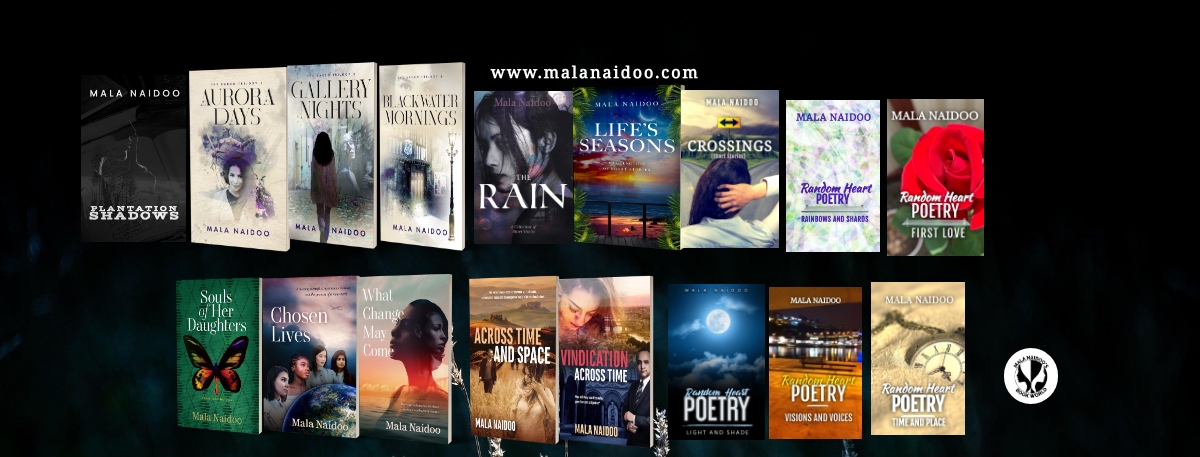
Gallery Nights by Mala Naidoo

Souls of Her Daughters by Mala Naidoo


Literary classics by Charles Dickens, Jane Austen, and many other literary great-reads offer timeless entertainment.

Add your favourite reads in the comment box below to spread the love of reading this holiday season to keep books alive.

Happy Reading! Happy Holidays!


← Back

Thank you for your response. ✨

Writing For Success

In my first post on the prolific and inspirational Trinidadian author and poet Brenda Mohammed, we got a glimpse into her writing journey.  Brenda has written twenty-five publications — her passion and dedication to literature is phenomenal.

Today we chat to Brenda Mohammed to catch up on her rapidly growing and expanding writing life and the scoop on her latest writing venture!


Tell us a little bit about yourself?

I am a former Bank Manager of a leading bank in Trinidad and Tobago. Later in life, I moved into the Insurance field and excelled there also. I always loved dealing with finance, and never dreamed that I would fall in love with Literature.


When did you start writing?

Actually, I was always a very good writer in my school days and won the top English Language prize when I graduated from High school at sixteen years of age.

When I joined the bank my superiors at the bank were always impressed with my ability to learn quickly, my efficiency in every department I was assigned, and also my writing skills.

When I was promoted to the job of Assistant Manager Credit I had to prepare detailed financial proposals for the Manager’s signature to be sent to the bank’s Head Office for approval. The Manager rarely changed a word, and the Bank’s Head Office always approved the proposals without any questions.

The Banking term for that was “clean sanctions,” something other Managers wished they could achieve. Later on, when I was appointed as Manager I continued with that skill and moved on to Senior Managerial positions. Yet, writing books never crossed my mind and I moved into Insurance where I also excelled, qualifying for membership in the Million Dollar Round Table, The Premier Association for Financial Professionals, {the name pertains to sales achieved and not earnings}, until I was struck by cancer and told by my doctor in Trinidad that she could do nothing for me.

To make a long story short, I survived and wrote the book, I am Cancer Free, which became a bestseller, and gave me the encouragement to write twenty-four more books.


You wrote twenty-five books. Can you tell us the genre of those books?

I write both fiction and non-fiction. The genres include Memoirs, Romance, Mystery, Poetry, Children, Science Fiction and Self Help.


Tell us something about your multi-award-winning book Zeeka Chronicles.


Zeeka Chronicles is about a vengeful man who misuses science in the year 2036 to create havoc in a small exotic island named Gosh. He is angry for two reasons. After his former lover jilted him, he married another on the rebound. His wife contracted the zika virus when she was pregnant. His child was born deformed as a result, and she died. He blamed the hospital for her death and his deformed child. This vengeful man kidnapped the son of his former lover and the story evolves thereafter.

The story is set in the year 2036 when there is great advancement in medical and information technology. It is a high-tech world.

Skillful robots are used as home helpers, and police use high tech weaponry, electric cars, and smartphones. The hospitals are well equipped with state of the art equipment and doctors and scientists are making significant breakthroughs and inventing cures for patients with critical illnesses.

Yet, in this high-tech world, the minds of some human beings remain evil.

Can Mankind ever achieve a sinless state? Will human beings forever continue to foster greed, malice, anger, jealousy, and the desire to control and take revenge?

I wrote this book to highlight the fact that material things can never improve the minds of some individuals.

Today, in spite of all the new and advanced developments, crime has increased to unstoppable levels. What will change humanity?

The benefits to readers are the underlying lessons to be learnt from the content, especially in light of the situation the world is experiencing today with COVID 19.


Who are the primary readers of your books?

My books are for both mature audiences and young adults and the children books are, of course for children.


What are you working on now?

I am working on the third story in a Mystery series – Barry Holmes Mysteries

What happened to Mary Loo has elements of romance, mystery and suspense. It will be a short story and should be ready for publishing by the end of May.

The book cover was designed by Mary L Schmidt.


Can you leave us with a valuable quote on Writing?

Writing is a mysterious journey of thoughts that can unravel the strangest imaginary plots.

Writing for me was exploring a new milestone.


What are your social accounts if people want to connect with you?

I am on Linked In, Twitter, Instagram, Pinterest, and Facebook, where I have nine author pages for each genre in which I write, and a personal page.

They are – Poetry to Enlighten, Zeeka Stories, Banker turns Writer, Romance Stories, Children’s Corner, Barry Holmes Mysteries, Brenda’s Video trailers, Fascinating Memoirs and Brenda’s Publications.

I am also available as the Founder of How to Write for Success Literary Forum.


Brenda Mohammed a former Bank Manager from Trinidad is a multi-award-winning author of 25 books, and Founder of the Literary Forums How to Write for Success, Poems for Suicide Prevention, Library of How to Write for Success, and Poems against Domestic Violence. Her award-winning book HOW TO WRITE FOR SUCCESS is popular amongst writers and University students.


She recently published three best-selling Anthologies – A Spark of Hope Volumes I and II, co-authored by 49 and 64 authors respectively, and Break the Silence: An Anthology against Domestic Violence by 87 authors. All three topped the charts on Amazon as Bestsellers No 1.

In November 2018 Brenda received two awards from Readers Favorite International at an award ceremony at the Regency Hotel in Miami for two of her books, ZEEKA CHRONICLES and I AM CANCER FREE.

She was inducted into the Indie Author’s Wall of Fame in January 2020.

Brenda was also honoured on 22nd February 2020 by the Peru Government for Excellence in Literature, and in August 2019 by the Seychelles Government for her Literary skills. 


You can connect with Brenda Mohammed through the links above.

I wish Brenda everything of the very best in her writing success.

Please like, share and comment.


← Back

Thank you for your response. ✨

Fiction Changemakers

If stories were never told — history would not exist — change would not occur.

So much that is fictional is drawn from reality.

The horrors that have occurred historically and afresh each day (as the daily news never fails to report) become the fictional realities writers create in imagined worlds. The fiction writer’s world is in tune with current and past societal occurrences. The subconscious mind sifts and imprints that which has emotive associations. From this collaboration of mind and emotions, the writer begins with a particular premise — then something magical happens — the pen takes on a life of its own.

Plotter or panster merge when that magic happens. Hey, presto! Fiction and reality commingle!

For this reason, mindful writing is imperative. It helps guide your book to a niche or a wider audience with a message melded to the entertainment a good book affords.


Every good story has a lesson to teach, an angst or joy to share


Where does the act of creative mindfulness emanate from?


The soul of the writer, his or her angst and joy sensitize the writer to the struggles people undergo — be it a socio-economic matter such as Charles Dickens’ novels  exposed on England’s elitism, and Jane Austen’s portraits of gender and social class. These are just two remarkable writers selected from a host of others of the day.


Today fictional writers create worlds around ‘me too,’ racism and power struggles. Power struggles and injustice are timeless from Fritz Lang’s 1927 German expressionist film Metropolis based on the 1925 novel by Thea von Harbouto, Orwell’s dystopian novel, Nineteen Eighty-Four and my current reading of American Dirt by Jeanine Cummins, referred to as a ‘high-octane’ story, are a few in the countless number of books that connect readers through discomfit to what it means to struggle and survive.


Political thrillers expose mismanagement, and immorality while entertaining readers with suspense, the drama of high stakes, etc.


If fiction mirrors reality it becomes a record for posterity like all good books. A ‘good book’ depends on which end of the moral spectrum both reader and writer share. If a book angers and soothes, keeps the reader on the edge of their seat by creating desired expectations for the protagonist — it’s a great story penned.


Fiction should make us uncomfortable enough to question where we went wrong, and how can we rectify it


Nothing is political in writing if it showcases reality. The word ‘political’ from my apartheid history conjures thoughts of being labelled as being on the wrong side of the law. Yet a political thriller exposes heinous human behaviour in organizations that we trust to uphold justice.


Fiction is reality dressed up as the world on the pages of a good book, one that dares expose the foibles of troubled societies


Discomfit, guilt and thought


Let’s continue to create fictional realities by rocking the boat of complacency in assuring that the history of the past and history in the making generate discomfort — discomfit elicits thought and one can only hope that positive action will follow to change catastrophes that are within the human scope and rectify atrocious human behaviour.


My stories cut to the bone on forgotten voices who deserve to be heard.


Here’s to more fictional stories for all our better tomorrows.


Happy Australian long weekend. Happy pleasurable reading hours.


← Back

Thank you for your response. ✨

Book Blurbs

Book blurbs are as important as the cover story of your book. It’s what readers look at to decide if they will take it home to love. Why? Because they cannot walk away from the temptation the blurb triggered. Think of it this way, if you’re a chocoholic, or one who cannot walk past a coffee shop, without going in to pick up a cup of your favourite beverage, because the aroma is overwhelmingly tempting,  or the sight and smell of your favourite chocolate bar, is irresistible enough to make you pick up many bars,  while you chomp on one on the way home!

It’s not that easy with a book blurb, but the temptation must be created through a strategic choice of keywords, associated with your genre. Tap into the right sensory imagery, tug at emotions, create a connecting interest. Say enough to grab the reader’s interest, to make them want to know more –  that should be your blurb goal.

Captivating your potential reader in 200 words, including your intriguing heading, is the sum of the blurb. Second, to the book itself, the blurb is a significant part of the book package. It’s a sales pitch that has to have a timeless ring. Intrigue without giving too much away is the trick. It takes several drafts to perfect the blurb, and it might also mean going back to it after your book has been published, to tweak your choice of language by perhaps escalating how you  present tension or to cut back on the number of words used etc, to draw more reader interest and enhance book sales.


Short, Concise, Punchy, Captivating


Often the blurb is left as the final step in creating a book. It’s a vital part of your book package and should be developed along with the writing of the story. A summary point of each chapter should be written to have a storehouse of ideas to draw from. Play around with possible blurbs as you are writing your novel. This morphs as you reach the middle or end of the writing process. The crafting of the blurb becomes less onerous this way.


A few suggestions to consider when constructing a blurb.

  • Who is my audience?
  • How will I entertain them?
  • What emotions do I want to elicit?
  • What’s at the core of my story – my purpose?
  • What’s the high point – the point of challenge and intrigue
  • What does my book offer?
  • How will I create a sense of place
  • What will I say about the characters?
  • Avoid spoilers
  • Use a hook opening line/question
  • Use hyperbole to heighten reader interest
  • Keep your voice/tone authentic
  • Write a blurb tailored to your genre
  • Keep it succinct, punchy, captivate the reader
  • End with a cliff-hanger

A book I recommend reading and drawing skills from in writing a killer blurb, is Bryan Cohen’s, How To Write A Sizzling Synopsis. It’s a step by step guide to a sizzling synopsis.

Write your killer blurb for your next brilliant story!

Please share your thoughts on what grabs you in a killer blurb, in the message box below.

Happy Reading, Happy Creating!

← Back

Thank you for your response. ✨


Need A Good Book?

Librarians are Writers’ Greatest Allies in their Ability to Influence the Joy of Reading


It gives me great pleasure, today, to introduce you to Fiona Sharman who has kindly shared her passion for her favourite books. One of Fiona’s favourite quotes is from ‘Pride and Prejudice’, when Mr. Bennet says, ‘for what do we live but to make sport for our neighbours, and laugh at them in turn?’


Fiona Sharman


Fiona works as a Teacher-Librarian at an all-girls’ school in Sydney but her friends think this is a cover for her slight obsession with reading and the beauty of well-crafted language. She came to librarianship by way of a background spent teaching English and History. Fiona is a passionate educator who loves working with and supporting young women but horse riding, sailing, traveling and generally seeking new adventures are what she enjoys when she’s not at work. Actually, books frequently accompany her on these adventures (except the horse riding) and her memories of great reads are interwoven with memories of great travel experiences –  Lucky Jim (Vietnam), The Blind Assassin (India), The Fishing Fleet (sailing in Burma)… you get the idea.  The historian in her is committed to non-fiction especially biography, the nature-lover is devoted to landscape memoirs, the feminist loves strong female protagonists, and the English teacher appreciates beautiful prose in whatever form it may come.


Here are ten of her all-time favourite reads and why she loves them.

1. Jane Eyre by Charlotte Bronte

The original, timeless, strong female protagonist. Bronte’s use of narrative voice captivates the reader from the first page, be they 14 or 40 years of age. Anyone who has ever felt like an outsider can relate to Jane and will champion her independent spirit.

2.The Blind Assassin by Margaret Atwood

I LOVE this book. Atwood is a genius but it’s also the time period, characters, split narrative, suspense and tightly controlled plot-line that won me over hook, line, and sinker.

3. The Shepherd’s Life by James Rebanks

This is so much more than a memoir account of a Lake District farmer’s life. Rebanks captures the history and beauty of the Lake District, the relationship between those who live on the fells and their environment, and contemporary conservation issues. Beyond this, Rebanks celebrates the richness of cultural traditions and humanity’s deep connection to the cycles of the natural world. He positions readers to ponder the value of informal education and knowledge in relation to more formal education systems.  Pheww…

4. A Fine Balance by Rohinton Mistry

I once read a review of this book where the reviewer exclaimed that they ‘felt sorry for anyone who hasn’t read this book’. I am not sure I can top that. Without spoiling the story, the title is a nod to the invisible line between hope and despair and it is a deeply humane story. It’s beautifully controlled narrative is set against the backdrop of the ‘Emergency Act’ of Indira Gandhi in 1970s India. Personally, I genuinely enjoy and have studied Indian history (which clearly helps) but this is a stunning book without needing to know its political context.

5. The Human Stain by Phillip Roth

A compelling story set against the background of the Clinton-Lewinsky scandal of the 1990s. While Roth’s characters are clearly flawed, it is his deeper commentary on the prejudices of the broader society that are exposed and questioned in this book. The title is also fabulous as it works on so many levels, literal and metaphorical, throughout the story.  A very thought-provoking read about individuals and the societies that determine their fate.

6. The Painted Veil by Somerset Maugham

When people ask me what I mean by ‘beautiful prose’ I usually say “Somerset Maugham”. I ADORE this man’s ability to capture in a few words or lines an entire era, its values, prejudices or (merely) the essence of human experience. I love that Maugham created female characters (like Kitty) who expose the injustices of patriarchy in real but subtle ways. I read this book (not all of it) curled up in the gorgeously excessive Victorian style Hopetoun Tea Rooms in Melbourne’s Block Arcade. The staff was so lovely that I was able to keep my table for lunch through until afternoon tea (this place usually has a queue outside all day every day). It was a total sensory indulgence – between the food, the décor and this exquisite novel. Bliss.

7. Six Degrees of Separation by Paul Guare

This play is profound in its simplicity. Inspired by true events it uses a dual-sided Kandinsky painting to expose the superficiality of an extremely affluent family in New York. Metaphorically, I’ve come across a number of ( the main character) Ouisa’s in my life but she is the most aptly drawn example that I’ve seen on the page. Constantly over-dramatising her own existence whilst simultaneously diminishing the real suffering of others, Guare uses Ouisa to show readers the starkness of the socio-economic divide and the misplacement of Western materialistic values.

8. Vile Bodies by Evelyn Waugh

No ‘best’ list of mine could be complete without acknowledging Evelyn Waugh. His satirical style is a delight as he captures the excesses of the 1920s and the Bright Young Things. Irreverent and fun.

9. The Last Painting of Sara de Vos by Dominic Smith

This contemporary novel asks the moral question of whether mistakes made early in life should be paid for later, regardless of how much the individual has striven to make amends for their misjudgement. Set against the world of art, Smith’s narrative cleverly links Renaissance Europe to 1960s New York to contemporary Sydney.  An engaging and suspenseful read.

10.  Burial Rites by Hannah Kent

I wanted to give a ‘shout out’ to this very talented Australian author.  It is not so much the subject matter that draws you in, rather it is Kent’s keen ability to evoke a foreign time, place and cultural context in such a way that the reader truly loses themselves in the story. I liked that this work was inspired by true events and that it so cleverly builds suspense and drama, right until the final chapter.


I wish you many happy hours of reading and encourage you to take a pick from Fiona’s generous sharing of her favourite books.

Please leave a comment in the message box below to start the conversation on your favourite books or add your thoughts on Fiona Sharman’s book selection.

← Back

Thank you for your response. ✨

error: Content is protected !!