We have read it and heard it repeated everywhere we look and listen.
Change is — has been — will impact all facets of life. The current global change that has claimed 2020 has challenged the ‘do I dare?’ mindset of the creative. The muse is a sensitive soul. She feels the angst as deeply as the joy — inspiration is derived and mined from this seat — gold mined!
Health crisis, economic crisis, the uncertainty of life, the fear of not so much the outdoors but whether we can trust that everybody is doing the right thing.
For how long must we entertain fear as it enslaves us by forfeiting joy?
The creative forges on to leave the carbon footprint of these challenging times.
Dare and dare again and the muse shall heed the call.
The creative day, if allowed to slide, is a difficult one to recover but is possible with the determination of, ‘I will dare.’
TS Eliot’s poem, The Lovesong of J Alfred Prufrock. conveys the uncertainty of modern times where ‘normal’ becomes unusual. Images of desolation pervade his poem:
Like a patient etherized upon a table/Let us go, through certain half-deserted streets,/The muttering retreats
This echoes the current emotional and scientific uncertainty we face.
The yellow fog that rubs its back upon the window-panes,
The yellow smoke that rubs its muzzle on the window-panes
Eliot’s raw emotions capture the universal angst of his time where rapid economic and technological advancement changed his perceptions of life. And the yellow fog of uncertainty seeps into 2020 rising, falling …
The natural outcome is to be perplexed but navigation to the new normal through introspection is vital.
The pen is the mighty memory of our time, of all times, and writing must go on as must art and music and all creative pursuits.
In the making as creatives, writers, artists, we share a universal experience in that it is normal to be afraid, and it is brave to dare by creating new worlds that either mirror the present or transport us to worlds we dream of. In dreaming we bring those hopeful worlds into the conscious mind of the reader/audience who in turn subconsciously works towards making that dreamed, hopeful world, a new reality.
The writer’s pen will never dry or fade — words speak into the future from the past bringing meaning and understanding that this too shall pass.
The human condition is live with the possibility for new stories to be told, poems to be written, songs to be sung and paintings to be created to articulate and quell all fear.
Do I dare, and do I dare, — oh yes, we must, to make this life the best life we have had the courage to dream into our reality!
Today step forward — leave the fences and backyards of your mind and speak of your fears, insecurity, and uncertainty through artistic expression.
Take a chance. Live your passion.
This is a time for you to be YOU in all that you do without the fear of judgement.
Happy writing. Happy creating. Happy daring to channel your way forward for a life free of angst with the promise of joy.
The mind is a powerful seat of creativity — when nutritiously fed, it leads to abundance in creative output and a mood of positivity.
Creativity blends, binds and benefits humanity. The practice of conscience mindfulness is essential for inner and outer harmony. A calm state is conducive to creative thought when mind and emotions are in sync.
Dwelling on the positive elicits the creative mindset through meditation, listening to inspirational or relaxing music, motivational talks, and reading, listening to or writing poetry. This creates an enhanced feeling of joy and general wellbeing. Consciously choosing what we give our attention to is either of benefit or dismantles our equilibrium. The choice rests within. Daily Flow Practice Inspiration Meditation enhances my day, bringing inner calm to invite the muse or conscious mindfulness to create new worlds and people that have a message to share.
Consciously choosing what we give our attention to is the act of mindfulness
To foster the creative state, a mental and emotional journey has to be undertaken, nurtured internally. Pain can be turned into positive creative energy by daily writing about the pain, the angst we feel. Keep a daily journal or diary at your bedside or on your desk and write to diminish the gravitas of the struggle — this conscious decluttering allows freshness or the sunlight of positive energy to seep in.
Turn pain into positive creative energy
Climbing a mountain takes sheer physical effort and stamina to reach the summit, so too is harnessing positive energy — it needs work. Who we engage with and how we engage is as important as what we read, write and listen to. Surround yourself with the company of positive people. Choosing what we eat has an impact on physical wellbeing, and if neglected it erodes wellness, clouds judgement and infiltrates every aspect of life. Equally choose how you will interact with life by rewarding yourself with what you enjoy, taking in a movie, buying yourself flowers or picking a bunch from your garden. The simple things yield profound benefit for body, mind and soul.
Elevating the mind can also be as easy as taking a walk in a park or alongside a river. For me the ocean brings peace. Walking along a shoreline cleanses my mind and frees my soul. Reading poetry is as beneficial as taking a walk in nature when poetry speaks to the spirit. Take time out to seek the simple pleasures of life. We don’t have to climb a mountain to prove how strong we are.
I have been losing myself in the delight of reading Allowing Now – A Book of Mindfulness Poetry by Orna Ross, launched on Friday 25 October. If you’re looking to soothe your soul or settle a disquieted mind look no further for mindful inspiration.
See into the delights of nature…
Look around you and see into the delights of nature — leaves dancing in the breeze, a beam of light peeking through clouds, the silver ripple blinking on a river or the gentle unfurling swish of a wave on a shore. The musical twitter of birds at first light is a celebration of life, a new day and a clear mind.
Make positivity your journey to a creative state by writing a positive thought, your wish for your day upon rising, and a thought on what you are grateful for before turning to sleep to return refreshed for another creative day.
Happy reading. Find your joy by choosing that which fuels your passion, creates wellness and makes your soul sing.
Please share, comment and spread the spirit of creative mindfulness.
Do you remember the things you did during your childhood that defines what you do as an adult?
I remember being passionate about drama, performance and the pleasure it elicited. When I say being passionate about plays, I mean reading them with great zeal.
Growing up in apartheid South Africa on the ‘wrong’ side of the colour line meant that going to the theatre was not an option. Additionally, television had not been introduced into the country. I make reference to this in an earlier post, To Kill a Mockingbird Moment Realised, here.
I remember going to the library, standing in a long queue to add my name on the waiting list for a particular playscript I was eager to read.
One such play that is vividly remembered is Toad of Toad Hall written by A.A Milne as the dramatisation of Kenneth Graham’s, The Wind in the Willows.
Toad of Toad Hall- A.A. Milne
Growing up under the horrendous apartheid regime in South Africa makes the adult me smile at this choice. As much as the child enjoyed Rat’s, Badger’s, Mole’s and Toad’s car and caravan adventures, the deeper issues were lost in the euphoria of ‘putting this on stage’ in the apartment building of my childhood.
Actors were sourced from eager children who were hungry for entertainment during the school break. Parents were at work and no laws protected downtown children from being left at home alone with an occasional check in from an elderly neighbour- this was all an aspiring eight-year-old producer needed!
Parts were allocated and lines rehearsed over two days. Pitch, tone, movement and a haphazard choreography were based on the whim of the eight-year-old producer who ensured she donned a hat and a scarf for a theatrical edge that was akin to those seen in magazines and the Sunday newspaper.
What a time was had by all! An intermission was in place and red Kool-Aid duly served as the drink of choice in plastic wine glasses to an innocent audience ranging in years from five to ten. Mothers’ costume jewellery, ‘plastic pearls’ and hats with feathers were placed askew on little heads for attendance at this momentous production in the dining-room of my parent’s apartment.
Innocent children made their debut into the world of theatre, revelling in being transported to a magical world away from the tedium and boredom that sets in after playing all the games children could come up with during a six-week long school break.
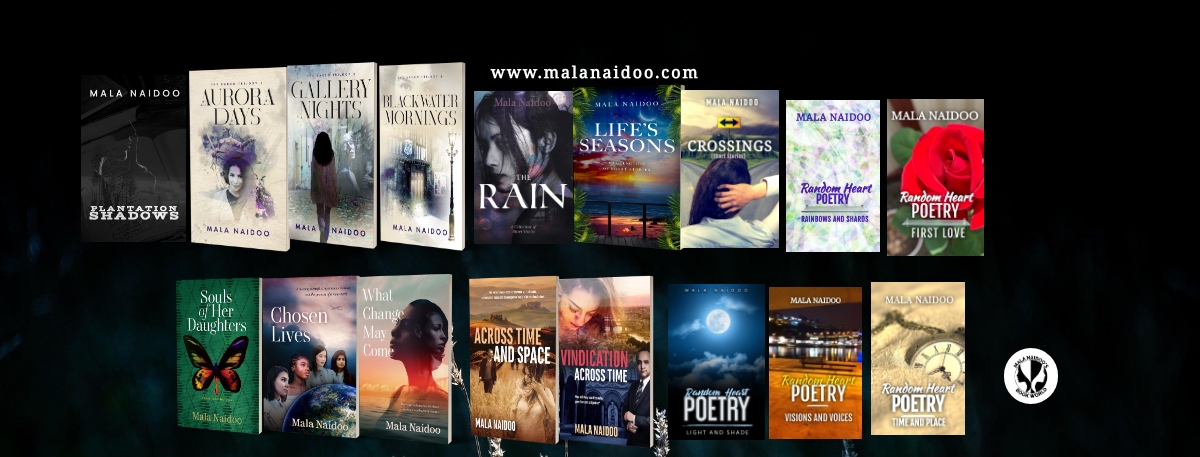
Fast-forward decades later, in another country of choice, the itch takes hold, not as a theatrical producer, but one who has started to pen fictional tales of life and its challenges, thus Across Time and Space is born.
Across Time and Space- Mala Naidoo
Such, such were the joys of childhood.
What do you remember of your childhood that lingers fondly as a defining moment? Share your thoughts below.
Librarians are Writers’ Greatest Allies in their Ability to Influence the Joy of Reading
It gives me great pleasure, today, to introduce you to Fiona Sharman who has kindly shared her passion for her favourite books. One of Fiona’s favourite quotes is from ‘Pride and Prejudice’, when Mr. Bennet says, ‘for what do we live but to make sport for our neighbours, and laugh at them in turn?’
Fiona Sharman
Fiona works as a Teacher-Librarian at an all-girls’ school in Sydney but her friends think this is a cover for her slight obsession with reading and the beauty of well-crafted language. She came to librarianship by way of a background spent teaching English and History. Fiona is a passionate educator who loves working with and supporting young women but horse riding, sailing, traveling and generally seeking new adventures are what she enjoys when she’s not at work. Actually, books frequently accompany her on these adventures (except the horse riding) and her memories of great reads are interwoven with memories of great travel experiences – Lucky Jim (Vietnam), The Blind Assassin (India), The Fishing Fleet (sailing in Burma)… you get the idea. The historian in her is committed to non-fiction especially biography, the nature-lover is devoted to landscape memoirs, the feminist loves strong female protagonists, and the English teacher appreciates beautiful prose in whatever form it may come.
Here are ten of her all-time favourite reads and why she loves them.
1. Jane Eyre by Charlotte Bronte
The original, timeless, strong female protagonist. Bronte’s use of narrative voice captivates the reader from the first page, be they 14 or 40 years of age. Anyone who has ever felt like an outsider can relate to Jane and will champion her independent spirit.
2.The Blind Assassin by Margaret Atwood
I LOVE this book. Atwood is a genius but it’s also the time period, characters, split narrative, suspense and tightly controlled plot-line that won me over hook, line, and sinker.
3. The Shepherd’s Life by James Rebanks
This is so much more than a memoir account of a Lake District farmer’s life. Rebanks captures the history and beauty of the Lake District, the relationship between those who live on the fells and their environment, and contemporary conservation issues. Beyond this, Rebanks celebrates the richness of cultural traditions and humanity’s deep connection to the cycles of the natural world. He positions readers to ponder the value of informal education and knowledge in relation to more formal education systems. Pheww…
4. A Fine Balance by Rohinton Mistry
I once read a review of this book where the reviewer exclaimed that they ‘felt sorry for anyone who hasn’t read this book’. I am not sure I can top that. Without spoiling the story, the title is a nod to the invisible line between hope and despair and it is a deeply humane story. It’s beautifully controlled narrative is set against the backdrop of the ‘Emergency Act’ of Indira Gandhi in 1970s India. Personally, I genuinely enjoy and have studied Indian history (which clearly helps) but this is a stunning book without needing to know its political context.
5. The Human Stain by Phillip Roth
A compelling story set against the background of the Clinton-Lewinsky scandal of the 1990s. While Roth’s characters are clearly flawed, it is his deeper commentary on the prejudices of the broader society that are exposed and questioned in this book. The title is also fabulous as it works on so many levels, literal and metaphorical, throughout the story. A very thought-provoking read about individuals and the societies that determine their fate.
6. The Painted Veil by Somerset Maugham
When people ask me what I mean by ‘beautiful prose’ I usually say “Somerset Maugham”. I ADORE this man’s ability to capture in a few words or lines an entire era, its values, prejudices or (merely) the essence of human experience. I love that Maugham created female characters (like Kitty) who expose the injustices of patriarchy in real but subtle ways. I read this book (not all of it) curled up in the gorgeously excessive Victorian style Hopetoun Tea Rooms in Melbourne’s Block Arcade. The staff was so lovely that I was able to keep my table for lunch through until afternoon tea (this place usually has a queue outside all day every day). It was a total sensory indulgence – between the food, the décor and this exquisite novel. Bliss.
7. Six Degrees of Separation by Paul Guare
This play is profound in its simplicity. Inspired by true events it uses a dual-sided Kandinsky painting to expose the superficiality of an extremely affluent family in New York. Metaphorically, I’ve come across a number of ( the main character) Ouisa’s in my life but she is the most aptly drawn example that I’ve seen on the page. Constantly over-dramatising her own existence whilst simultaneously diminishing the real suffering of others, Guare uses Ouisa to show readers the starkness of the socio-economic divide and the misplacement of Western materialistic values.
8. Vile Bodies by Evelyn Waugh
No ‘best’ list of mine could be complete without acknowledging Evelyn Waugh. His satirical style is a delight as he captures the excesses of the 1920s and the Bright Young Things. Irreverent and fun.
9. The Last Painting of Sara de Vos by Dominic Smith
This contemporary novel asks the moral question of whether mistakes made early in life should be paid for later, regardless of how much the individual has striven to make amends for their misjudgement. Set against the world of art, Smith’s narrative cleverly links Renaissance Europe to 1960s New York to contemporary Sydney. An engaging and suspenseful read.
10. Burial Rites by Hannah Kent
I wanted to give a ‘shout out’ to this very talented Australian author. It is not so much the subject matter that draws you in, rather it is Kent’s keen ability to evoke a foreign time, place and cultural context in such a way that the reader truly loses themselves in the story. I liked that this work was inspired by true events and that it so cleverly builds suspense and drama, right until the final chapter.
I wish you many happy hours of reading and encourage you to take a pick from Fiona’s generous sharing of her favourite books.
Please leave a comment in the message box below to start the conversation on your favourite books or add your thoughts on Fiona Sharman’s book selection.



You must be logged in to post a comment.