Keeping Histories Alive

The world is teeming with the here and now, current stories in the making with the mounting flux of national and international events and situations that drown the past as voices evaporate into the mists of time. The danger is in relegating these voices to forgotten histories when they have much to teach this time on human kindness and compassion, to obliterate the self-centred I, me and my way of thinking and behaving.

Fiction writers have the skills at their finger-tips to animate these voices through fictional recreations, Many such esteemed writers, as Toni Morrison, Maya Angelou, Chimamanda Ngozi Adichie, Elif Shafak, et al, have done so to great effect over time.


Ignorant of history, we find it easy to accept our isolation from one another. We are more able to recognize differences than shared experiences and perspectives. History proclaims our common humanity. – Author: Linda Simon


South Africa’s apartheid history has a multitude of women’s voices, women of colour – some of whom have gone unnoticed under the radar of time.

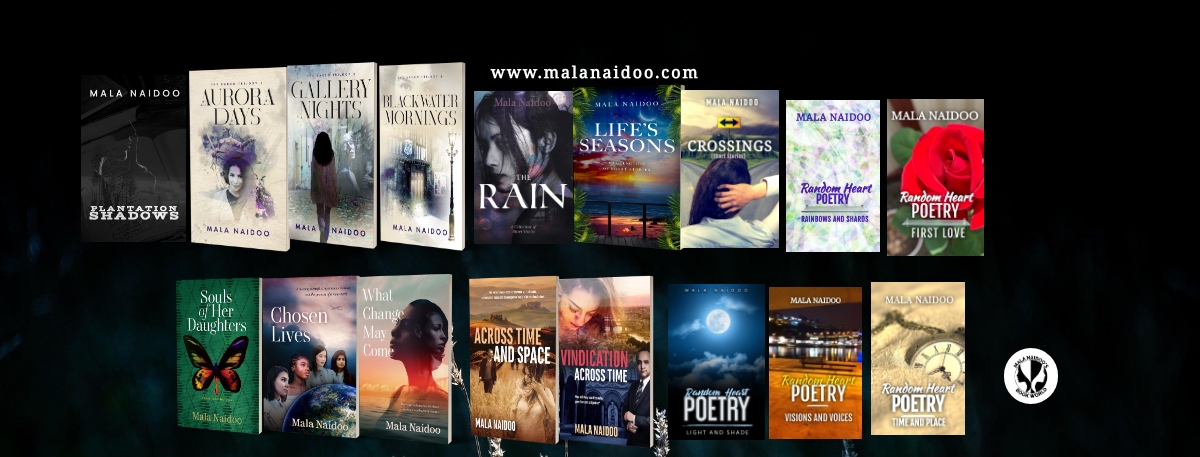
 Souls of Her Daughters arrived to highlight the role that women of colour made to the contribution in dismantling apartheid’s constructed barriers of race, sex, culture and ethnicity.

In Souls of her Daughters, two mothers, Varuna and Elsie, the mothers of Grace and Patience unite as one family when their husbands are brutally killed during the darkest times in the land’s racist history. Their daughters, Grace and Patience, become the stoic women they reveal themselves to be while fighting their own demons on sexism and abuse. Kindness and compassion pave the way forward as the personal histories of Varuna and Elsie in demonstrating their resilience under the scrutiny and accusations of racist stereotypes.


From humble beginnings both Grace and Patience emerge as women of courage, serving humanity in an international arena. Before they achieved this level of confidence they found a space where they were valued, belonged, to reach out to those struggling a similar or worse fate.

These four forgotten voices were deep, and the reach expansive that it  opened the way for two more novels to follow, Chosen Lives, and, What Change May Come. These novels that followed, Souls of Her Daughters takes the reader on a journey from South Africa to Australia, Ireland and India. The novels showcase the kindness and compassion of two sisters born from different mothers into a segregated South African society with the potential to overcome the debilitating challenges of their birth country’s political history.


Fiction has a valuable role to play in the recreated telling of stories that did not make it into the history pages of its respective time, yet these stories carry the potential to educate the here and now for a future built on kindness and compassion. These human qualities dissolve the quagmire of the human condition.


Please like and share your thoughts and ideas on the recreated fictionalised histories you would like to read.

← Back

Thank you for your response. ✨


2020 and Beyond – Voices in Literature


Diverse voices exist in literature but are under-represented in traditional publishing

The tragedy of George Floyd’s death in the United States has sparked a resurgence for the recognition of black writers. Read the rumble in the UK here on what the newly found Black Writer’s Guild has initiated.

It is shocking to note that black writers are offered a lower advance to that of their white contemporaries, and editors ask for white characters to be added to books. At some universities, students are asked to write for a maninstream audience denying  rich cultural voices that confirm that we are indeed, …one under the sky of humanity.

As an author of colour, in Australia, I faced the dilemma of whether I should create a neutral ‘non-black’ pen name to get publishing recognition. But my writing mission is, In our angst and joy, we are ONE under the sky of humanity, which does not support using a pen name and so authenticity prevailed.

My apartheid past in South Africa had stolen the right to feel comfortable in my skin or to dare to speak out against racism. Hence my debut novel Across Time and Space and the sequel Vindication Across Time, present the bald face of racism as a universal disease through my eyes. My third novel, Souls of Her Daughters exposes injustice on multiple levels.


Fear makes one believe that a name that hints at race would be bypassed by publishers and readers. Listen to the words of author Michael La Ronn who articulates the issues black writer’s face in writing and publishing. Note what he says about gaslighting 


Racism – Inequality – Injustice – Prejudice – by any name must be caught and called in the books we read, movies we watch and conversations we have


The Zulu word Ubuntu refers to the human spirit as it should be:


  • I am because we are
  • humanity towards others
  • the belief in a universal bond of sharing that connects all humanity


In my writing of multicultural stories the spirit of Ubuntu prevails.


What will you be reading and watching in the renaissance of Black Lives Matter in literature?

The movies, In My Country poignantly depicts the Truth and Reconciliation Commission (TRC) in South Africa, and Rabbit-Proof Fence, a gut-wrenching  revelation on Australia’s Stolen Generation are reminders of human atrocities that should never be allowed to recur…

From  Uncle Tom’s Cabin and beyond, voices have raised the alarm but sadly the call to end racism fell on deaf ears. Now it must be made history, an unforgotten one to remind us that prejudice is heinous and should be obliterated from the stage of life. Diverse voices that are in the main ignored, share why the human condition needs a radical shake-up.


Feel the angst, walk a mile in the shoes of the racially downtrodden – only then will you know the corrosive impact of racism.


The wound of prejudice cuts deep to the soul leaving indelible scars.


But you pick your head up, as you do, to face another day no longer silent especially to subtle bias…


In the wake of the change in 2020 and beyond, walk a mile through these suggestions to know and feel that in our diversity the common factor is that we are emotional beings with the capacity to rectify prejudice by the stories we tell and read.


Here are ten suggestions where diverse voices rip out your heart to sensitise your soul.


  1. Long Walk to Freedom – Nelson Mandela
  2. . My Place -Sally Morgan
  3. Talking to My Country – Stan Grant
  4. To Kill a Mockingbird – Harper Lee
  5. The Underground Railroad – Colson Whitehead
  6. Between the World and Me – Ta-Nehisi Coates
  7. Cry the Beloved Country – Alan Paton
  8. The Power of One – Bryce Courtney
  9. The Bluest Eye – Toni Morrison
  10. Race Talk and the Conspiracy of Silence – Derald Wing Sue


May you write and read stories that share histories to sensitise our souls to dismantle racial bias.


← Back

Thank you for your response. ✨

‘To Kill a Mockingbird’ Moment

Going to the movies for the first time was a landmark moment in many ways. Living during the ‘Group Areas Act’ era in South Africa meant living in racially segregated suburbs. Going to the Grand Theatre on the upper end of town implied being in the same space – somewhat anyway with white residents. This anticipated visit to the Grand Theatre generated tremendous excitement in a young child’s world to see, yes that’s right, ‘Snow White and the Seven Dwarves!’


Apart from being a momentous event in a young child’s life, it came as an awakening event that dwells deep in memory resurfacing with vigour when situations trigger the enlivening of such a memory.


Two queues lined up to buy tickets for the show – one ‘Whites only’ queue, the other, ‘Non- Whites only’ just as the local park benches and public toilets were labeled. This negative, exclusion labeling applied to the airport arrival and departure terminals areas too.

The stares across the racially segregated ticket purchase queues are remembered with the awkwardness and need to keep one’s eyes downcast for fear – fear that if the stare was returned it might be perceived as ‘doing the wrong thing, an unlawful act’ – such was the fear the dark child of apartheid felt.

Entry into the movie theatre, needless to say, had its separate entrance too, this time the Non-White entrance led to a flight of 100 steps up to the gallery. Non-Whites had to sit in the upstairs gallery while White patrons to the theatre sat in spacious seats downstairs. In the early teenage years, this ignited the child’s connection to Harper Lee’s ‘To Kill a Mockingbird,’ when Tom Robinson was on trial. Non-White folk who were confined to the upstairs gallery in the tightly packed Maycomb courthouse was reminiscent of the segregation at the Grand Theatre in the dark days of apartheid South Africa.

Peering over the upstairs railing from the high in the sky gallery, childlike curiosity prompted the voyeur within to see how ‘the other side lived’. Thinking back to that moment stirs the soul with sadness – the distance between the upstairs gallery, out of sight from the downstairs gallery, a hundred steps up – no stairway to heaven for an asthmatic child or aging grandparent who lovingly accompanied grandchildren on this momentous visit to the movies.
Snow White and the dwarves transported the child into a magical world leaving behind the racially divided queues and hidden away, out of view, sky-high seating.

Growing up in a racially aware, politicised home where Nelson Mandela’s release from prison lived in the hearts and minds of most adults, had a huge impact on the child. Non-White parents put aside their deeply felt grievances with grace and dignity to ensure their children were not denied the joys of seeing and experiencing the fairy tales they loved, come to life on the silver screen, albeit in a racially segregated theatre, so far removed from the reality of their daily lives.

Social justice was born from a perception of deeply felt social injustice in the child’s psyche on that very day, the day that Snow White made her debut on the big screen in a little town in South Africa.

Atticus Finch soon became Nelson Mandela of the Rainbow Nation where black and white exploded – a palette of many colours – merging in love, acceptance, kindness,  and tolerance.


Such were the days of the child’s early childhood in a country racially divided, decreed by the law of the land.


Walk away from hatred and unkindness, you deserve better, you have much to offer the world, walk away with grace and dignity to preserve your soul, walk away to love, acceptance and  kindness, walk away to a better world that awaits you…- MN

We all have stories to tell. What’s your story?


Share your story…make a difference

← Back

Thank you for your response. ✨

error: Content is protected !!