What it means to write in the long shadow of a system that ended, but never fully left.
I grew up in a world where identity was assigned before it was understood.
Apartheid taught us, from childhood, that a person could be categorised, separated and judged according to the colour of their skin. It entered the ordinary rhythms of life, in where one could live, where one could go, which schools one could attend, whom one could know, and which futures seemed possible. Yet for a child, political systems are not initially understood as political systems. They are experienced as the boundaries of everyday life.
Behind every imposed identity there is an individual life teeming with hopes, contradictions, vulnerabilities, humour and dreams.
Looking back, I realise that those formative years taught me that history is not something that exists only in textbooks. History lives inside people. It enters families through stories, silences and memories. It shapes the way parents protect their children, the way grandparents remember another time, and the way a child learns to read what is said, and what is deliberately left unsaid.
South Africa’s transition in 1994 gave writers a new country to describe, but not a blank page. Apartheid had shaped language, land, family, and memory so thoroughly that no post-apartheid author could simply start fresh. Writing after apartheid has meant writing through it; inheriting its unfinished business even while trying to imagine something beyond it.
Much of the internationally known writing from the apartheid years followed a recognisable shape from oppression, resistance, and moral reckoning. Post-apartheid authors have had to decide whether to continue that tradition or break from it. Many chose to break from it, turning toward stories that apartheid-era literature had less room for, more particular to my fiction is where personal and family history fall both inside and outside the frame of political struggle.
To write as a post-apartheid author is to hold two things at once, freedom from a system that dictated so much of what could be said, and responsibility for describing what came after it honestly. The best of this writing doesn’t treat 1994 as an ending, but rather as the start of a much longer, more ambiguous story, one that is still being written.
My early years taught me to notice the spaces between people, the invisible boundaries, the things that remain unsaid, and the resilience beneath apparent ordinariness. The relationship between memory and identity remains complicated.
Most importantly, what remains is that stories matter because people matter.
Shed Light on Narrtives that Matter
Identity is layered. We inherit histories we did not choose, yet those histories become part of the way we see the world. We inherit languages, traditions, beliefs, family stories and memories of places. We also inherit the wounds and silences of previous generations.
But inheritance does not have to mean repetition.
To tell a story is to say, I saw this. I remember this. This life mattered.
And perhaps that is what my formative years under apartheid ultimately taught me, not simply how to remember, but why remembering carries a responsibility.
The past cannot be changed. But the stories we choose to tell about it can determine how it is understood by those who come after us.
It is with great joy today that I travel on the blog from Sydney to Washington to feature the inspirational Keshni Washington who I met through an introduction from a respected and trusted mutual acquaintance. I have had the privilege of attending a virtual screening of ‘Immigrant Story Telling Night’ with Keshni Washington and speakers on the night who shared their honest, authentic, lived experiences as immigrants.
Regardless of where we reside in the world, the connection is palpable.
Author – Keshni Washington
My ten questions introduce Keshni’s life and work in Washington DC as a writer and compassionate person, living, working, and contributing to DC society with a strong connection to her South African roots.
1.What is your most vivid memory of South Africa?
I miss those perfect hot dry Joburg summer evenings, the smoke of a braai (bbq) with friends and the clear skies and stars. Along with this memory, I also miss the taste of Koo baked beans and South African mayo potato salad.
2. Did you move to Washington for work?
Yes, I was recruited from South Africa to work for an international non-profit that is based in Washington DC. I had never been to the USA before coming through for the interviews. I worked there for 8 years but have been trying my hand at being an entrepreneur for the past year.
3. When did you realize you wanted to be a writer?
I can remember composing the opening to my first book when I was 11 on the walk to and from school in Chatsworth, Durban. But I was soon discouraged and advised to do something more financially rewarding that would secure my future – I grew up in an apartheid segregated neighborhood and so being able to support yourself and others financially was a natural priority. I put away the dream until decades later in life. Coming back to it about 5 years ago, reaffirmed the feeling inside me, that this is what I was meant to do, and I know I will be telling stories for the rest of my life. I have been learning and honing my skills and now have two draft novels.
4. Tell us about your ‘Signal Fire Series’ podcast and what motivated you to do it.
I wanted to fuel my own fires of inspiration by talking to some of the people that inspire me about their journeys and glean some of their wisdom. I realized quickly that these conversations could do the same for others out there, whatever their passion. Since I have deep roots in South Africa, I decided to host conversations with both Americans and people from my first home. It has been an expansive experience, in which I have found a new admiration for every single person’s journey, whether they pursue their passion in their spare time or full time. It’s my offering, and I hope the person who needs it will find their connection and inspiration.
5. Please share your recent publishing success and writing motivation.
Published in Yellow Arrow Literary Journal
I have recently had short pieces/essays published in American literary journals: Yellow Arrow Literary Journal, Mer Vox Quarterly and Pen-in-Hand Literary Journal. I have also been fortunate to attend two writing workshop intensives – VONA (Voices of Our Nations Arts Foundation) with author Daniel Jose Older and Tin House Writing Workshop with author Alaya Dawn Johnson.
Keshni Washington’s favorite writing spaces where a cup of South African Rooibos tea is served at the Jamaican Tea Shop in DC.
Sunday street-side cafe
Espresso and mini cake
Writing at Deep Creek Lake, Maryland
Jamaican Tea Shop in DC
6. What genre do you enjoying reading the most?
This is hard to narrow down as I read just about everything. When I was young, I was obsessed with science fiction. When I got older, I gravitated to literary fiction and poetry. Over the past year, I have been reading a lot of YA as my latest novel is a YA novel, which has been a ton of fun.
7. Tell us about Tin House, and the experience you have gained/are gaining.
Tin House is an American publisher of award-winning books of literary fiction, nonfiction, and poetry; home to a renowned workshop and seminar series; and partner of a critically acclaimed podcast, Tin House champions writing that is artful, dynamic, and original.
The writing workshop consists of a series of small classes of no more than eight writers per class, so spots are limited. I got to work with the amazing Alaya Dawn Johnson. As part of the selection process, I submitted the first three chapters of my book, and these chapters were critiqued during the workshop by both my classmates and my workshop leader. All my classmates were critiqued this way. It was an invaluable opportunity for feedback and discussion. I had one-on-one meetings with Alaya and a literary agent who gave me feedback on my query letter. There were many amazing craft lectures by the faculty, generative exercises, and discussions about the publishing industry. We had the opportunity to do a reading from our work and mingled with other amazing writers attending and teaching at the workshop. It was an intense but invaluable experience.
8. When did KAMA DC start and what is your role at KAMA DC?
I first found Kama DC when I signed up to participate in their Immigrant Story-Telling Night. (where immigrants share a five-minute story from their experience on the theme of the night.) I have since stayed with Kama DC as a volunteer – part of the Storytelling team. Kama DC is a nonprofit in the DC area, run by volunteers, whose mission is to build community through immigrant-led experiences, providing a platform for immigrants to teach classes, share stories and their skills and passions to foster awareness, understanding and community. I also inaugurated and now run the @immigrantsOftheDMV Instagram feed, which is similar to Humans of New York in that we invite immigrants on the DC, Maryland, and Virginia area to do a takeover – hold the handle and share a bit about their story, home country, and experiences in the USA. It is a wonderful group of people and I am immensely proud to be a part of this mission.
9. What has been most inspirational about your semester of Creative Writing at GW?
During this semester we get to learn from published author Cutter Wood. It is focused on creative non-fiction aka essays, and how to write our true stories. As my self-study has been focused on fiction and novel writing for many years it’s wonderful to develop this different writer muscle. It is a small class of 13 people. We write a new piece every week, so I have to dig around in my memories and experiences and create something on a schedule. And the best part is sharing in class and getting to grow through the experiences and creations of the wonderful writers in my class.
10. If there is one piece of advice that you would share with young aspiring writers, what would it be?
To just start. Just write. Whether you think it’s imperfect or feel you are not ready. Just write. Put your fingers to the keyboard, or your pen to paper today, start journaling today. You are not too young nor too old. Just write. You will get better by doing, I guarantee this. But you must start, the world needs your stories.
With gratitude and best wishes to the inspirational Keshni Washington for sharing her creative journey, life and work in Washington DC.
The world is a melting pot, an ever-increasing paradise of voices that need to be heard if tolerance and understanding are to reign for peaceful coexistence.
Migrant literature, while evident through powerful voices, needs new sounds to add to the colourful history that should be shared if we are to live side by side.
Knowledge is necessary to foster understanding and compassion to move us closer to our innate humanity. Living in international communities in the 21st Century is a goldmine of multiculturalism that offers rich insights on culture and values.
What better way than to extend understanding through the literature we read and write. This could be a work of fiction, a non-fiction book, or a blog that creates connections to our neighbours near and far.
Literature is and should continue to be a vehicle that dispels ‘otherness’ or the ‘outsider’
Samantha Govender
I have for you today a reader’s perspective on what she enjoys about migrant literature in Australia. Samantha Govender, author of the blog site, Currychick – Spice it Up, covers everything from culture, history, education, lifestyle, glorious food, expat tales and more. She graciously agreed to answer my questions on migrant literature.
What is your home country?
‘I hail from the striking, picturesque country of South Africa nestled in the southern hemisphere.’
Why did you choose to migrate to Australia?
‘My LIFE AS AN EXPAT series on my blog charts that moving away from one’s country of birth is truly one of the most dauntinglife-changing experiences anybody can undergo. The crime and general political climate in South Africa were unnerving so the opportunity to move was an enticing prospect. Many of my colleagues were seeking greener pastures and Australia seemed to be offering that. When my husband finally agreed, I grabbed the bull by the horns and took the leap to leave my motherland. In a nutshell, we sought a better life and future for our two children.’
What do you enjoy about Australia?
‘Beautiful one day perfect the next.’ Truly, I do not exaggerate when I call this country ‘heaven on earth.’ I love the people, the food, and the freedom. The safety and abundant, carefree living that comes with first world living, is supreme. Australia has enveloped my family and made our move worthwhile. I feel blessed to call this magnificent place home.’
Name the three things you miss about South Africa?
‘The food ‘Bunny Chow’ (yum! read about it on my blog); the feeling of belonging and not having to constantly prove yourself; the culture in addition to friends and family that gives you a deep sense of belonging. I think only a migrant will cognize the profound need to belong.’
What is your genre of choice today? Has it changed in the last ten years?
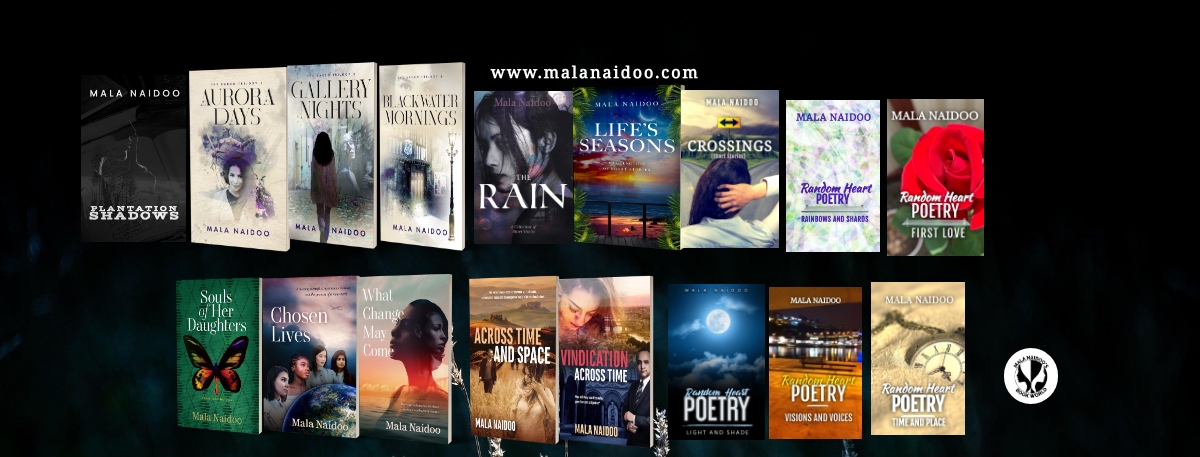
‘My job is intensive so reading is my ‘go to’ place. As much as I prefer print books, I am steering along with modern technology. Thus, I use my iPad and Kindle a fair bit to download genres such as politics, health, well-being, and romance. Currently, I am reading Shashi Tharoor’s Inglorious Empire while hankering to read Mala Naidoo’s sequel Vindication Across Time. Finally, to answer the last part of the question, I would say yes. As I have grown older my taste for more thoughtful, serious reading has increased somewhat.’
What role does migrant literature play in Australia for you?
‘Migrant literature is necessary for establishing connections, to feel you are not alone in fears, hopes, joy, cultural expressions etc. Recently I listened to acclaimed novelist Salmon Rushdie whose perspective that some literature is timeless, mirrors mine. Accordingly, I agree that migrant literature is vital in our current ever-changing society.’
Do you believe migrants should give voice to their culture and values through literature and other art forms?
‘Absolutely! I think it’s the best channel and a means of expressing our story to others. Be it a humble blog like mine or a letter to the editor; voicing our opinions as well as sharing our experiences are paramount to us being noticed and valued. The trials and tribulations in addition to the magnificent experiences migrants undergo must be heard by all. Literature and art open this communiqué giving us the ability to speak and more importantly to be heard.’
What other migrant voices would you like to read about?
‘I am always keen to try out new authors and meet people who have made life-changing choices in their migratory or other journeys in life. I recently had an insightful conversation with a co-worker from South Korea who has made Australia home. No doubt listening to and embracing migrants and their perspectives is an evolving, unending education.’



You must be logged in to post a comment.