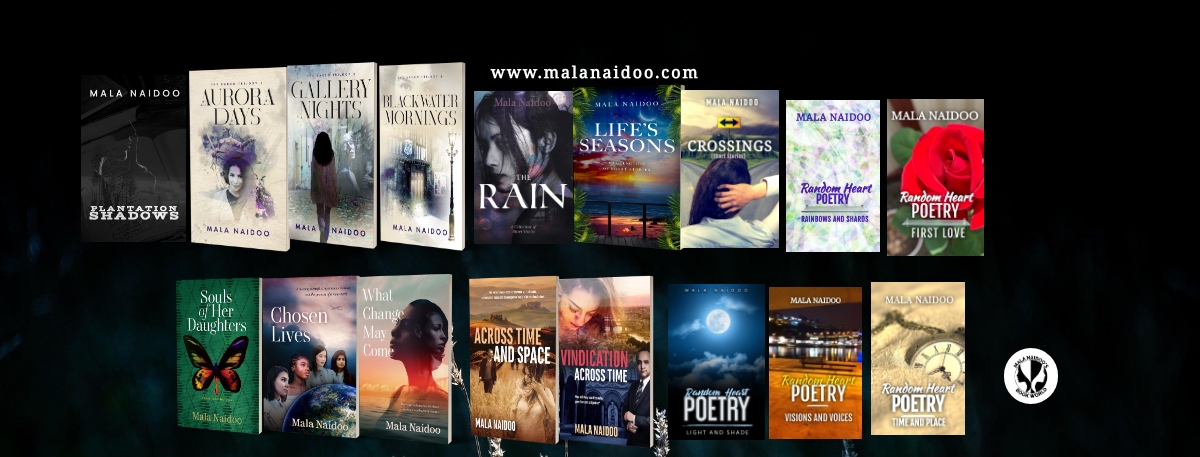
Announcement of Title

The joy of writing over several weeks and months is finally seeing the artist’s  impression in the cover design of the story that has emerged from, and lives in the writer’s imagination.


The much-anticipated sequel title to ‘Across Time and Space,’ set for a spring 2017 release (depending on where you reside in the world), is :


VINDICATION ACROSS TIME


← Back

Thank you for your response. ✨


Do You Remember The Days?

Do you remember the things you did during your childhood that defines what you do as an adult?


I remember being passionate about drama, performance and the pleasure it elicited. When I say being passionate about plays, I mean reading them with great zeal.


Growing up in apartheid South Africa on the ‘wrong’ side of the colour line meant that going to the theatre was not an option. Additionally, television had not been introduced into the country. I make reference to this in an earlier post, To Kill a Mockingbird Moment Realised, here.


I remember going to the library, standing in a long queue to add my name on the waiting list for a particular playscript I was eager to read.


One such play that is vividly remembered is Toad of Toad Hall written by A.A Milne as the dramatisation of Kenneth Graham’s, The Wind in the Willows.


Toad of Toad Hall- A.A. Milne


Growing up under the horrendous apartheid regime in South Africa makes the adult me smile at this choice. As much as the child enjoyed Rat’s, Badger’s, Mole’s and Toad’s car and caravan adventures, the deeper issues were lost in the euphoria of ‘putting this on stage’ in the apartment building of my childhood.


Actors were sourced from eager children who were hungry for entertainment during the school break. Parents were at work and no laws protected downtown children from being left at home alone with an occasional check in from an elderly neighbour- this was all an aspiring eight-year-old producer needed!


Parts were allocated and lines rehearsed over two days. Pitch, tone, movement and a haphazard choreography were based on the whim of the eight-year-old producer who ensured she donned a hat and a scarf for a theatrical edge that was akin to those seen in magazines and the Sunday newspaper.


What a time was had by all! An intermission was in place and red Kool-Aid duly served as the drink of choice in plastic wine glasses to an innocent audience ranging in years from five to ten. Mothers’ costume jewellery, ‘plastic pearls’ and hats with feathers were placed askew on little heads for attendance at this momentous production in the dining-room of my parent’s apartment.


Innocent children made their debut into the world of theatre, revelling in being transported to a magical world away from the tedium and boredom that sets in after playing all the games children could come up with during a six-week long school break.


Fast-forward decades later, in another country of choice, the itch takes hold, not as a theatrical producer, but one who has started to pen fictional tales of life and its challenges, thus Across Time and Space is born.


Across Time and Space- Mala Naidoo


Such, such were the joys of childhood.


What do you remember of your childhood that lingers fondly as a defining moment? Share your thoughts below.

← Back

Thank you for your response. ✨

School BOOK TALK

It’s with gratitude that I write this post today in respect for the invitation to speak on reading and writing at a local school whose English Faculty and Librarian are tirelessly working to foster a love for reading to encourage students to expand their horizons and improve their speaking and writing skills.


Leading up to my talk, students were asked to send me their response to, ‘I enjoy reading because…’ – a simple question that elicited some thoughtful responses from teenagers.

School Book Talk

Here are a few lines that suggest that young readers seek refuge between the pages of a book:

  • I enjoy reading because it is a spectacular and intriguing ticket to a distinctive and captivating dimension which either creates a gulp of despair or a shiver down my spine.
  • I enjoy reading because it allows me to be in two places at once.
  • I enjoy reading because it allows me to escape reality without leaving the comfort of my home
  • I enjoy reading because it allows me to broaden my horizons without having to get on a ship and sail halfway across the world…
  • I love reading because my heart is satisfied- my heart learns more than my brain can ever know- I learn priceless lessons. It’s the portal to my heart.


Additionally to complement the study of Cry Freedom I was asked to share my apartheid, South African experience on a personal level to forge greater connections to students’ appreciation and understanding of the world through the study of their school selected text.

The sharing of a terrible history elicited compassion and questions from students on how one overcomes this decimation of one’s people and identity and yet remain simple and humble, free from anger. My response was, that drawing from family values, the people one associates with and careful selection of role models will ultimately work in sync to fortify and support the entrance into light from darkness. I cited Nelson Mandela’s ideology of tolerance, acceptance, and forgiveness as the selfless way forward. This attribute shapes the crafting of the character, Marcia Ntuli, in my novel Across Time and Space.

The final message was that reading expands understanding of diverse ways of thinking, promotes exposure to varied writing styles and elicits inspiration from the unique crafting of characters and their experiences.Ultimately it’s about allowing strength to grow from fear.


I declare after all there is no enjoyment like reading! How much sooner one tires of anything than of a book! – When I have a house of my own, I shall be miserable if I have not an excellent library. ~ Jane Austen


Here’s to many hours of delightful and informative reading!

What are your views on the benefits of reading for teenagers today and into the future? Extend the conversation today.

← Back

Thank you for your response. ✨

Fear: Thy Strength

After an evening at the amazing Headlong, Nottingham and Almeida Theatre production of 1984, the timeless warning of the danger of unchecked power and the futility of resistance invited thoughts about the state of society in other areas of power, control and fear.

The passive aggressive comment, the staring down to intimidate, the proclamations of intellectual superiority, cultural, religious or racial bias uttered from a monocultural, bigoted point of view instils fear in the targeted individual, reverberating with the mental torture Orwell’s character, Winston Smith undergoes.

Sleepless nights, dreaded days, endless bouts of nausea, skulking in the shadows away from penetrating eyes, questions about questions.

The long day’s journey into another sleepless night becomes relentless. Guilt, self-questioning and a whittling away of self-confidence reeks of the fascism of workplace politics.

Competitiveness of the narcissistic ladder climbing co-worker or the sadistic joy in pulling others down is yet another corrosive dimension of inhumanity.

Systemic torment dims the light of the once vibrant, optimistic individual, the light is interrupted as dark days take over. Winston Smith tried to hang onto the waning light in Nineteen Eighty-Four.

With every knock…

The eroded self-confidence and panic attacks sends the tormented individual hurtling into a bottomless pit of mental anguish …


Each act of power and control, topples the victim blow-by-blow…


BUT

While the message is bleak, while it might not seem possible, there is a light at the end of the long, dark tunnel, the light of strength.


Fear is thy strength when compassion and love grow from the depths of pain.
In fear, there resides hope.


Hope is the light — fiction and poetry hold the power to transform fear to courage as all struggles pass, they exist in the now—the page turns as truth lifts its head to the sun. 


George Orwell predicted a future that has become a reality today, not only within the realm of politics and governance but also serves as a cautionary note to take a closer look in the mirror to decide if our souls are indeed supportive or destructive of each other.

A dark message sheds light on what should be rectified to save ourselves and the ‘unborn’, the next generation, from even darker inhumane acts.


What will you do today to uplift someone from the quagmire of human cruelty?


Share and Comment:


← Back

Thank you for your response. ✨

To Speak or not to Speak

A writing life is one of solitude if writing in crowded spaces is not conducive to creative thought.

While writing fiction might entail living within the confines of one’s imagination, there emerges the gratitude for precious moments spent with close friends and family who understand the writer’s period of ‘absence’ from the social hub. The art of conversation keeps books alive as stories unfold, are morphed and recreated to generate hours of pleasurable reading.


Precious moments are often a coffee catch up and soulful reconnecting.


Being in the moment, in conversation with the person should be valued for the human connection with authentic people who do not pry, question only when needing honest clarification, and accept the sheer pleasure of personal engagement.


Being in conversation with someone, seeing their joy and fear, hearing their laughter and feeling their moments of distress is priceless-no mobile phone interaction or other social media platform can replicate the shared face to face rather than face-time interactions. To be able to reach out and touch someone’s hand to console them or share belly-aching laughter is the essence of human communication and interactions.


I recall some years ago being in a restaurant in LA, having an early dinner, after a day of sightseeing, when I noticed a young family, parents and two children at dinner with heads down, eyes glued to their handheld devices as they scrolled through their distractions, eating dinner in silence.


Cyberspace engagement in favour of human company is creeping into relationships, eroding the exhilaration of animated or quiet conversation between and among people. This makes those in company, particularly the elderly, for whom a virtual world does not equate with social engagement, feel ignored or unimportant.


Looking someone in the eye as they speak to you indicates you are present in the moment and responsive to what they are saying. Attentiveness says you are valued.


My idea of good company is the company of clever, well -informed people who have a great deal of conversation; that is what I call good company. ~ Jane Austen


Conversation about the weather is the last refuge of the unimaginative~ Oscar Wilde


A single conversation across the table with a wise person is worth a month’s study of books. ~ Chinese Proverb


Are we slipping further and further into an age where the only conversation we might be exposed to will be the dialogue in a novel?


Are you keeping the art of face-to-face conversation alive? Share today what you value the most about conversations with good friends and family, or if you have a different view. Please share your views in the comment box below.


← Back

Thank you for your response. ✨

Sensitivity in Stories

A post read recently suggested writing from a knowledge base and not from imaginative creations that might be insensitive if writing about mental illness, physical disabilities, emotional disorders etc. While I agree with being sensitive by not causing injury to others, art should mimic and extend reality if understanding and connections are to be formed.

The question is – does one have to proceed with caution when creating a character with mental illness or a physical disability in a novel?

The depiction becomes insensitive when it supports stereotypes, insults, separates and denigrates actions and situations the character is placed in. To create a character who overcomes a difficulty by honing other powerful skills or having amazing support from family and community to achieve goals is indeed not insensitive but rather supportive of what a cohesive humanity is – certainly a message for raising the lot of the human condition.

The foremost purpose of writing, fiction, in particular, is to entertain the reader more than to inform. However, if the writer is able to strike a balance between entertain and inform, the reader is likely to gain valuable understanding from such a piece of writing. If written without dictating what is right and wrong then sensitivity should prevail and the writer is more likely to connect with the consciousness of the reader which might motivate the reader to read more books by the same writer.

When entertainment and purposeful information are included in a work of fiction, a level of research is necessary to sustain the story to its logical, authentic conclusion. If the storyteller/writer has first-hand experience of events, social issues, illness, particular ways of thinking and behaving then research is not the prerequisite as it would be for a nonfiction book that covers specialised areas such as crime, history, science, psychology, culture, economics etc.

Research will not go amiss in fiction writing, it should add colour and depth to the story plot and character representations. When creating characters with a medical condition, research around the condition or perhaps speaking to a medical specialist on how the condition manifests will add authenticity to the story. How much research should one engage in is dependent on how significant that character is to the overarching story or plot. Striking a seamless balance between the story and research is essential to avoid having the story appear like an ‘unofficial’ handbook or textbook. Shaping characters in true to life situations are more likely to lead to an enjoyable reading experience. For the writer to create authenticity in a story, it is necessary that the purpose of writing is to entertain first and then inform on matters that pertain to character and plot.

The writer has to give voice first to what he or she is passionate about. If one is to expose the harsh reality of particular situations prevalent in society, then that which makes the reader uncomfortable is equally necessary. We bandy around that we need to be ‘moved’ for change to occur – to be ‘moved’ is either happily or unhappily so, with joy or sadness. If we are to be catalysts for thought change through writing fiction or nonfiction books, it should come with some thought-provoking messages – George Orwell’s Nineteen Eighty-Four might leave readers either grateful that they have control of the decisions they make in life or it might result in a re-examination of whether they are indeed free.

Fiction and nonfiction books are of equal value to the reader when they create thought change or thought searching connections.

What do you think? Should sensitivity be at the heart of all our writing? Should the writer entertain, inform and shock the reader?

I would love to hear your thoughts. Please comment below.

← Back

Thank you for your response. ✨


Wellness While You Write


Everyone is a writer- authors, students, teachers, business executives, talk show hosts, journalists, doctors, lawyers, engineers and the list goes on. Some of us write for longer periods in our day and others in short spurts, depending on what you do and want to achieve from your writing.

How do you take care of your energy levels, nutrition, body and mind, when writing pins you to your desk for most of your day?


When the writing muse comes calling, all else is forgotten, the writer lives in the space where ideas unfold upon ideas, time stands still. 


Often writing in the comfort of our own space can lead to poor eating patterns. This might seem like common sense but we need to be reminded to sustain ourselves for the long haul. Writing is mental, creative energy that needs sustenance – yes sustenance – I don’t mean food for the soul – that is important, but, you need good wholesome food, first, before the reward food if it’s your choice. Do you keep a jar of lollies at your writing desk?

Here’s a strategy for a healthier writer body and mind:

If you start your day at 5 am and head to the kettle for your coffee fix. Stop. You need to sustain your energy for the duration of your writing day/ hours.

Try this for three days and note the difference.

  •  fill a jug with water, slice half an English cucumber or a whole Lebanese cucumber, and add it to the water.Cucumber is a source of vitamin B. Leave the skin on and you add vitamin C to your drink which is much needed to ward off colds with winter advancing in this neck of the woods. A dash of chopped mint is optional but a great herb to add. Adding a thin slice of lemon will pack on more vitamin C.
  •  while the water, cucumber, and mint infuse,  get in a few back stretches while standing in the kitchen and a few more cat stretches on the carpet or exercise mat if you have one readily available. Arching and relaxing your back will serve you well for a day or hours in your writing chair.

Now for the refreshing drink:

  •  a tall glass of cucumber-infused water should be sipped while standing up – only because you will be sitting in your chair for an extended time. Keep the blood flowing like you would on a long haul flight.
  •  having that cup of coffee should come after the cucumber infused water which would have energised you by now, clearing the mind, cleansing and oxygenating the blood. The antioxidants perform their magic. Cucumber is an anti-inflammatory food which might aid with swelling feet if you are prone to this after hours of sitting at your laptop.It might help your aching fingers or wrists after hours/days of typing too.
  •  if you are an exercise junkie, (if you can fit that in with your writing schedule) and need your morning run, eat a banana before you head off.
  •  now for breakfast, you’ve stretched, cleansed, had your coffee treat or banana and run, what should your choice of breakfast be before you hit the writing page?  

Here are some options depending on whether you are vegetarian, vegan, gluten-free, lactose intolerant or diabetic etc.

  •  a small slice of fruit, if you had the banana, skip this step, – a small bowl of rolled oats will sustain you for hours of writing – if you prefer eggs – poach them and eat with a slice or two of lightly grilled tomato.
  •  If you have avocado on hand, a slice will add to a healthy mix. Limit bread to wholemeal/gluten-free if you are going to have a slice of toast.
  • take your jug of cucumber infused water and leave it close to your writing desk to sip at will – why should you do this? It hydrates you, keeps you clear-headed, mentally alert and the bonus is you will be forced to stand up to walk to the toilet! 

As writers, time does not exist when in the creative maze of writing, two hours may seem like twenty minutes. 

You might ask, what about lunch and dinner?

      A light lunch perhaps, a topping of your choice (no to jams and spreads) on wholemeal or gluten-free crackers or bruschetta followed by a cup of green tea. Dinner could include grilled or steamed vegetables, fish, or any lean protein of your choice with a salad, followed by a cup of herb tea and perhaps…perhaps… a tiny treat of your choice.

Here’s hoping this works for you as it does for me, if you have suggestions on how you remain well and sustain yourself on your writing days, please share by writing in the comment box below.


Wishing you many healthy, happy writing hours!

Please share how you maintain a healthy desk-bound body, mind and spirit?

← Back

Thank you for your response. ✨


Authenticity

We want to believe.

We crave loyalty.

We need assurance.

We are human after all.

  • In creating characters in fictional tales, those that resonate with the reader are the characters who are either perceived as most authentic in their expressions of truth or deception.  Literature mirrors the fabric of humanity highlighting concerns on the human condition creating understanding and connections with the reader. Readers want to identify with characters in the books they read to keep hopes and aspirations alive.


  • In conversation, the following were identified as underpinning the expression of authenticity

#  motives,
#  relationships
#  sincerity

What does it truly mean to be an authentic person?

Fifteen character components that I identify as essential in this quest for personal authenticity or that which you create in your characters could include:


  • being true to yourself first before you can be true to others
  • going it alone even if you are the only person in the room holding a different view
  • saying you can’t do it anymore or that you need assistance
  • risking friendship by saying you feel used or need to be heard.
  • being proud of one’s origins, culture and values
  • acknowledging the presence of others
  • being comfortable in your own skin
  • being truly happy for others in all they accomplish
  • embracing diversity/ withholding judgment on race, culture, religion, sexual orientation, disability, political affiliation, socio- economic standing
  • greeting with a smile that extends from the soul to the eyes to the mouth
  • upholding the truth as it is
  • not allowing fear to govern choices
  • protecting vulnerability rather than exploiting it.
  • reaching out to those in need even if you don’t have enough for yourself
  • striving to be the best version of yourself.


How Difficult is it to be Authentic?

It does not require one to renounce worldly aspirations nor live like a saint or hermit.
Being authentic is simply being you, not a carbon print of someone else or living up to the expectations of others.


If you are always trying to be normal you will never know how amazing you can be- Maya Angelou

To be yourself in a world that is constantly trying to make you something else is the greatest accomplishment.- Ralph Waldo Emerson

There is nothing more rare, nor more beautiful, than a woman being unapologetically herself; comfortable in her perfect imperfection. To me, that is the essence of true beauty.- Dr. Steve Maraboli


Should your brave new world of being true to yourself be feared?

Only if you lose – your way – yourself – in a sea of manipulation and deception. The character, Meryl in Across Time and Space undergoes a steep learning curve to emerge as…I leave you to find out…and the sequel will reveal more.
When you are surrounded by authentic people, you feel the positive vibration around you. This energy allows you to flourish. Separating the wheat from the chaff comes with life experience as you glide towards the true, the real you.


Here’s to creating enhanced versions of ourselves and the characters we create

Like, Comment and Share.

← Back

Thank you for your response. ✨


Energising Creative Thought


Here are a few practical suggestions to a question posed this week which is a significant and very real concern:

‘How to centre yourself and clear your thoughts before writing?’

  • The time of day when your energy levels are high and you are rested is a good time to sit down to gather your thoughts.
  • Have a plan for what you hope to achieve for that particular writing session- is it a paragraph, a chapter or some research on a new idea? I have a skeleton plan of what I would like to create in my chapters- this is done through dot points which help to structure my thoughts that I build upon as I write.
  • Keep a journal on random thoughts that emerge each day.


  • If gathering your thoughts hits a roadblock, try this exercise:
  1. Look around the room you are in – what object catches your eye, write a brief description of that object using as many sensory images as you can come up with – visual, auditory, olfactory, tactile.
  2. Consider why you might have been drawn to that object – Colour? Shape? Associated memory? Who was the person who might have given you the object or where and when it became yours?
  3. Write a paragraph on the size, shape, colour, ownership and memory associated with the object.
  4. Record your thoughts, in your phone or other recording device, by speaking about the object first,  then write them down as you hear it on your recording adding on  the ideas as you go.
  • If this does not spark your creative energy, pick up a book, turn to any page and read the first line – stop – absorb – now write down what you think might happen next.
  • A quiet space, undisturbed, gives voice to your thoughts to pick up the pen or tap on your keyboard, a quiet space will lead to thoughts being centred where the noise of a crowded space might distract  creative thought. This also depends on whether you can work with complete stillness, as I do, you might find a bustling coffee shop, as the protagonist, Meryl,  in my novel, Across Time and Space, does suitable to creative thought  if undisturbed by intrusive newcomers like the infamous, ‘roving professor’.
  • Once you find the space that is conducive to creative thought, tune into your inner clock, establish a rhythm to clear and centre your thoughts. If this does not happen in one sitting, go back later, or the next day – persistence and consistency is the key.

The most potent muse of all is our inner childStephen Nachmanovitch 

Happy Writing!


← Back

Thank you for your response. ✨


Is Commitment on Your Agenda?

Across Time and Space explores commitment in relationships in romance, friendship and family relationships. Whether or not it leads to the commitment of, ‘I do’ – commitment is a primal need in relationships for one to feel valued. The protagonist in Across Time and Space has been in a relationship for a length of time, a comfortable, complacency envelopes the relationship creating restlessness that becomes the catalyst for unimagined challenges.

This begs the question, does commitment mean unstinting devotion and loyalty akin to ‘til death do us part?’ The answers are vast and varied depending on the values one has embraced or formed.

Being raised in a time and place which instilled that a promise of commitment meant fulfilment of that promise on a nominated, ceremonial day which comes with its own merits and flaws. This might be considered ‘old world’ or fit for ‘Cinderella and her Prince Charming’, yet the expectation is that couples will unite or commit in a way they deem appropriate to both of them. Yes, the operative word is both – not ‘one’ making a decision, on a whim, that life’s path has beckoned a change for ‘one’ without consideration for how this might impact on the other half of both. Such is the life of the protagonist in Across Time and Space and her partner – good people in their own right who buckle under the fear of commitment, fear for the loss that might be incurred in all that has yet to be achieved in life.

This leads me to why should commitment be feared as the end to individuality and relinquishing of one’s dreams? Commitment should encompass all spheres of one’s life in relationships: singular and joint dreams, commitment to professional ideals and commitment to going off on a whim if its one’s choice to do so by acknowledging that both need to be aware of such changes. Meryl, in  Across Time and Space will clarify the choices she makes to catch the star of her destiny that she feared might never be realised in her lifetime.

Commitment can have its dark and dangerous side when passion overrides reason. This brings to mind Catherine and Heathcliffe in Emily Bronte’s Wuthering Heights where both are inextricably and destructively hemmed to each other. Stepping outside literature as we turn on our televisions to the reality of the evening news or an online article on domestic violence which results from unhealthy commitment which is power and control. Supposed commitment, commitment without reason creates a dark, terrible and often tragic situation.

Commitment in family relationships be it as mother, father, grandparent, carer or extended family member should be based on trust, approval, open communication and support from love shared  to promote good mental health.

Love, respect and freedom of choices are a right that should not be debated, it’s a basic human right – a human right that should acknowledge commitment to respectful consideration through communication  before heading off alone into the sunset.

Commitment to values  includes commitment to the values of place, the place we call home – the country- the city- the street- our backyards. It is often those who cannot commit on a personal level who cannot commit to democracy, justice and a fair go.

Reason should always caution passion, dreams should be lived for peace and joy to reign for both halves in any relationship and for all in our choice of place that we call home.

What’s your take on commitment to all things in life?  I would love to know your thoughts.

Please Like, Share and Comment

← Back

Thank you for your response. ✨

Women You are More

It was a good week reading and hearing the voices that speak up and out about acknowledging women in literature and in every professional, political and social sphere. The momentous global Women’s Marches this year are indicative that times have indeed changed, however, silence or ‘Feminism Lite’ as warned by Chimamanda Ngozi Adichie, subvert the right of a woman to proudly be herself, to be seen and heard for what she believes is good for her.


Women Helping Women                     


Ironically the media on this day, 10 March 2017, has reported, much to the chagrin in many quarters of society, that stay at home mums,  are draining the country of much-needed skills. This understating of the role stay at home mums play in raising children, raising the next generation to be upstanding citizens and contributors to the world of tomorrow is questioned and frowned upon as not making a valuable contribution to society and hindering the economy?

This says that the War of Women against such opinions, studies and other such claims is an ongoing battle. Margaret Atwood’s states that The Handmaid’s Tale is more relevant than ever and Jude Kelly, theatre director and producer enlightens in a TedWomen talk on  ‘Why Women should tell stories of humanity’.

                                                            ***

My Tribute to YOU

  • YOU are amazing in all you juggle in your day
  • YOU are amazing in the boundless energy and strength you demonstrate
  • YOU are amazing for your selfless dedication to your profession, family, friends, community
  • YOU endure each day with no complaints with an ever-ready smile for others
  • YOU are the rock when things fall apart
  • YOU are kind, generous and loving
  • YOU are SPECIAL –  NOBODY can take that away.

                                                           ***

 I leave you with two powerful messages from MEN on the significance of YOU

THE HAND THAT ROCKS THE CRADLE IS THE HAND THAT RULES THE WORLD.

BLESSINGS on the hand of women!
Angels guard its strength and grace.
In the palace, cottage, hovel,
Oh, no matter where the place;
Would that never storms assailed it,
Rainbows ever gently curled,
For the hand that rocks the cradle
Is the hand that rules the world.

Infancy’s the tender fountain,
Power may with beauty flow,
Mother’s first to guide the streamlets,
From them, souls unresting grow—
Grow on for the good or evil,
Sunshine streamed or evil hurled,
For the hand that rocks the cradle
Is the hand that rules the world.

Woman, how divine your mission,
Here upon our natal sod;
Keep—oh, keep the young heart open
Always to the breath of God!
All true trophies of the ages
Are from mother-love impearled,
For the hand that rocks the cradle
Is the hand that rules the world.

Blessings on the hand of women!
Fathers, sons, and daughters cry,
And the sacred song is mingled
With the worship in the sky—
Mingles where no tempest darkens,
Rainbows evermore are hurled;
For the hand that rocks the cradle
Is the hand that rules the world

-William Ross Wallace (1819-1881)


As long as outmoded ways of thinking prevent women from making a meaningful contribution to society, progress will be slow. As long as the nation refuses to acknowledge the equal role of more than half of itself, it is doomed to failure.

– Nelson Mandela (1918-2013)


Please Like, Share and Comment

← Back

Thank you for your response. ✨

Fertilising the Imagination

When access is denied, imagination provides fertile ground for creativity.

The absence of television in apartheid South Africa was strategic, to keep the masses ignorant regarding democracy and justice in a bid to thwart the emerging voices of resistance. Avid reading and listening to the radio for recreation offered many hours of joy in a world where outdoor games were limited in apartment blocks.


Born in South Africa  during the height of the apartheid era meant that I had a childhood devoid of a television set in the family lounge room. The only ‘moving pictures’ apart from the local cinema were those created in my imagination.


Radio held its own fascination with the popular weekly, Friday evening, crime fiction episodes of, Squad Cars. I listened intently, forming images in my mind about places and situations in each episode. My rite of reading passage into the world of crime depicted through voices and sounds grew each week. Crime/Detective/Adventure fiction in children’s books from the Famous Five series to Nancy Drew, The Hardy Boys and ultimately Agatha Christie’s and Edgar Allen Poe’s short stories were hunted down each week at the local library. Visions of snaking queues of children lining up, thirsty for their favourite book is imprinted in my memory. Such were the days…

After school radio programs for children were eagerly anticipated, excitement gained momentum with the chatter of voices speculating what  Noddy (by Enid Blyton) would be getting up to and whether Mr. Plod, the policeman’s kind and watchful eye over Toyland would save another day. Empathy for the skittles who did not seem to care whenever they were run over, filled my waking and sleeping hours. The imagination was ablaze with stories that wove into the stories of my mind’s eye. The imagination was fertilised with self-created images of places, characters, and events. An emotional investment of compassion for those who struggled or were mistreated and revulsion for those who harmed others was set in motion.

Listening and reading awakened the inner being as fodder for the imagination in the years ahead in the creation of my own stories – in the adult years, I turn back to my own voice recordings of my reactions to places I have visited, places that I have been moved by, to mulch and refresh an evocative sense of place through the voices and visions of my characters.

Audio books are a blessing, like reading is, to supercharge the imagination for a personal take on people, places, and events that ‘moving pictures,’ with all its commendable grandeur, might not quite fuel.

‘Logic will get you from A to B. Imagination will take you everywhere’- Albert Einstein

What do you think?

← Back

Thank you for your response. ✨


error: Content is protected !!