As 2020 dawns it will be remiss not to look at the world that is changing before our very eyes.
Through Australian eyes, sadly, the ongoing bushfires have encircled our lives affecting health, and mindset with loss of human lives, homes, fauna and flora — this impacts the creative soul and spirit which is closely aligned to the natural cycle of life. There is an unease that wants answers and quick solutions to a problem that has been steadily growing.
As we cry, ‘climate change’ — it is more about necessary unified ‘human change’ to rectify that which ails our burning country. Change can be initiated by ongoing fostering of awareness that we all have a part to play to improve the state of our country, the world and subsequently the human condition. As writers, this awareness becomes a moral obligation, as I see it. Books/stories are valued for the message/s they extend to make us aware that our angst is a global issue.
Natural disasters multiply around the world causing human decimation, yet the power to minimise this rests in human hands. I draw the analogy to writing, the creative arts — the passion exists, but a huge effort is required to produce quality art — passion without persistence is naught.
Literature today will speak into all our tomorrows about human negligence and irresponsibility in the quest for more. Like the wars of the past and those that exist in the here and now, it is a time for soul searching and a coming together to rectify that which has gone awry. Like editing a manuscript, we cannot take out without replenishing with good, better, and best to improve the story, poem, or essay — likewise, constant extraction from the earth must be restored.
Healing is not a band-aid fix to the problem — it takes a mammoth collaboration of all sectors of society to reach out and do what is necessary — cut back on all forms of pollution/emissions for a purer balanced tomorrow.
It’s never too late to begin afresh if it matters, like revisiting a manuscript to cleanse, to be rid of that which is not necessary, to clear the waters for something brighter, purer, clearer and better.
Let’s make the 2020’s a healing decade of body, mind, spoken and written word, the spirit, relationships and heal the earth we live on and from.
All positive contributions matter — raising one life, saving one wild animal or property is the beginning of survival from extinction by fire or other natural or human ills that befall the planet.
As we look forward to a bushfire-free future, let us remember we all have a part to play to save this beautiful land we call home.
Have a safe and happy entrance into the next decade. May it be filled with many blessings.
May peace abound and the earth receive the blessing of rain, may poverty and pain diminish.
Today I turn the spotlight on South African Author Vash Karuppa whose debut novel DESTINY FOR LOVE ARRANGED is a favourite among readers in South Africa and abroad. Her novel captures the cultural significance of life, and the command and necessity of love in a voice that connects the reader to place and culture and the understanding that the heart is not entirely self-directed.
Synopsis: Destiny for Love Arranged:
Destiny for Love Arranged is a contemporary, gripping and angsty, second chance Indian romance that reveals the love of family and friendship bonds during trying times. All protagonists are of South African Indian origin.
The story revolves around Aariyan Ranjan, a highly successful CEO of a Hotel Empire and Varini Iyengar, an Oncologist, both are forced into a temporary marriage of convenience to help them resolve personal dilemmas.
Not because it had anything to do with his heart he thought stoically…, but because it suited his purposes…
While Aariyan is determined to treat their marriage as he would any other business deal, love rarely listens to logic, and what follows is anything but business. On the other hand, Varini soon finds herself gravitating toward and rejoicing in the love she thought lost forever with a hidden hope that their marriage of convenience will end in a union of everlasting love. The story is embedded with cultural anecdotes familiar to any family of Indian origin. It takes their family, friends and a life-threatening situation to show them the love they lost is worth fighting for.
In short, this is a story about family, friendship, and starting over, as Aariyan and Varini embark on a journey toward a second chance at love. You will get to share in their moments as they discover that vulnerability can be their strength and the most perplexing problems can be overcome with the support and resourcefulness of a loving family and faithful friends. This is Book 1 of a trilogy.
About the Author
Vash is a South African author of Indian origin who has been a bookaholic from about the age of five. Her addiction for books grows exponentially daily, so after spending years concentrating on her role as a corporate executive and a short stint as an entrepreneur, she decided to unleash her number one desire i.e. a passion for writing. Whilst books of most genres interest her, it was romance that captured her soul. Her writing portrays the lives and drama of ordinary people who readers can easily relate to. The crux of her stories celebrates the power of true love coupled with the timeless bonds that exist between family and friends while capturing the true essence of diverse cultures.
Vash Karuppa is a member of the Romance Writers Organisation of South Africa (ROSA)
What inspired you to write Destiny for Love Arranged?
For many years I have read articles around the call for diverse romance novels that incorporate multi-cultural aspects into a traditional romance plot. In addition, I’m a hopeless romantic myself and always had a plot in my head around a story that integrates family and friendship bonds (which I have been blessed to have throughout my life) together with a typical romance story.
When I eventually decided to put pen to paper, it all just naturally came together, giving birth to Destiny for Love Arranged. Finally, I am aware there aren’t many novels written which share intricacies of the South Indian culture and I was determined to write about it. Looking at the feedback received thus far from readers, it was well-received.
Have you always wanted to be a writer? How long did it take you to write your novel?
Being a passionate romantic and voracious bookaholic, reading was a drug to which I had an instant addiction, one that only grew with time. While books in all genres interest me, it was romance that I was drawn to. From as early as my pre-teen years, I loved the ‘happily ever after (HEA)’ syndrome hence my love with any book in the romance genre, and later as a teenager with a dream of writing my own HEA story.
Writing a novel has always been part of my bucket list, so, after spending years concentrating on my role as a corporate executive, I eventually unleashed my number one desire and passion for writing with Destiny for Love Arranged
I didn’t really plan on publishing my work though, because I started writing for my own fulfilment. However, when a few of my friends read the script, they encouraged me to consider publication and so it happened….
The hardest part of completing the story was not knowing how to stop. I had so much more to tell but owing to publishing rules on limited word count and reader expectation of the length of books I had to cut out a lot from the original script.
What’s your typical writing day like?
Owing to a “day job”, I tend to confine my writing to nights for at least 2 hours a day in the week and whatever time I can hijack on the weekend.
My best writing is done in a quiet space in my little apartment directly next to a window where I can have the warmth of the sun and sounds of chirping birds to keep me company while writing.
Who is your greatest source of inspiration?
My 92-year-old maternal grandfather has undoubtedly been the inspiration behind my love for writing. He taught me how to read and then introduced me to the word of writing through the books he wrote and is still writing might I add.
What are your future writing plans?
Books 2 and 3 of the Keshavam Industries trilogy is almost complete and will be released between December 2019 and February 2020.
I have a new series planned for the rest of 2020.
Destiny for Love Arranged is on Amazon for your reading pleasure.
People ask, ‘so how does one complete a novel?’ The simple response is, ‘write every day.’
Fifty words on a page are better than a blank page.
Consistency is key and if for whatever reason writing is impossible on a day, double up the output in the next writing session. Perhaps not all in one go, divide the writing time to two sessions if possible, on a given day that fits in with what is already on your plate.
Carpe Diem!
Writing more is by showing up, at a regular time, bottom on the seat, minimal distractions or no distractions at all. Commit to a solid ninety-minutes, then change the activity, but if the juice is still flowing go back for another session.
Blocks of time, free of distractions is essential to see a creative project to completion.
write to the rhythm of the car wash
writing relaxation at the hairdresser
writing on a train ride
Ways in which to maximise creative time is to have a notepad/journal at the ready wherever you are. I have A5 journals in my handbag, workbag and pencils stashed in every pocket. Sitting in the doctor’s or dentist’s waiting room, or with colour in your hair at the hairdresser, or as I do, while sitting in the car at the car wash, scribble a few lines to keep the momentum of your story going. Watching soap suds gyrate in a splash of colour stirs the imagination! Back at your desk, if that’s where you prefer to write, draw those mini journal creative thoughts into your WIP manuscript.
Having word count goals helps to hold one accountable. My target is to finish a chapter at each writing session, if possible, or to leave a trigger sentence for the next writing session, to pick up the pace, action and momentum.
Caught in a roadblock? Pull out a notepad and write, if you can’t take your eyes off the road, audio record your verbal musings — now traffic cops, I dare to say, have not come up with traffic fines for the some time… somehow writer at a standstill in a roadblock, NOT in moving traffic, I must add – that is a massive NO-NO! Anything that will hinder the imagination is a blaring siren and flashing lights… although a fictional high-speed chase adds adrenaline to a thriller… let me add that… to my…
Like we need our zzzz’s, we need our number of words down on the page each day.
Some like holding themselves accountable through a writing group and others prefer to create their own deadlines. Either way, commitment matters to take your draft from a manuscript to an actual book.
Courage is the commitment to begin without any guarantee of success ~ Wolfgang Von Goethe
Some have a few writing days set aside in the week and commit like it’s a job they go to for five or six hours a day. If these are the only days available, the habit is cultivated and creative productivity soars on those days. Roads trips, as long as you’re not doing the driving, is another great way to nab some writing hours, the imagination will be stimulated as you travel through various locations.
My next some time… somehow is to jump on a train and go to the furthest end of the line and back while writing. I am a desk-bound writer so this is an adventure that might or might not yield a new result. Let’s hope nobody throws me off the train for wearing heavily shaded sunglasses, a cap and seen to be furtively writing some secretive lines, perhaps on the comings and goings on each platform?
Get on that train, write at the car wash, whatever you do, do create space for your book!
Happy Writing, Happy Musing!
Carpe Diem!
Please share your some time… somehow to help others maximise writing outcomes.
Every voice like every story has its place in the world. A niche audience might be readers of a particular history, people and culture of forgotten voices. In an era that has in so many ways moved leaps and bounds forward, the opposite is true of human tolerance. Everywhere we dare to look, the capacity of the human spirit for evil outweighs the good around us, often overshadowing a multitude of voices and actions for common good.
Stories, fictional stories, even if thematically dark demonstrates the human capacity for change. Fiction has had and continues to have the rite of passage to dismantle oppressive notions of the wicked side of human nature.
At the Sydney Writer’s Festival last week, the festival theme, ‘Lie To Me,’ resonated with memories, of the apartheid era where race and power/powerlessness named and played the game, and understanding of the impact of assimilation on the stolen generation. An evening of storytelling affirmed the need to keep telling our societies’ truths to dispel the mistruths in the media, in politics and the use of social media as a tool to denigrate.
Forgetting past atrocities in no way heals the human condition. It’s a double-edged sword — remembering keeps the pain alive, but alive in recall that has the potential to thwart such heinous future acts. To quote Descartes, ‘I think therefore I am,’ is significant, but must be married to, ‘I feel therefore I am,’ and what better way than through a fictional story that ensures that the movement towards human value for all lives, does indeed matter.
Those who cannot remember the past are condemned to repeat it. ~ George Santayana
Cultural stories of forgotten people hold them in conscious thought, remembered as life lessons to pass on to the next generation. While such stories might have a micro niche audience because they tell of the far-flung corners of history, they must be told.
Lines from Vindication Across Time sees the character Marcia Ntuli telling Michael Morrissey, a human rights lawyer about her mother’s hardship as a single mother under the apartheid regime.
Mama Dolores…the police would barge into our home and drag her to the police station for questioning. They were rough with her, they broke things in the house… kicking her in the back, calling her an evil kaffir. It was horrible. ~ Vindication Across Time.
Michael walks in Marcia’s and Mama Dolores’s shoes to gain an understanding of what preceded democracy in a troubled land. His theoretical basis on what constitutes human rights has a ‘live’ life lesson in a recount of the terror Marcia’s mother endured at the hands of the district police. This, in turn, opens the depth of understanding on what might have been misreported in historically written and spoken accounts of this era. The voices of men/women struggling on the fringes of society are left forgotten if not told through story, to entertain and awaken compassion that a history forgotten is dangerous — it lurks in the dark corners of the mind ready to be unleashed in the terrors we experience today.
The storyteller has the power to dispel untruths by telling stories that make us uncomfortable, those stories that some publishers are reluctant to put out into the world, so why wait, when a world of empowerment, without gatekeepers, awaits the telling of unheard stories.
Go tell those stories today. Keep an underrepresented history alive, in the minds and hearts of a niche audience in engaging fictional stories -stories that tell of truths that have been swept under a forgotten, tattered rug.
Share your reading that has inspired a new wave of thinking in the comment box below.
So many voices, so many stories in a country as diverse as Australia, each sharing a connection to people and place.
Today on the blog we have Rhonda Forrest, a high school teacher, from beautiful, sunny Queensland. Rhonda began writing under the pen name ‘Lea Davey’. Her first two novels, Silkworm Secrets and The Shack by the Bay were published under the pen name, Lea Davey, however her latest novel, Two Heartbeats, published October 2018 has been published under her real name, Rhonda Forrest. Having always lived in Queensland, the vast Australian Outback and the pristine Whitsundays feature strongly in her stories. Rhonda Forrest shares her story and tells us more about her writing journey.
Meet the Author
Rhonda Forrest/Lea Davey
Biography – I was born in Brisbane and grew up in Rochedale, which at the time was a rural farming area. It was a fabulous place to grow up and as kids, we spent our time playing in the bush, riding horses and living in a community where everyone knew each other. I married at the age of 21 and my husband and I moved to acreage at Bannockburn where we lived for thirty years. Along with a menagerie of animals it was here that we brought up our three daughters and made life-long friends with many of our neighbours. At the age of 40, after a multitude of different jobs and running my own business, I decided to study. After 4 years of full-time study, I graduated as a high school teacher of History and English. Recently we have moved to Tamborine Mountain and live between the mountain and a 100-year-old cottage with a rambling garden up in the Whitsundays. Both places are quiet and idyllic places to live and write.
Writing Journey – As a child, I loved reading and was surrounded by books. My mother who is 90, still to this day reads every day and as a teenager, she always handed me her books after she had finished them. Nothing was off-limits and I vividly remember being enthralled by books written by Harold Robbins, James Michener, Wilbur Smith and Jackie Collins. I used to always think that one day I would write a book, however, it wasn’t until about five years ago that I had time to seriously think about pursuing my writing. Long hours spent out on a tinnie in the middle of the ocean fishing, allowed plenty of time for daydreaming and the story of, The Shack by the Bay began rolling around in my head. Once I started writing the words flowed easily and I knew that I had found a new passion in my life – writing!
Genre – All of my books are different. The Shack by the Bay is contemporary historical fiction, Silkworm Secrets is contemporary fiction and Two Heartbeats is Romance. My favourite genre is historical fiction although I also love to read true-life stories.
Motivation – If you want to do something you should just have a go at it. I don’t think I ever considered failing, actually I don’t think about the end result that much, I just go for it. Really you have nothing to lose and once I start writing it’s hard to stop until the story is finished. The editing and parts that come after the actual writing for me are the hardest parts and I would love just to be able to write and to have someone else do the rest for me. But when this is not possible I stay motivated, buoyed along by the lovely reviews and comments I get from readers. With writing, it is not about the money that you make (because that is limited) but rather the motivation that comes from readers who love your books. One of the most exciting things is to look on the Brisbane library website and see that all 5 copies of your book are being borrowed!
Influencers – Probably the biggest influence for me in relation to my writing was the Australian author Coleen McCulloch. It was after I read her book, The Thorn Birds, in 1977, that I decided I would write a book. It took 40 years to have time to do that, but eventually, it happened.
Favourite Books – Just recently I read Boy Swallows Universe which is set in Brisbane so lots of familiar places and just a fabulous entertaining read. My Instagram page has a countdown of my top 50 books and these range from Mao’s Last Dancer to All the Light We Cannot See as well as, The Old Man and the Sea and Australian classics, The Cattle King and My Place. I have so many favourite books, but I do love historical fiction. The Garden of Evening Mists, A Good Muslim Boy and The Space Between Us are also some of my favourites.
If you want to do something you should just have a go at it
Favourite part of the Australian Landscape That’s a difficult question as there are so many parts I love. I have travelled throughout Australia and it is often the coastlines that take my breath away. Crashing waves on rugged cliffs in South Australia, white sandy beaches with turquoise waters in Western Australia, red boulders with soaring waves in Tassie and of course the familiar pristine waters of the Whitsundays, rich with turtles, whales and dolphins. Equally beautiful though is the scrubby bush with the sun searing down on it and soaring gum trees, the bark dappled and ghostly against our vivid blue sky. We really do live in the most beautiful country and I always appreciate the beauty that surrounds me, be it the rolling hills around Tamborine Mountain, the thick rainforests just down the road from my house or the hazy valley views from the lookouts up here on the mountain. I love it all and much of that love of the landscape comes through in my books.
Book Covers – Designing book covers has been a journey in itself. The cover for The Shack by the Bay comes from part of a photo that I took of a shack down in Tasmania while Silkworm Secrets cover was a painting a friend did for me. For Two Heartbeats I engaged the help of a graphic artist, Ethel Beckett, also from Brisbane, who did a fabulous job giving me exactly what I wanted.
The Shack by the Bay (Lea Davey) An isolated fishing shack on a beautiful bay in the Whitsundays provides Luke with a retreat where he can find peace and solitude. However, the discovery of family war relics and a developing relationship with the beautiful Lily connects family histories and reveals a story that threatens to destroy his chance at real happiness. Will the wartime secrets prove to be the breaking point for a beautiful romance? Or can two families put the deeds of the past behind them? Romantic and purely Australian, The Shack by the Bay captures the pristine beauty of the Whitsundays and the wartime memories of older Australians while introducing an eclectic blend of friends and family. Silkworm Secrets (Lea Davey) Ruby and Bobby are best friends who spend their spare time together in a tree house where they retreat from the adult world and share their secrets. To Ruby’s dismay, Bobby’s family life is far different from her own and when he is forced to leave home at a young age it seems that the two may never see each other again. But after many years the events of the past resurface, and as an adult, Ruby is unexpectedly faced with the gravity of their secrets and the seeking of justice. A court case forces her to search for Bobby who has not been seen since he left home as a child. Will she find him amidst the vastness of the Australian outback and if she does, will he want to return to what he has spent his entire life running away from. This is a story about the secrets that children keep, the strength that comes from a childhood friendship and a special family love that overcomes the hardships of the past.
Two Heartbeats (Rhonda Forrest) When Jess heads west for a fresh start in a small mining town, the dusty outback is a far cry from her former life in the city. Despite having no knowledge of country life, she finds herself loving the isolation and local people. All she has to do is keep her head down and work hard to create a better life for herself and Johnno, the only person she has ever truly cared about. The caring warmth of a new circle of friends allows Jess to feel that maybe, for once, her life is heading in the right direction. However, problems arise when her temper and stubborn nature collide with her new boss, Daniel, who is suspicious of her background story. Has Jess been honest, or is there a hidden secret to justify his distrust of her? Set amidst the rugged outback of Australia, with a cast of eclectic characters, Two Heartbeats is a story of friendship, resilience and the hope that ultimately loving relationships may triumph over obstacles defined by the past.
With gratitude to Rhonda for sharing her writing journey, and books with us today. Please add your thoughts in the box below:
Voice is the defining feature of any book we read. It is unique to the author and is often what draws readers to pick up a particular book, by a particular author.
Turning to influencers is a significant aspect of the writer’s professional development, but mimicking the voice of another, as in tone, values, the nuance of language, etc, minimises the authenticity and value that a unique voice offers. Just as our personalities differ, so too does voice – it has character, personality, and it becomes the signature of the writer/speaker/narrator.
Readers find comfort, delight, and excitement in the voice they read, in being entertained or informed, or perhaps both. The rush to ‘be like others,’ comes with the risk of losing purpose or creating a voice that is inconsistent with the message. Voice is a significant part of connecting with readers. It communicates values and visions drawn from life experience, culture, lifestyle, education, angst, joy, and more, as part of early, and ongoing socialisation. We are after all, beautifully unique.
The writer’s voice is delivered through narration, characterisation, description etc. In characterisation, the writer’s voice is distinct, based either on personal experience, research conducted, and observations of human patterns of behaviour and communicating. Tension or suspense through voice is also drawn from the writer’s observed, or experienced fears, to capture the moment with accuracy and evocative creative design. This should move the excitement/thrill to the next level, for the reader. Emotional aspects of a novel are effective in holding the reader’s attention when it comes through from an authentic/believable/unadorned voice.
We often say, ‘seeing’ is believing, but, ‘feeling’ is living the moment in a book – it might well be remembered long after the book has been put down. Now, Shakespeare’s Othello craved, ‘ocular’ proof, of his wife’s alleged infidelity, yet if he cautioned his doubting mind by embracing his deep love for her, he might have lived his happily ever after. Well, one can surmise and hope, it’s to the writer’s credit when readers are overjoyed or disappointed when the character/s either meet up to or deviate from their expectations.
The accolade is huge when readers say, I could hear your voice while reading.
Voice in graceful narration is as important as the ‘voices’ that diverse characters are given in stories. Narration, description, and dialogue are the pillars of a novel with plot guiding the platform through the author’s voice as the vehicle that intersects with the reader’s experience.
Listen to an excerpt from Morgan Freeman’s narration in The Shawshank Redemption, based on the novella written by Stephen King- reading a story, or excerpt out aloud after it has been written or during the process of writing is of tremendous value to shift and polish how meaning is created through voice. The flow, tone, and authenticity of voice become transparent when reading aloud. Record an excerpt and play it back to catch if ‘voice’ is represented as imagined during the writing phase.
Honesty or truth should ring through the writer’s voice to establish a valued connection to the reader, creating an expectation that makes the reader continue to turn the page. Voice can be frivolous, serious, angry, calm etc. depending on the type of tale being told. Hence consistency of voice, dependent on the genre/scene/story etc. is imperative to hold the reader’s attention. It makes the reader return for more. A relationship is formed between the reader and ‘voice’ for a fulfilling engagement with the book.
Whose voice is it anyway?
The writer’s unique voice does not have to be written in Jane Austen’s, Charles Dickens,’ or any favourite writer’s style, it is about reaching readers with an authentic voice regardless of the niche appeal the story might have. A writer’s voice is the ‘heard’ presence of the writer.
Listen here to Pat Schneider, author, on how nuances of voice emerge.
More food for thought:
“For last year’s words belong to last year’s language And next year’s words await another voice.” ~T.S. Eliot
“Your writing voice is the deepest possible reflection of who you are. The job of your voice is not to seduce or flatter or make well-shaped sentences. In your voice, your readers should be able to hear the contents of your mind, your heart, your soul.” ~ Meg Rosoff
“My aim is to put down on paper what I see and what I feel in the best and simplest way.” ~ Ernest Hemingway
Happy reading and writing in your unique voice!
Please share your ideas on the significance of ‘voice’ in stories in the comment box below.
There are numerous defining aspects to what makes a character in a novel or short story, an outlier.
This is shaped by societal and cultural values, or more directly by prejudice. Size, race, ‘foreign’ origins are just some elements that create the outlier fence. This deepens when layers of social and professional barriers are erected making the outlier, who ascribes to individual ways of expression, an ‘outsider’ rather than a unique contributor to society.
Regardless of the category/label attached to the outlier, it’s divisive, destructive, and a living death for the character experiencing the hell of being (mis) treated as such.
The outlier syndrome is growing in society, slouching back to outdated values, and emerging new forms of prejudice in how individuals treat each other. Literature should mirror life in all its ugliness, hopes and dreams. While we read to lose ourselves in the pages of a good book, what is the experience worth if it does not linger with the ills evident in society, and the hope that we have the capacity to be change agents? Writing purely on the prejudice of life without the yardstick or suggestion on how this ‘disease’ can be overcome, would be remiss on my part, in particular, in any story I tell. Writers are change makers by opening our minds and voices to what needs rectifying. This is the beauty and at times the daunting reality of being a writer.
Hardship is a fact of life for the majority of the worlds’ population. This is not defined by financial issues alone. My novels capture these issues from death, parting relationships, loneliness, cultural pressures, past psychological and physical traumas, and more. In each situation, an individual or character is an outlier by choice or societal prejudice.
Literature offers that connection to the outlier’s suffering and hope for redemption and redefinition. Reading is imperative, words linger and dwell deep in the readers’ psyche as a visual and emotional connection to the situations and events the outlier might experience.
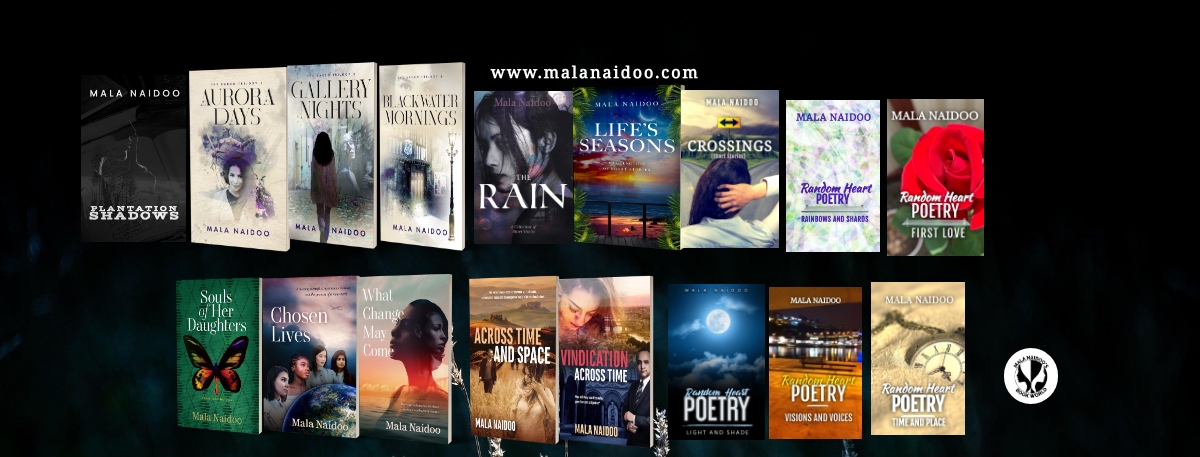
Souls of her Daughters reveals that the outlier syndrome affects all regardless of professional or social position. Dr Grace Sharvin struggles with her secret, making her an outlier in her family- in her need to conceal her pain from her mother and sister. Her sister, Patience, is an outlier through interracial adoption in apartheid South Africa, forcing her to acknowledge her birth culture. Across Time and Space and the sequel Vindication Across Time unveil both Meryl Moorecroft and Marcia Ntlui as outliers in personal, cultural and professional contexts. Michael Morrissey, a human rights lawyer, becomes the outsider in his relationship with Meryl when the course of their lives change. Housekeeper, Ana Kuznetsov and Boris Malakov are outliers in their complicated families. Global landscapes invite the notion that the situations characters undergo are not isolated – shaping the universality of human angst and joy.
The Rain, a Collection of Short Stories presents this notion in the human capacity for good and evil.
Drama, crime and abduction bring high entertainment value to the reader, but beneath the layers lie the human face and soul of the outlier. The character should be carefully crafted to invite empathy or repulsion by stripping away layers that shroud the essence of human angst and joy.
The continuation of ‘Souls of Her Daughters,’ in the next saga, Chosen Lives, grows in representing the outlier theme with glimmers of a futuristic world where perfection resides in imperfection.
One Voice, Many Worlds
Let’s continue to create stories that leave a lingering message.
Please add your thoughts in the message box below:
No pain, no gain, no compassion, did the book you read make you feel, did it create a connection? Did you feel the fear, pain, joy, laughter, hope, and love or perhaps just one, maybe two of these emotional triggers through the characters and events in your book?
‘In a dark time, the eye begins to see’ ~ Theodore Roethke
Some of the greatest artistic expressions emanated from the seat of pain, ‘a dark time’. Sylvia Plath’s Ariel comes to mind, her suite of poems on life and pain.
Emotion brings art to life, inviting the beholder to stop, listen, and absorb, to feel the pulse of the writer’s being.
In a dark time, challenges and struggles turn the eye and ear inward. Stop… still yourself from thought and action – listen and connect to your internal landscape. When writing grows from such a place, compassion is born through created events and characters.
Emotion, regardless of whether it’s negative or positive, draws us in, more so when love and understanding emerge through the connection. We are emotional beings. While Descartes said, ‘I think therefore I am’ (Cogito, ergo, sum) – it can be said, ‘I feel, therefore, I connect’ or ‘I feel, therefore, I understand, appreciate…’
Giving in to the emotion-feeling the pain to redefine your world (pixabay image)
Stories should build connections, to validate the reader by bringing characters and their challenges to life. When readers leave a review on the connections the writer’s prose created for them, this provides valuable feedback and acknowledgment.
Here’s an extract from my latest novel, Souls of Her Daughters when the realization of where her life is at, comes crashing down on the protagonist… too much has happened, the past and present collide…
Grace walked around the hospital grounds, confused, lost in thought on the uncertainty of life. Visions of what her mother would have done came to mind. She walked to her car, sat back in the seat and sobbed for all she had lost in her life, and that poor Mrs. Beresford lay dead for the better part of a day, waiting for someone to claim her – Grace understood the pain of loneliness.
Loss and loneliness are sadly, but realistically universal. With the protagonist feeling the emotional weight of both, in a single moment, empathy is elicited and might perhaps connect with the reader, offering solace that we essentially are not alone in what we feel.
Emotional connections whether through song, literary fiction or a life-size painting, draw us in by the intensity of the emotion expressed.
Alternately, there are light-hearted moments in the novel, to lift the weight of the struggles the protagonist and the women around her undergo. The blurb concludes, ‘A timeless tale of every woman’s story…’ Timeless on the struggles and celebrations of life, of women from different cultural contexts and professional backgrounds but nonetheless women with collaborative fighting spirits.
Tapping into the essence of our humanity through any art form, is a way forward, to capture the moment in its rawness, to allow us to walk away from the wars of the world, to look at the pleasure and beauty of life, to let the time of struggle pass. Appreciation and compassion are bred from challenges – how do you know the dark side, if you have not felt it? So too, characters’ lives should represent life through art to make fiction sing with timelessness.
Souls of Her Daughters captures the dark side of life, but the positive emotions swell in the relationship between mothers and daughters. Amidst tears, there is laughter, the reality of the experience of life. I hope you read this tale which will leave you with the message – never deter telling the truth, no matter how painful it might be.
I leave you with this timeless TED message from Susan David, that encapsulates the essence of Souls of Her Daughters, on embracing your emotions in its truth.
Please leave your thoughts in the message box below or sign up to receive future posts, free book offers, and the occasional newsletter.
You will enjoy the process of creating the story you have always wanted to write.
What’s holding you back?
Fear and Time?
Counteract fear by writing the best story you can. Temper your inner critic, the belief that you’re an imposter in the craft – avoid this or you become your own worst enemy. Trust your desire to write and turn to the supportive person in your life who will allow your light to shine.
Find time in your day to get down as many words as you can. Do it consistently to keep yourself inspired to go on to complete your novel. Fifteen minutes a day is better than not writing at all.
Will you be a pantser or plotter?
Would you meticulously plan scenes, with graphs and maps etc or let your creative energy lead you with just the basics planned out for your novel? There are various schools of thought on being a pantser or plotter. I’m somewhat hybrid on that. Mental planning with a few scribbled thoughts here and there make me more a pantser than a plotter.
Pantser or Plotter
Challenges that could occur
Shut the door as you write, as Stephen King advises in, On Writing: A Memoir of the Craft, ( I gained the courage to finish and publish my books drawing from the advice in this book), until you are ready to tell the world.
Once you begin to tell others, be prepared for either cynicism or support. The cynics are not worth your time – leave them to their cynical worlds and do what you have to do – write the best story you can!
Writing is an emotional process that often dives into a point of long-held pain or passion. When dubious eyes, lopsided smiles, and tongues that doubt, disturb your orbit, it’s time to turn them down or off.
Consistent writing, turning to influencers of the trade and reading books on how to write well or listening to podcasts on writing and signing up for webinars on the craft is the way to pay your way forward in your growth as a writer.
No story is not worth telling if your aim is to enlighten or connect with your reader or you know what you have to say will make a difference- write that story.
And there’s more…
Writing the story is not all you have to consider, you should then research traditional and self-publishing options and find your best fit. Know your genre, research writers in the genre you want to write in and carve your approach, your own style. Once the final product, the actual book, with a professional cover, professional editing, blurb, author biography, ISBN, date, publisher, and place of publication etc are in place, the marketing of your book begins. Whether you opt for traditional or self-publishing, the onus is squarely on your shoulders to market your book.
Don’t put off writing your book. Now is the best time.
It took me several years to finally master the fear to turn to my beta reader to have a look at my work.
We need more stories, stories that speak of angst and optimism and stories that make us laugh out loud, hold us in suspense, evoke disbelief or leave us in meditative contemplation.
We need stories that remind us of our essential humanity.
Write your book today. Publish it…
Don’t you know yet? It is Your Light that lights the worlds – Rumi
Does this resonate with you? Please share your thoughts in the message box below.
It’s the summer of December 2017. Eleven months of the year are done and perhaps not quite dusted yet as we tie up loose ends to set us free for the holidays.
Do you take stock of the year in your business of life? Do you tick off all that you have achieved and create another list of goals yet to be achieved?
The final month of a year is time to step back, think over and set the bar further for a host of things that will drive your passion into the next year.
Here are some suggestions to consider although your life plans may differ:
Mark ‘you’ time in your calendar for a balanced life
Make time for those important people in your life
Toss toxic relationships
Avoid pulling down others – ‘live and let live’
Set goals desired for 2018
Address that which was not achieved in 2017
Search for and befriend influencers in your line of work/life experience
Lend a helping hand to those less fortunate – every little bit counts
Clear out the clutter that has not delivered as expected in 2017
Surround yourself with positive energy
Take a holiday once a year, go someplace you’ve never been to before.
Nurture your spirit
Look at yourself in the mirror- what ‘face’ are you presenting to the world? – SMILE!
Keep a gratitude journal, write one affirmation each day no matter how small it may seem to you
Ask yourself, ‘what would I like to change about myself for 2018?’ – again this could be a minor change
Remain authentic and steadfast to your life goals
It may seem like a long list, but all areas are within our grasp. Let’s take stock of what matters to us the most.
My stocktake revealed:
A reconsideration of balance
Time management considerations: to fulfill and extend my writing and reading aims
Making time for relationships that matter
Saying ‘no’ to some demands
To make a difference in what I do and how I do it
To get in more hours of sleep for a healthier me
And then some…always a WIP!
List your dreams for 2018, pin them up on your fridge, above your desk, on the dashboard of your car, your wallpaper on your phone, slip a page with your goals/dreams inside your favourite book. Create a five-year time capsule, bury it in the garden or a pot plant. (This was done in collaboration with a friend and looking back it’s amazing how most of the goals have been realised or are in the process of being realised.
Inking rather than just thinking the dream is closer to claiming it!
Dig up the buried time capsule when the time is right, and you’ll be surprised!
Wishing you an insightful stocktake of the self in this final month of 2017.
Add your tips on how to clear the decks for the New Year with an action plan for an enhanced life in the message box below.
Kindness, Thankfulness, and Generosity in equal parts, blended together, is the alchemy needed for harmony and peaceful coexistence.
The words, ‘thank you,’ ‘I give thanks,’ ‘I’m grateful for,’ send out good vibrations to both the messenger and recipient of these encouraging words.
Let’s take a look at wise words on moments of gratitude.
‘I can no other answer make, but thanks, and thanks’ ~ Shakespeare, Twelfth Night
‘Oh Lord that lends me life, lend me a life replete with thankfulness’~ Shakespeare, Henry V1, Part 2 (This is quoted in Vindication Across Time
May the work of your hands be the sign of gratitude and reverence to the human condition. ~ Mahatma Gandhi
‘…Any who is grateful does so for the profit of his own soul’ ~ Surah AL-Luqman 31:12
Always be rejoicing, Give thanks for everything’ ~ Thessalonians 5:16, 18
‘When eating bamboo sprouts, remember the man who planted them’ ~ Chinese proverb
Whenever I am offered in devotion with a pure heart, – a leaf, a flower, fruit or water – I accept with joy. ~ Bhagavad Gita
‘What counts in life is not the mere fact that we have lived. It is what difference we have made to the lives of others that will determine the significance of the life we lead.’ ~ Nelson Mandela
So what am I giving thanks for in my life? Firstly it’s the gratitude I feel for having a loving family, caring friends, amazing students, the realisation of my creative dream through the Divine, supportive readers, and followers.
A Simple Thanks, Goes a Long Way
If there is a lesson I reflect upon with gratitude — it is injustice — this has infused my soul with the firm understanding that one should never mistreat, abuse and slander the kindness, and uniqueness of others. My writing speaks from my soul with gratitude for finding my voice.
Thanksgiving is my everyday quiet moment, my soulful to-go to place.
Have a blessed Thanksgiving. Continue to exude love, kindness, acceptance, tolerance, and understanding. Above All: continue SMILING, it gives others permission to smile too, that you acknowledge them, that you see them.
What are you truly grateful for today?
Please share your comment below to inspire others. Join my community today for monthly newsletters, blog posts, and promotions here.
The world is a melting pot, an ever-increasing paradise of voices that need to be heard if tolerance and understanding are to reign for peaceful coexistence.
Migrant literature, while evident through powerful voices, needs new sounds to add to the colourful history that should be shared if we are to live side by side.
Knowledge is necessary to foster understanding and compassion to move us closer to our innate humanity. Living in international communities in the 21st Century is a goldmine of multiculturalism that offers rich insights on culture and values.
What better way than to extend understanding through the literature we read and write. This could be a work of fiction, a non-fiction book, or a blog that creates connections to our neighbours near and far.
Literature is and should continue to be a vehicle that dispels ‘otherness’ or the ‘outsider’
Samantha Govender
I have for you today a reader’s perspective on what she enjoys about migrant literature in Australia. Samantha Govender, author of the blog site, Currychick – Spice it Up, covers everything from culture, history, education, lifestyle, glorious food, expat tales and more. She graciously agreed to answer my questions on migrant literature.
What is your home country?
‘I hail from the striking, picturesque country of South Africa nestled in the southern hemisphere.’
Why did you choose to migrate to Australia?
‘My LIFE AS AN EXPAT series on my blog charts that moving away from one’s country of birth is truly one of the most dauntinglife-changing experiences anybody can undergo. The crime and general political climate in South Africa were unnerving so the opportunity to move was an enticing prospect. Many of my colleagues were seeking greener pastures and Australia seemed to be offering that. When my husband finally agreed, I grabbed the bull by the horns and took the leap to leave my motherland. In a nutshell, we sought a better life and future for our two children.’
What do you enjoy about Australia?
‘Beautiful one day perfect the next.’ Truly, I do not exaggerate when I call this country ‘heaven on earth.’ I love the people, the food, and the freedom. The safety and abundant, carefree living that comes with first world living, is supreme. Australia has enveloped my family and made our move worthwhile. I feel blessed to call this magnificent place home.’
Name the three things you miss about South Africa?
‘The food ‘Bunny Chow’ (yum! read about it on my blog); the feeling of belonging and not having to constantly prove yourself; the culture in addition to friends and family that gives you a deep sense of belonging. I think only a migrant will cognize the profound need to belong.’
What is your genre of choice today? Has it changed in the last ten years?
‘My job is intensive so reading is my ‘go to’ place. As much as I prefer print books, I am steering along with modern technology. Thus, I use my iPad and Kindle a fair bit to download genres such as politics, health, well-being, and romance. Currently, I am reading Shashi Tharoor’s Inglorious Empire while hankering to read Mala Naidoo’s sequel Vindication Across Time. Finally, to answer the last part of the question, I would say yes. As I have grown older my taste for more thoughtful, serious reading has increased somewhat.’
What role does migrant literature play in Australia for you?
‘Migrant literature is necessary for establishing connections, to feel you are not alone in fears, hopes, joy, cultural expressions etc. Recently I listened to acclaimed novelist Salmon Rushdie whose perspective that some literature is timeless, mirrors mine. Accordingly, I agree that migrant literature is vital in our current ever-changing society.’
Do you believe migrants should give voice to their culture and values through literature and other art forms?
‘Absolutely! I think it’s the best channel and a means of expressing our story to others. Be it a humble blog like mine or a letter to the editor; voicing our opinions as well as sharing our experiences are paramount to us being noticed and valued. The trials and tribulations in addition to the magnificent experiences migrants undergo must be heard by all. Literature and art open this communiqué giving us the ability to speak and more importantly to be heard.’
What other migrant voices would you like to read about?
‘I am always keen to try out new authors and meet people who have made life-changing choices in their migratory or other journeys in life. I recently had an insightful conversation with a co-worker from South Korea who has made Australia home. No doubt listening to and embracing migrants and their perspectives is an evolving, unending education.’
Do writers plan to write a sequel? Why are sequels so popular?
Sometimes they are planned and sometimes they grow from the first book for a host of reasons.
We live in an age where we are desirous of connections for the long haul, we want more as we book our Netflix favourite series into our private calendar time-slots; we crave more when we connect or are moved by a story and its people.
We desire more of what we enjoy, what we look forward to. Connections with people and places make us reluctant to leave. The story is anticipated as an after work or relaxing weekend read. It’s locked in and beware the unsolicited ringing of the telephone or doorbell! Solitude is non-negotiable!
For the writer, unfinished matters in the first book lead to the second book which unveils new situations and hidden aspects of characters and situations, sometimes shocking or expected and satisfying.
Picking up reader feedback from the first book while the sequel is being written is significant in ensuring that favourite characters are not destroyed or killed off too early, reader and writer satisfaction is imperative.
In the writing of my debut novel Across Time and Space, the sequel began to emerge by the end of the penultimate chapter, there was more my characters had to say, there was more that had to be revealed. The intrigue of the first tale created expectations that needed further exploration. Relationships needed to grow.
Truth and deception were left skulking in the shadows at the olive grove in Viareggio in Across Time and Space and these ghosts came calling for more.
This made me restless to dive into the sequel, some cautioned ‘not so soon,’ others begged ‘when will it be ready?’ The process became an organic growth –an obsession to take the story to where it was leading me. Hence the birth of the sequel, Vindication Across Time.
What will be lost, what will be gained when the dark forces of human nature obscure truth and justice?
Will this become an Across Time series?
The question we are left with is, ‘what are we keeping hidden from view in the hope of leading or appearing to lead a happy and by anyone’s definition, a ‘normal’ life?’
Coming to terms with our ghosts as something of the past rather than defining our present worlds is significant in Vindication Across Time.
Whose ghosts will be exhumed in this tale of love, loss, hope, and patience?
Have you read, Across Time and Space?
What are your thoughts on book sequels and television series, what do you anticipate in Vindication Across Time?
Please leave your comments in the message box below.
The joy of writing over several weeks and months is finally seeing the artist’s impression in the cover design of the story that has emerged from, and lives in the writer’s imagination.
The much-anticipated sequel title to ‘Across Time and Space,’ set for a spring 2017 release (depending on where you reside in the world), is :
Do you remember the things you did during your childhood that defines what you do as an adult?
I remember being passionate about drama, performance and the pleasure it elicited. When I say being passionate about plays, I mean reading them with great zeal.
Growing up in apartheid South Africa on the ‘wrong’ side of the colour line meant that going to the theatre was not an option. Additionally, television had not been introduced into the country. I make reference to this in an earlier post, To Kill a Mockingbird Moment Realised, here.
I remember going to the library, standing in a long queue to add my name on the waiting list for a particular playscript I was eager to read.
One such play that is vividly remembered is Toad of Toad Hall written by A.A Milne as the dramatisation of Kenneth Graham’s, The Wind in the Willows.
Toad of Toad Hall- A.A. Milne
Growing up under the horrendous apartheid regime in South Africa makes the adult me smile at this choice. As much as the child enjoyed Rat’s, Badger’s, Mole’s and Toad’s car and caravan adventures, the deeper issues were lost in the euphoria of ‘putting this on stage’ in the apartment building of my childhood.
Actors were sourced from eager children who were hungry for entertainment during the school break. Parents were at work and no laws protected downtown children from being left at home alone with an occasional check in from an elderly neighbour- this was all an aspiring eight-year-old producer needed!
Parts were allocated and lines rehearsed over two days. Pitch, tone, movement and a haphazard choreography were based on the whim of the eight-year-old producer who ensured she donned a hat and a scarf for a theatrical edge that was akin to those seen in magazines and the Sunday newspaper.
What a time was had by all! An intermission was in place and red Kool-Aid duly served as the drink of choice in plastic wine glasses to an innocent audience ranging in years from five to ten. Mothers’ costume jewellery, ‘plastic pearls’ and hats with feathers were placed askew on little heads for attendance at this momentous production in the dining-room of my parent’s apartment.
Innocent children made their debut into the world of theatre, revelling in being transported to a magical world away from the tedium and boredom that sets in after playing all the games children could come up with during a six-week long school break.
Fast-forward decades later, in another country of choice, the itch takes hold, not as a theatrical producer, but one who has started to pen fictional tales of life and its challenges, thus Across Time and Space is born.
Across Time and Space- Mala Naidoo
Such, such were the joys of childhood.
What do you remember of your childhood that lingers fondly as a defining moment? Share your thoughts below.
It’s with gratitude that I write this post today in respect for the invitation to speak on reading and writing at a local school whose English Faculty and Librarian are tirelessly working to foster a love for reading to encourage students to expand their horizons and improve their speaking and writing skills.
Leading up to my talk, students were asked to send me their response to, ‘I enjoy reading because…’ – a simple question that elicited some thoughtful responses from teenagers.
School Book Talk
Here are a few lines that suggest that young readers seek refuge between the pages of a book:
I enjoy reading because it is a spectacular and intriguing ticket to a distinctive and captivating dimension which either creates a gulp of despair or a shiver down my spine.
I enjoy reading because it allows me to be in two places at once.
I enjoy reading because it allows me to escape reality without leaving the comfort of my home
I enjoy reading because it allows me to broaden my horizons without having to get on a ship and sail halfway across the world…
I love reading because my heart is satisfied- my heart learns more than my brain can ever know- I learn priceless lessons. It’s the portal to my heart.
Additionally to complement the study of Cry Freedom I was asked to share my apartheid, South African experience on a personal level to forge greater connections to students’ appreciation and understanding of the world through the study of their school selected text.
The sharing of a terrible history elicited compassion and questions from students on how one overcomes this decimation of one’s people and identity and yet remain simple and humble, free from anger. My response was, that drawing from family values, the people one associates with and careful selection of role models will ultimately work in sync to fortify and support the entrance into light from darkness. I cited Nelson Mandela’s ideology of tolerance, acceptance, and forgiveness as the selfless way forward. This attribute shapes the crafting of the character, Marcia Ntuli, in my novel Across Time and Space.
The final message was that reading expands understanding of diverse ways of thinking, promotes exposure to varied writing styles and elicits inspiration from the unique crafting of characters and their experiences.Ultimately it’s about allowing strength to grow from fear.
I declare after all there is no enjoyment like reading! How much sooner one tires of anything than of a book! – When I have a house of my own, I shall be miserable if I have not an excellent library. ~ Jane Austen
Here’s to many hours of delightful and informative reading!
What are your views on the benefits of reading for teenagers today and into the future? Extend the conversation today.
After an evening at the amazing Headlong, Nottingham and Almeida Theatre production of 1984, the timeless warning of the danger of unchecked power and the futility of resistance invited thoughts about the state of society in other areas of power, control and fear.
The passive aggressive comment, the staring down to intimidate, the proclamations of intellectual superiority, cultural, religious or racial bias uttered from a monocultural, bigoted point of view instils fear in the targeted individual, reverberating with the mental torture Orwell’s character, Winston Smith undergoes.
Sleepless nights, dreaded days, endless bouts of nausea, skulking in the shadows away from penetrating eyes, questions about questions.
The long day’s journey into another sleepless night becomes relentless. Guilt, self-questioning and a whittling away of self-confidence reeks of the fascism of workplace politics.
Competitiveness of the narcissistic ladder climbing co-worker or the sadistic joy in pulling others down is yet another corrosive dimension of inhumanity.
Systemic torment dims the light of the once vibrant, optimistic individual, the light is interrupted as dark days take over. Winston Smith tried to hang onto the waning light in Nineteen Eighty-Four.
With every knock…
The eroded self-confidence and panic attacks sends the tormented individual hurtling into a bottomless pit of mental anguish …
Each act of power and control, topples the victim blow-by-blow…
BUT
While the message is bleak, while it might not seem possible, there is a light at the end of the long, dark tunnel, the light of strength.
Fear is thy strength when compassion and love grow from the depths of pain. In fear, there resides hope.
Hope is the light — fiction and poetry hold the power to transform fear to courage as all struggles pass, they exist in the now—the page turns as truth lifts its head to the sun.
George Orwell predicted a future that has become a reality today, not only within the realm of politics and governance but also serves as a cautionary note to take a closer look in the mirror to decide if our souls are indeed supportive or destructive of each other.
A dark message sheds light on what should be rectified to save ourselves and the ‘unborn’, the next generation, from even darker inhumane acts.
What will you do today to uplift someone from the quagmire of human cruelty?
A writing life is one of solitude if writing in crowded spaces is not conducive to creative thought.
While writing fiction might entail living within the confines of one’s imagination, there emerges the gratitude for precious moments spent with close friends and family who understand the writer’s period of ‘absence’ from the social hub. The art of conversation keeps books alive as stories unfold, are morphed and recreated to generate hours of pleasurable reading.
Precious moments are often a coffee catch up and soulful reconnecting.
Being in the moment, in conversation with the person should be valued for the human connection with authentic people who do not pry, question only when needing honest clarification, and accept the sheer pleasure of personal engagement.
Being in conversation with someone, seeing their joy and fear, hearing their laughter and feeling their moments of distress is priceless-no mobile phone interaction or other social media platform can replicate the shared face to face rather than face-time interactions. To be able to reach out and touch someone’s hand to console them or share belly-aching laughter is the essence of human communication and interactions.
I recall some years ago being in a restaurant in LA, having an early dinner, after a day of sightseeing, when I noticed a young family, parents and two children at dinner with heads down, eyes glued to their handheld devices as they scrolled through their distractions, eating dinner in silence.
Cyberspace engagement in favour of human company is creeping into relationships, eroding the exhilaration of animated or quiet conversation between and among people. This makes those in company, particularly the elderly, for whom a virtual world does not equate with social engagement, feel ignored or unimportant.
Looking someone in the eye as they speak to you indicates you are present in the moment and responsive to what they are saying. Attentiveness says you are valued.
My idea of good company is the company of clever, well -informed people who have a great deal of conversation; that is what I call good company. ~ Jane Austen
Conversation about the weather is the last refuge of the unimaginative~ Oscar Wilde
A single conversation across the table with a wise person is worth a month’s study of books. ~ Chinese Proverb
Are we slipping further and further into an age where the only conversation we might be exposed to will be the dialogue in a novel?
Are you keeping the art of face-to-faceconversation alive? Share today what you value the most about conversations with good friends and family, or if you have a different view. Please share your views in the comment box below.
A post read recently suggested writing from a knowledge base and not from imaginative creations that might be insensitive if writing about mental illness, physical disabilities, emotional disorders etc. While I agree with being sensitive by not causing injury to others, art should mimic and extend reality if understanding and connections are to be formed.
The question is – does one have to proceed with caution when creating a character with mental illness or a physical disability in a novel?
The depiction becomes insensitive when it supports stereotypes, insults, separates and denigrates actions and situations the character is placed in. To create a character who overcomes a difficulty by honing other powerful skills or having amazing support from family and community to achieve goals is indeed not insensitive but rather supportive of what a cohesive humanity is – certainly a message for raising the lot of the human condition.
The foremost purpose of writing, fiction, in particular, is to entertain the reader more than to inform. However, if the writer is able to strike a balance between entertain and inform, the reader is likely to gain valuable understanding from such a piece of writing. If written without dictating what is right and wrong then sensitivity should prevail and the writer is more likely to connect with the consciousness of the reader which might motivate the reader to read more books by the same writer.
When entertainment and purposeful information are included in a work of fiction, a level of research is necessary to sustain the story to its logical, authentic conclusion. If the storyteller/writer has first-hand experience of events, social issues, illness, particular ways of thinking and behaving then research is not the prerequisite as it would be for a nonfiction book that covers specialised areas such as crime, history, science, psychology, culture, economics etc.
Research will not go amiss in fiction writing, it should add colour and depth to the story plot and character representations. When creating characters with a medical condition, research around the condition or perhaps speaking to a medical specialist on how the condition manifests will add authenticity to the story. How much research should one engage in is dependent on how significant that character is to the overarching story or plot. Striking a seamless balance between the story and research is essential to avoid having the story appear like an ‘unofficial’ handbook or textbook. Shaping characters in true to life situations are more likely to lead to an enjoyable reading experience. For the writer to create authenticity in a story, it is necessary that the purpose of writing is to entertain first and then inform on matters that pertain to character and plot.
The writer has to give voice first to what he or she is passionate about. If one is to expose the harsh reality of particular situations prevalent in society, then that which makes the reader uncomfortable is equally necessary. We bandy around that we need to be ‘moved’ for change to occur – to be ‘moved’ is either happily or unhappily so, with joy or sadness. If we are to be catalysts for thought change through writing fiction or nonfiction books, it should come with some thought-provoking messages – George Orwell’s Nineteen Eighty-Four might leave readers either grateful that they have control of the decisions they make in life or it might result in a re-examination of whether they are indeed free.
Fiction and nonfiction books are of equal value to the reader when they create thought change or thought searching connections.
What do you think? Should sensitivity be at the heart of all our writing? Should the writer entertain, inform and shock the reader?
I would love to hear your thoughts. Please comment below.
Everyone is a writer- authors, students, teachers, business executives, talk show hosts, journalists, doctors, lawyers, engineers and the list goes on. Some of us write for longer periods in our day and others in short spurts, depending on what you do and want to achieve from your writing.
How do you take care of your energy levels, nutrition, body and mind, when writing pins you to your desk for most of your day?
When the writing muse comes calling, all else is forgotten, the writer lives in the space where ideas unfold upon ideas, time stands still.
Often writing in the comfort of our own space can lead to poor eating patterns. This might seem like common sense but we need to be reminded to sustain ourselves for the long haul. Writing is mental, creative energy that needs sustenance – yes sustenance – I don’t mean food for the soul – that is important, but, you need good wholesome food, first, before the reward food if it’s your choice. Do you keep a jar of lollies at your writing desk?
Here’s a strategy for a healthier writer body and mind:
If you start your day at 5 am and head to the kettle for your coffee fix. Stop. You need to sustain your energy for the duration of your writing day/ hours.
Try this for three days and note the difference.
fill a jug with water, slice half an English cucumber or a whole Lebanese cucumber, and add it to the water.Cucumber is a source of vitamin B. Leave the skin on and you add vitamin C to your drink which is much needed to ward off colds with winter advancing in this neck of the woods. A dash of chopped mint is optional but a great herb to add. Adding a thin slice of lemon will pack on more vitamin C.
while the water, cucumber, and mint infuse, get in a few back stretches while standing in the kitchen and a few more cat stretches on the carpet or exercise mat if you have one readily available. Arching and relaxing your back will serve you well for a day or hours in your writing chair.
Now for the refreshing drink:
a tall glass of cucumber-infused water should be sipped while standing up – only because you will be sitting in your chair for an extended time. Keep the blood flowing like you would on a long haul flight.
having that cup of coffee should come after the cucumber infused water which would have energised you by now, clearing the mind, cleansing and oxygenating the blood. The antioxidants perform their magic. Cucumber is an anti-inflammatory food which might aid with swelling feet if you are prone to this after hours of sitting at your laptop.It might help your aching fingers or wrists after hours/days of typing too.
if you are an exercise junkie, (if you can fit that in with your writing schedule) and need your morning run, eat a banana before you head off.
now for breakfast, you’ve stretched, cleansed, had your coffee treat or banana and run, what should your choice of breakfast be before you hit the writing page?
Here are some options depending on whether you are vegetarian, vegan, gluten-free, lactose intolerant or diabetic etc.
a small slice of fruit, if you had the banana, skip this step, – a small bowl of rolled oats will sustain you for hours of writing – if you prefer eggs – poach them and eat with a slice or two of lightly grilled tomato.
If you have avocado on hand, a slice will add to a healthy mix. Limit bread to wholemeal/gluten-free if you are going to have a slice of toast.
take your jug of cucumber infused water and leave it close to your writing desk to sip at will – why should you do this? It hydrates you, keeps you clear-headed, mentally alert and the bonus is you will be forced to stand up to walk to the toilet!
As writers, time does not exist when in the creative maze of writing, two hours may seem like twenty minutes.
You might ask, what about lunch and dinner?
A light lunch perhaps, a topping of your choice (no to jams and spreads) on wholemeal or gluten-free crackers or bruschetta followed by a cup of green tea. Dinner could include grilled or steamed vegetables, fish, or any lean protein of your choice with a salad, followed by a cup of herb tea and perhaps…perhaps… a tiny treat of your choice.
Here’s hoping this works for you as it does for me, if you have suggestions on how you remain well and sustain yourself on your writing days, please share by writing in the comment box below.
Wishing you many healthy, happy writing hours!
Please share how you maintain a healthy desk-bound body, mind and spirit?



 About the Author


You must be logged in to post a comment.